IN FIVE PARTS.—PART V.
We admire some flowers for their color, others for their fragrance, and still others for their symmetry; but there are flowers which are seen in great abundance in California, which we love not simply for what they are, but for what they promise. We would not search for them in our dooryards, nor yet in the forests, expecting to find them peeping out through the thick underbrush, nor scattered along the streams, stooping to kiss their shadows in the brook. We would not wander in the meadows expecting to see the green floor carpeted with their floral beauty; but we would hasten to the valley or plain, where hundreds of acres of trees have their branches draped with this clinging beauty.
This scene is one of enchanting beauty to all. The child goes into ecstasies over the “big patch of flowers.” The artist’s eye sees these attractions of absorbing beauty, while the horticulturist beholds not alone the blossoms, but the clusters of tempting, luscious fruit.
While the flowers of which we are now speaking are just as symmetrical as those already spoken of, we prize them for different reasons. The one blooming in all the freshness and beauty we esteem for the material good it will sometime furnish us, the other coming forth in its blushing loveliness is admired but for a time by the more esthetic and artistic natures, and then having reached its state of perfection, withers and decays.
California has been called “the flower garden of the world,” but this is not her only appellation, for she is also known as “the orchard of the United States;” yet when we think that her fruit products are even now well known in Europe, Asia, Africa, and the islands of the sea, and she is still reaching out to the remotest corners of the earth, we are tempted to call her the “orchard of the world.” This extensive orchard embraces over five hundred thousand acres of land, in which are found oranges, figs, lemons, olives, pomegranates, and many other fruits brought from the genial southern clime; while apples, pears, apricots, peaches, cherries, and prunes are from the more rugged climate of the north.
The trees of our orchards begin to bloom very early; the almonds budding in January are in February completely covered with their garments of purest white. To one who is accustomed to dwelling in a clime where at this time of year all nature is robed in a mantle of white, it would appear as if the branches were heavily laden with fresh, drifted snow. In March, April, and May the peaches, prunes, and other early spring fruits are in bloom.
It is a scene never to be forgotten to gaze across one of these immense orchards just as the sun is fading from sight; apparently it smiles into a bed of pink and cream, while its last rays seem as the reflection from nature’s daintily painted canvas beneath. This we might call the poetical side of the scene, while that of a more practical nature comes a little later when these blossoms have matured, and the fruit is ready for harvest. In the former scene all was quiet and calm; now all is alive with busy workmen, preparing the fruit for canneries, dryers, and packing houses. These establishments are found in all important fruit sections, giving employment to over fifty thousand people, largely women and children. As fruit naturally follows the blossoms, when we see the trees covered with them, we are led to conclude that an abundance of fruit will be the final result; but I wonder how many have ever seen a fig-tree in blossom. But you say, “The fig-tree has no blossoms; it never blooms.” You know the saying, “We cannot always judge by outward appearances,” and I think it applies particularly in this case, for outward appearances to the contrary, the fig-tree has a blossom.
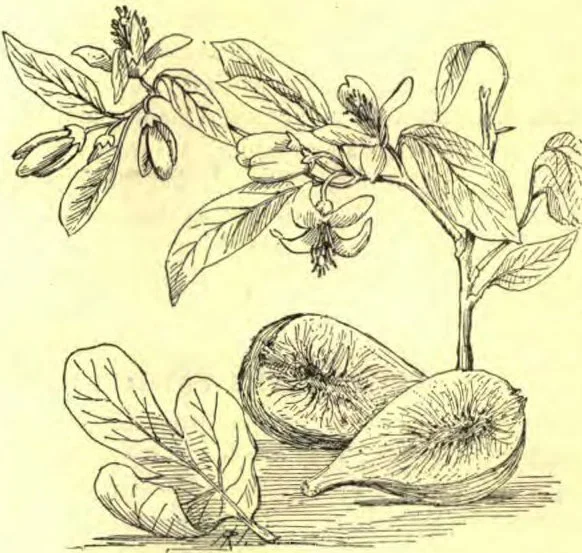
One of the first signs of spring is the appearance of the baby figs on the bare limbs of our fig-trees. The fruit grows, and later the leaves are put forth, concealing the fruit with dense foliage. What about the blooms? The artist has helped us to solve the problem, and given us a hint that to find the blossom we must look inside the fig. Lining the entire inner surface of the fruit are very minute flowerets, in each of which, when the fig is ripe, we find a seed.
To some the orange blossom may be a novelty, while others constantly breathe the air laden with its fragrance. Doubtless many have seen orange trees, bearing both blossoms and fruit, in greenhouses; but to see them in all their beauty and sweetness, one must see them growing in their native soil.
Orange trees may be found growing in almost all parts of the State, but our large groves, covering hundreds of acres on a stretch, are found in the southern part. We have many varieties, the most common of which are the Mediterranean Sweets, Washington Navels, and Jaffa, the last being transported from Joppa, in Syria.
The first growth is from the seeds, which are put to soak in water until they turn black, when they are planted in sand beds. Having sprouted and begun to grow, they are taken from the sand and placed in long nurseries. On reaching the height of about two or three feet, these seedlings are again transplanted and grafted with the choice varieties named above. The trees begin to bloom the following year, and bear some fruit, but a full crop is not gathered until the seventh or eighth year, when the trees are laden with this golden fruit. The trees are in bloom from April until July, at the end of which time the fruit begins to appear, and is left on the trees during the summer and part of the winter months to ripen, and is gathered the following February and March. The harvest time is so late that very frequently the trees are seen in full bloom while as yet the ripened fruit hangs thickly on its boughs. The creamy flowers among the green leaves, the green fruit growing on the same branch with the golden clusters, present a scene of attractive beauty. Involuntarily in fancy we wander through the beautiful gates of pearl to view the delights of that Eden “blossoming with gladness,” where grows the tree of life, which bears twelve manner of fruit, and yields her fruit every month.
KITTIE WAGNER.