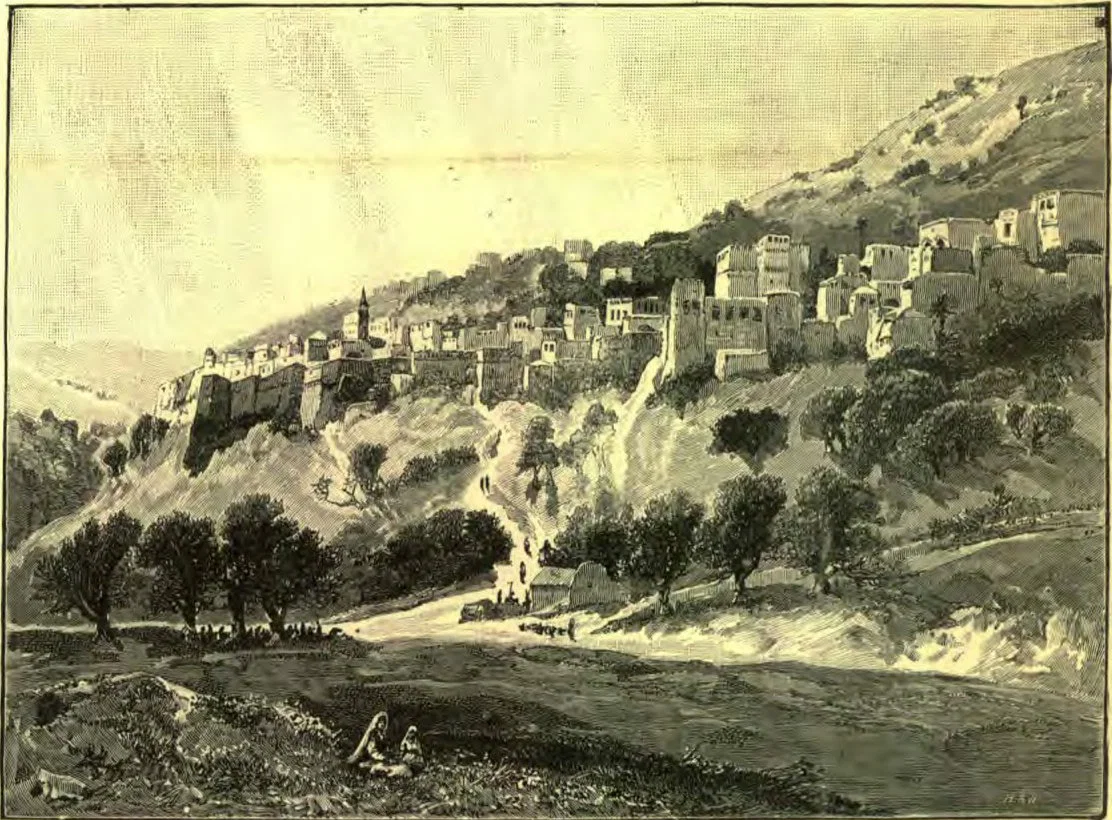
NAZARETH

17%

S. D. A. Publishing Association · Battle Creek, Mich. · Jan 10, 1895

FromThe Youth’s Instructor, Vol. 43, No. 2.

Read the full edition

NAZARETH

Now the Arabic En-Nasirah is a little country-town of lower Galilee which owes the constant attention given it solely to the circumstance that it was the home of the blessed Saviour, for a number of years. Neither the Old Testament nor the great Jewish historian Josephus makes mention of the place. According to the brief allusions made to it in the New Testament, the people of Nazareth were not susceptible to religious reform, but fanatics who, by reason of their general ignorance and coarseness, were held in contempt among the more cultured Jews. The appellation “Nazarene” was given to the Saviour very likely by his enemies, with evil intent. In Syria the first Christians were likewise derisively named thus after what was then only a Galilean village; and among the Arabs the term “Nasrani” (plural, Nasara) was universally applied to Christians. Quite early in the present dispensation Nazareth became a place of some note, for Jerome, in the fourth century, found already a stately church edifice erected over the spot called Ava Maria; and Arculphus, about 700 A. D., speaks of a second church on the supposed spot of Mary’s home.
NAZARETH.
NAZARETH.
The Crusaders made Nazareth an archbishopric, transferring the see of Bethshean (Scythopolis) to Nazareth. At present the town has probably twelve thousand inhabitants, ten thousand of whom profess Christianity. Among these are found Greek and Roman Catholics (Melchites and Maronites), Protestants, etc.
As to the natural environments of Nazareth, we quote from a learned visitor to the place:—“It lies in a narrow, oblong basin running nearly east and west, about a mile long, and having an average breadth of something less than a quarter of a mile. A girdle of rounded hills encircles it, shutting out all view of the world beyond, and giving that air of quiet, peaceful seclusion which constitutes its chief charm, and its peculiar adaptation to the early history of our Lord. The narrow, rugged glens that branch off in all directions among the hills seem as if made for meditation. The hill on the northwest of the vale overtops all the others, rising to a height of some four hundred feet above the village, and is crowned by a wide-domed tomb. Its side is steep, furrowed by ravines, and broken by ledges of bare rock. On its lower declivities, partly in the ravines, partly on the shelving base, and partly on the sides and tops of the rugged ledges, stand the houses of Nazareth—plain, neat, substantial stone buildings. This is the hill on which the evangelist tells us ‘their city was built’ (Luke 4:29); and there is more than one cliff along its side that might have served the purposes of the fanatical populace when they led him unto a brow of the hill, that they might cast him down headlong. That the brow was in the near vicinity of the village, is plain from the evangelist’s words. Hence appears the absurdity of the monkish legend which places it on the so-called Mount of Precipitation, a hill about two miles southeast of the town, for no better reason, apparently, than that it is a striking object as seen from the plain of Esdraelon. Under the grand altar of the Latin convent is the grotto where, according to the legend, the Virgin Mary once lived and received the salutation of the angel Gabriel. This is the Latin Church of the Annunciation. But the Greeks have their Church of the Annunciation by the side of the one fountain of Nazareth, a short distance east of the village. Legends like these are of no authority. From the crest of the western hill above Nazareth, where stands the Wely—saint’s tomb—of Neby Ismail, is one of the noblest prospects in all Palestine, very similar to that from the top of Tabor.”
There is no place in all the world which has been privileged as highly as Nazareth; for after the return of the child Jesus with his parents from Egypt, he dwelt there, year after year, until he entered upon his public ministry. And yet, in spite of the presence of the Son of God for so long a time among them, the people were ready to stone him upon the very first occasion on which he gave evidence of his divine power and mission. They seemed to be unwilling to accept anything whatever from him; and apparently the only public recognition given him on their account was the stigma “Nazarene,” a synonym for a low and contemptible person. A. K.