Manners and Customs
The native Hawaiians are mild, pleasant, indolent, and very fond of music and flowers. Most of them are large, finely formed, and approach more nearly the original standard than the majority of white persons of the present generation. The pure Hawaiian is very dark, has black or dark-brown eyes, and an abundance of either straight or curly black hair.
I will relate, as it was told to me, an instance illustrating the Hawaiians’ simple manner of life and love of ease. Years ago, before the white man’s influence was so widely felt, about a dozen Kanakas (native men) united their interests, and went to live at one house. One man obtained work, and for a whole month labored industriously, as indeed he must; for the burden of supporting the whole family rested upon him. It is true their wants were few and simple, an abundance of poi and raw fish being enough to satisfy even the most fastidious; but even these necessaries could not be obtained for nothing, and so Number One toiled cheerfully on, looking forward to the good time coming.
At the end of a month his work was done for a year; and Number Two took his place, followed by each of the others in turn.
And so they lived, happy and contented, lounging in the sunshine, singing, playing the beloved guitar, sleeping, and — resting. Sometimes, feeling especially energetic, they made poi. This is a paste, or pudding, and was formerly made by baking taro, sweet potatoes, or breadfruit in underground ovens, and afterward peeling and pounding them up with more or less water. The mass was then left to ferment, after which it was again worked over with more water, until it attained the consistency of thick paste. This was known as “one-finger poi,” from the manner of conveying it to the mouth, which is not with spoon or fork, but with the forefinger of the right hand. There are also two- and three-finger poi, according to the consistency of the dish.
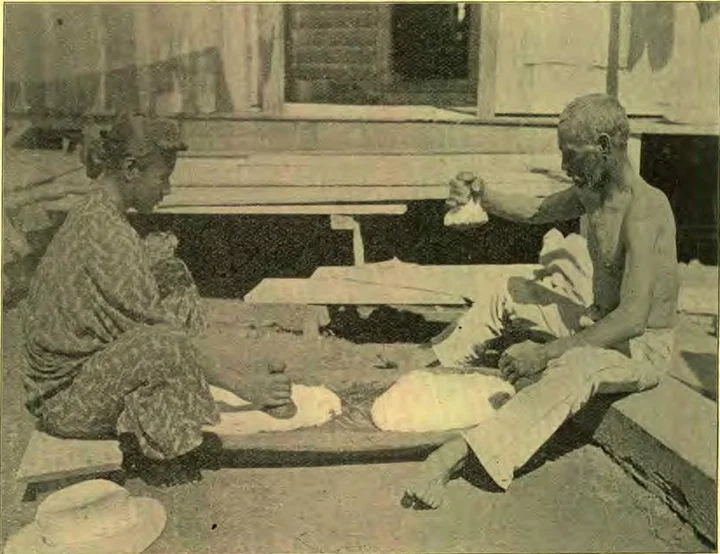
At the present time most of the poi is made by Chinamen. The taro is first boiled, and then ground, mixed with water, and allowed to ferment, after which it is ready for use. It is carried around in kegs or pails fastened to the ends of long poles borne on the shoulders of the little yellow men from the Orient.
The curiosity of the fastidious American or Englishman is generally satisfied with one look at the cloth that covers the bucket, its ancient appearance being sufficient to dissipate all previous desire to investigate the mysteries of this favorite dish of the Hawaiians.
During the recent epidemic of plague, many barrels of poi were taken in wagons to the quarantine lines, and there dealt out to the natives, in bowls, pitchers, pails, and all kinds of dishes. The Chinese and Japanese seem to like it as well as do the Hawaiians; and it was a curious sight to see men, women, and children of all sizes and colors, from black to light yellow, each awaiting his turn to be served, and then walking quietly away with his treasure.
Ordinarily nearly all the natives and the Chinese, as well as Japanese and Portuguese, go barefoot; but since the breaking out of the plague, one rarely sees bare feet upon the street. Stockings, however, are deemed superfluous, and are generally omitted.
The Hawaiian luaus, or feasts, are generally objects of interest to foreigners as well as to the natives themselves.
The food for these is usually prepared in the following manner: First a deep hole of the required size is dug. In this a wood fire is built. Rocks are next added; and when these are sufficiently heated, they are covered with ti leaves, and the articles to be cooked are placed upon them. Roast pig is generally a very prominent, and often the principal, dish at these luaus, and it is generally roasted whole. Besides this, there are fish, beef, taro, and sweet potatoes. These are placed beside the pig, and all are covered with ti leaves, banana leaves, a clean white cloth, and, last of all, with earth. After several hours the coverings are removed, and the feast is ready to be spread.
One has only to recall his childhood days, when he roasted potatoes and apples in the ashes, and green corn before the glowing coals of the kitchen fire, to realize the superior excellence of the food thus prepared.
We are informed upon good authority that a certain kind of dog, raised and fattened upon poi, is also considered a great delicacy.
LENA E. HOWE.