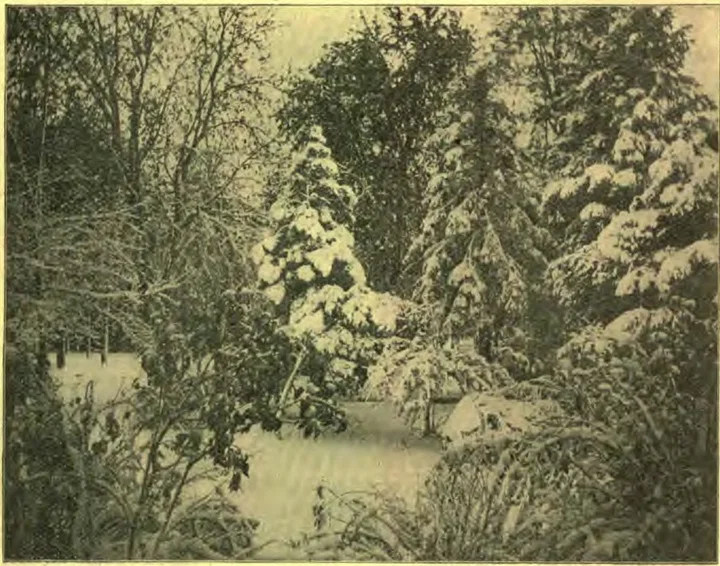
Although, for instance, oaks and beeches are frozen when their cells are cooled down to forty-five degrees below the freezing-point, or thirteen degrees below zero, it does not necessarily follow that a temperature of thirteen degrees below zero will kill these trees. I have lived in countries where the temperature of the air was about forty degrees below zero for some days, but oaks and beeches were unaffected by it. This is explained by the fact that the excessive cold being of but short duration, the temperature of the soil does not fall to even the freezing-point, except perhaps at the surface. The warmth of the under strata of the soil furnishes the plant with the heat necessary to keep it alive.
By what means is the earth kept warm?—The sun shining upon the earth for a portion of nearly each day during the winter does much to keep up its temperature. It is a fact that the ground is warmed much more than the surrounding air. We have often seen ice and snow melting in exposed places, when the temperature was still somewhat below the freezing-point.
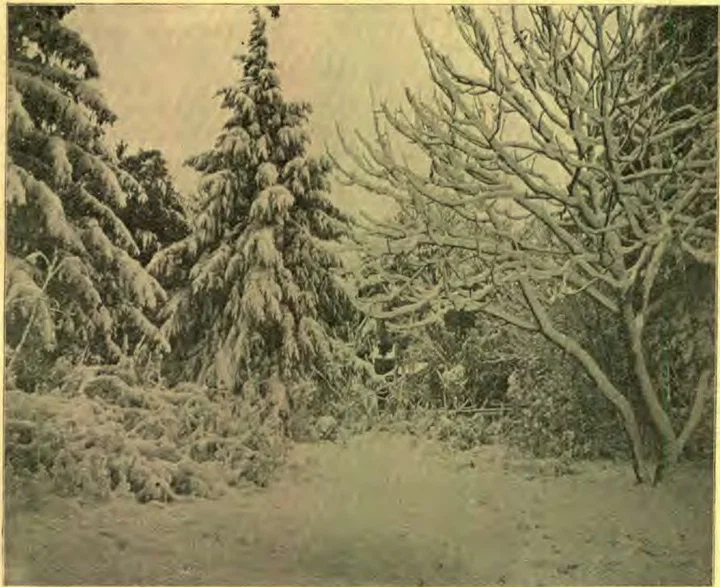
Snow also is generally supposed to be a great protection from loss of heat. In this climate, wheat often freezes when there is but a light fall of snow, or when the ground is bare; on the other hand, it endures much greater cold at times when there is a heavy layer of snow. Often, also, plants are protected from freezing by heaping up snow about them; gardeners often use snow effectively in protecting plants. Again, during very rigorous winters, trees and plants have been known to freeze down to a level with the snow, while the part that was protected survived, and subsequently sent up a new growth.
But really, snow, twigs, leaves, straw, earth, etc., serve as a protection only when the cold period is of comparatively short duration. They prolong the loss of heat, and so only protect against the first onset of cold. In long and continuous cold, the temperature of the coverings not only sinks gradually, but finally it becomes so low that even the thickest covering of snow, or straw, or leaves, or earth affords no protection to vegetation. All coverings that protect from freezing in temperate zones are therefore entirely useless in arctic regions.
In the temperate zone, when the sun shines on the snow, if only for a few hours of the day, the snow becomes warmed, and usually melted, at the surface. Where this occurs, the temperature of the snow does not fall so low as in the arctic regions, where for six months of the year there is no sun. In places in the Alps, the minimum thermometers show that the temperature a short distance beneath the surface does not fall much below the freezing-point, and often not even so far.
At the same time the temperature of the air may be many degrees below the freezing-point. The reason for this is that air is transparent to the larger portion of the sun’s heat, allowing heat to pass through it. The snow does not allow the heat to pass through, but instead, gathers it up, and is warmed thereby. Snow on the side of a roof in the shade will not melt, while that in the sunshine melts. The snow in the shaded place is as cold as the surrounding air; but that in the sun absorbs heat, and becomes warmer than the air.
It is a remarkable thing, and we may as well state it here, that solar rays hot enough to blister the skin, or, if concentrated, to burn the body to a cinder, may pass through the air, and still leave it at an icy temperature.
But resuming our topic: the sun, shining on cold, freezing days, though it may not seem to warm the air at all, and may seem unable to accomplish anything against the frost king’s power, is really doing much good, in that the earth and snow are thus kept warmed, and plant life is protected until the warm, bright days of April and May.
As we study the means by which God cares for the works of his creation, we are led to see something of the hidden meaning and beauty of the text that declares that “his tender mercies are over all his works,” and to take to our hearts the promise: “If God so clothe the grass of the field, . . . shall he not much more clothe you?” L. A. REED.