BABY SIGNS

4%

Review and Herald Publishing Company · Battle Creek, Mich. · Jun 7, 1900

FromThe Youth’s Instructor, Vol. 48, No. 23.

Read the full edition

BABY SIGNS

The last half of a forty-mile ride is not likely to be as much fun as the first half. That is what the little Todhunters were thinking. For the last mile it had been very quiet indeed in “Grandpa Tod’s” big surrey. Then Katherine broke the silence with a great sigh that could be distinctly heard above the gentle clitter-clatter of the wheels and the thud of Bonnibel’s hoofs. They were passing a bit of a lonely, unpainted house. “There’s a baby in that house,” mama said, suddenly, and her sweet voice was as cheery as if she were not tired at all.
“Where? I don’t see one,” Eric said.
“On the clothesline!” laughed mama, pointing to a row of flapping little dresses. “I can always tell which are the baby houses, Monday afternoons! And I always look. I like to see the little wet petticoats and aprons; and when I don’t find them, I’m always sorry for that house!”
“Why, I never looked!” said Katherine.
“Nor I,” Eric chimed in.
Grandpa Tod laughed. “I’m seventy-two years old, and I never looked. I’m going to begin now.”
“So’m I!”
“And I!”
“Me, too!” It was the tiniest little Todhunter who said that, and they all laughed. She had just waked up, and everybody knew she hadn’t the least idea what she was saying, “Me, too,” to! At the next house there were no little flapping clothes on the line; but Grandpa Tod nodded his gray head decisively. “There’s a baby in that house,” he said.
“Why, Grandpa Tod, I don’t see a sign of one!” Eric cried. “Is there?” he added.
“I see a sign,” and grandpa let Bonnibel walk past the pretty white house very slowly. Mama smiled. She saw the sign, too. Then Katherine saw it. “It’s that board nailed ’cross the kitchen door, to keep him from tumbling out!” she cried; and at the sound of her voice a small brown head and two round brown eyes appeared above the board.
“Well, then, why don’t they wash his clothes?” remarked Eric, gravely. After that they looked at all the houses for baby signs. It was great fun. At the first one they passed that had no “sign” at all, Katherine’s bright little face clouded over. “I’m sorry for that house!” she murmured. Sometimes it was a battered dolly, sometimes a little cart, or chair, or baby carriage. Sometimes one discovered the sign, and sometimes another. More often than not, it was on the clothesline they found it.
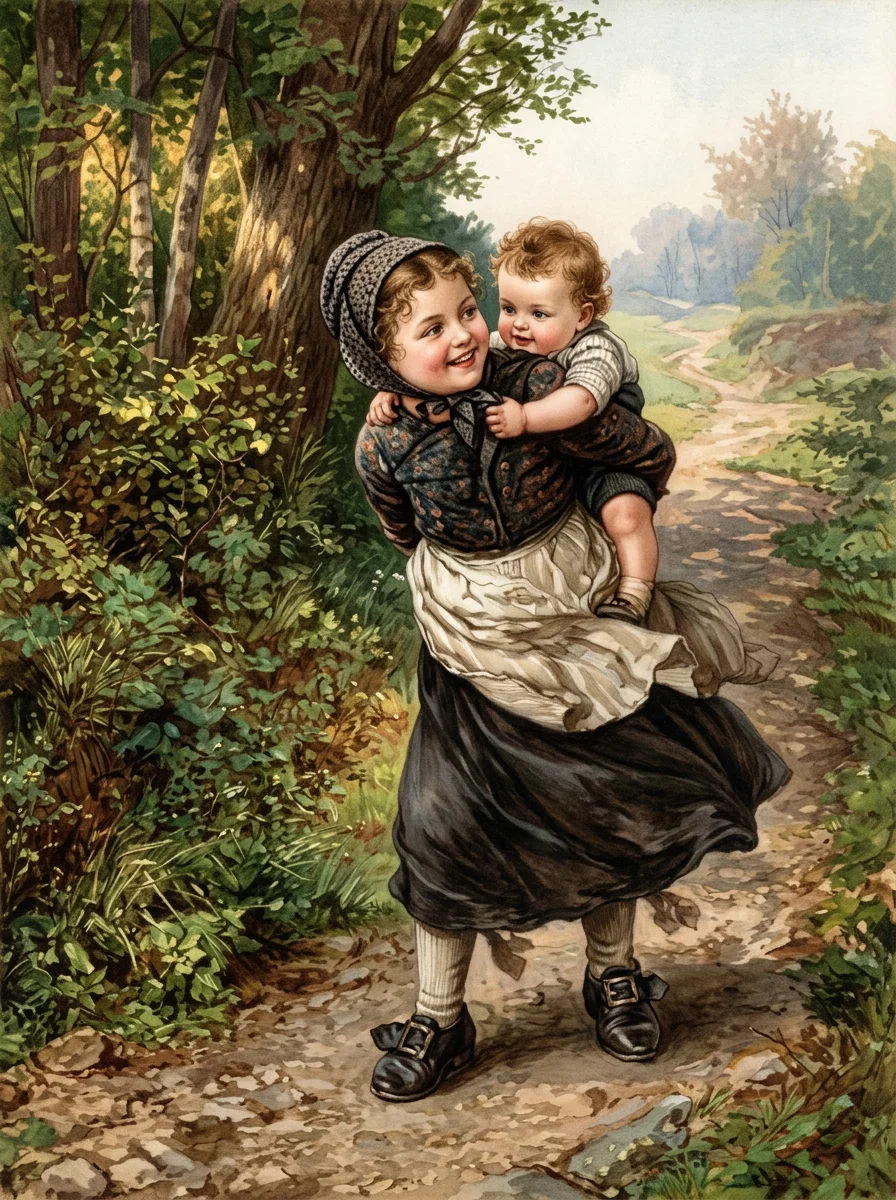
“WITH LAUGHING HANS, HER BROTHER DEAR”Restored with AI
“WITH LAUGHING HANS, HER BROTHER DEAR”
“There’s a baby there—hark!” said mama, and they all listened. Some one inside the open screen-door was singing in a low, monotonous, sweet croon.
“He’s just going to sleep,” whispered Katherine. “Drive soft, grandpa.”
At another house, Grandpa Tod discovered the “sign,” and such a queer one! Even mama couldn’t find it.
“There’s the sign,” was all grandpa would say; and how everybody hunted, while Bonnibel stopped for a drink of running water at the trough. But nobody found it but grandpa.
“We give it up—you’ll have to tell,” the children said at last. And then with his whip, Grandpa Tod pointed to a row of poppy plants, with all the bright blossoms lying in wilted little heaps beside them. “Oh!” mama said. “Oh!” the rest chorused.
“Yes, he’s a witch of a baby, too, to pick them all off!” laughed grandpa.
“Are you sure ’bout that sign, grandpa?” Katherine asked, doubtfully.
“Sure! but if you’re not, there’s another for you.” It was a little pink sunbonnet lying beside the road, with a wilted poppy-head near it.
The last half of the forty-mile drive wasn’t long at all. It came to an end too soon. It was Eric, after all, who found the last baby sign, and the most puzzling one of them all. They were passing a pleasant little brown home wreathed in vines. No one was in sight. Under one of the trees was a rocking-chair tipped over backward, and halfway up the trim little board walk lay a heap of soft, white cloth, that somebody had dropped. Those were Eric’s “signs”! Everybody smiled at them, until, just as they were leaving the little brown home behind, a sharp, imperative wail sounded. The baby, crying!
“But what made you think he was in there, just by that tipped-over rocker and that sewing-work, Eric?” cried puzzled Katherine.
“Why,” Eric explained, gravely, “she did that when the baby cried, you know. She got up in such a hurry the chair tipped over, and she dropped her sewing on the walk. He’s the first baby, prob’ly.”
And right then the forty-mile drive ended.—Annie Hamilton Donnell.