New Year's Night
Although no human voice is heard outside, it is not always so inside. The unruly crowd that filled the streets a few hours ago is still alive, but behind closed doors. The food purchased must be eaten with great noise and glee. No guests are invited to the feast, for the simple reason that there are none to invite. Each one wishes to be at home, around the family table.
As a rule, the Chinese do not sleep at all on New Year's night. They regard it as a sacred duty to watch through the hours in which the new year, in the symbol of a fatted ox, is warring with the old year, represented by the symbol of the skeleton of a cow. There can be no question as to the fatted ox gaining the victory. In their ecstasy at this, they begin with a festival that is beyond description, and to shout, with all their might, “Shi-in-pao, chong-in-y!” which means, “At the beginning of the year, fat and satisfied; at its close, abundance.” The fat ox and profusely decked tables are to represent each day of the year. But to tell the truth, which the Chinese themselves, though unwillingly, are often obliged to disclose immediately after the New Year's festival, one readily sees that they lack the necessities of life. Empty dishes and cold kettles can no longer supply the need that, during the festival, they fondly hoped would be supplied. The fat disappears from the ox in an alarming manner, and the disagreeable skeleton presents itself to many when they awake from their opium stupor late in the forenoon of the first day of the new year. “The five blessings are absent this year again,” is their complaint, as they begin to look about for something to eat.
Every member of the family is present at the New Year's feast, and the best room is occupied. Here are found food and wine in abundance. Hungry mouths must be filled, and sad hearts made happy—but alas, what happiness! In many instances the beginning and end are, especially to the mother and daughters, a severe scolding and misuse; and the New Year's etiquette is soon forgotten.
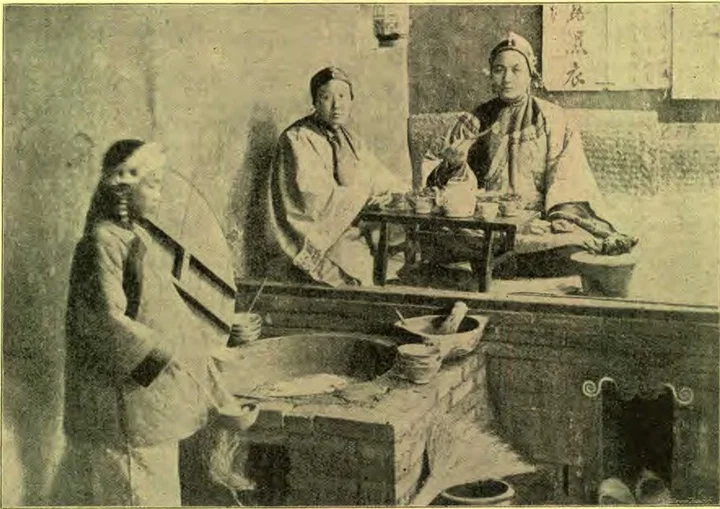
The food generally eaten through the night is a mixture of all the vegetables that can be bought. These are prepared with oil. Cakes made with oil are also served in abundance. Pepper and other spices, also pork, are freely used. All this food is eaten with wooden chopsticks seven or eight inches long. Much whisky is served, but fortunately it is not intoxicating. It has, however, a very offensive odor, which has been likened to that produced by burning iron chips in sulphuric acid. Opium is smoked all night.
On the “kang,” the elevated platform that serves as table, chair, bed, etc., the family gather before them all that has been prepared for the feast. This “kang” is provided with a fireplace on one side, and pipes, through which the Chinaman seeks to conduct the smoke and heat. But smoke is usually spiteful, at least in China, and goes out the same way it came in. All except foreigners seem to thrive well on the “kang,” however.
Some lie down, drawing the poison from their opium-pipes; others sit around with their wine-bottles. Card-playing receives its share of attention. Some one in the family who has the faculty of surprising the uncultivated ear by means of song and playing, has perhaps secured an old drum, and now he beats it with great force, at the same time singing in a loud voice a monotonous song. No one can wonder that this is pleasing to the now stupid Chinese. They are in ignorance; they do not know the Saviour, the spring of all joy and gladness. They have not tasted the waters of the stream of blissful peace. The heartstrings are broken, and discord is heard in every corner.
Shortly after midnight a great uproar begins. Any one not aware of what is coming could not but believe himself surrounded by hostile armies. Doors are opened, and out troop men and boys, all supplied with fireworks, rockets, fire-crackers, large and small, bombs, shells, etc., and the air is filled with noise and din till daybreak. Bells are rung, and every imaginable instrument that can be made to produce a sound is worked upon till the echo is heard from mountain to mountain. Past valley and hill is heard the loud noise to frighten the serpents and witches. Demons and kwei-tsi of all kinds flee when they hear the New Year's noise,—at least so think our fallen brothers in China; but when they are brought to believe in the world's Redeemer, they rest as sweetly as you and I when the old year dies, and the new begins.
When morning dawns, and the sun is shedding his golden beams over land and sea, the noise dies away, and all voices are hushed. The angel of peace hovers over mountain and valley, and with her wings fans away the echo of the last night's uproar. The work of New Year's night is ended; next comes hao-ko-nien, or Happy New Year. E. PILQUIST.