It was a fine, warm day. Teddy was lying on the grass under the big elm. Two beautiful birds, with black heads and orange-colored breasts, were very busy in the branches above his head. They were building a nest.
Teddy was quietly watching every movement. He was sure he had seen a picture in mama's bird-book that looked like these birds; and he was going to watch and see how they built their nest. Then he would tell her all about it; and she would find the name of the birds in her book; for that was the way she found the song sparrow's name one day when he was singing in the hedge.
The birds seemed to be very happy in their work. They kept up such a constant chitter-chatter that Teddy wondered if they were really talking, and could understand each other.
Sometimes the long string they were weaving into the nest would get caught in some twig in the big tree. Then again the breeze would carry away a blade of grass at the critical moment. But in spite of these mishaps, the little builders chirped merrily away, the male often pausing to pour out his happy song.
Teddy had heard mama say that people could sometimes learn lessons from birds; and he believed this was a lesson to him—a lesson on patience. Only yesterday he had tried to make a pasteboard box, and the sides would not come even. He tried again and again, and still the sides were uneven. Then he cried, and would have given up; but mama encouraged him, and taught him a little verse,—
“If at first you don't succeed, Try, try again.”
Teddy remembered how impatient he felt, and he was glad the birds had shown him his fault. Then a little Bible verse that mama had taught him one day in his nature lesson, came to his mind,—“Ask . . . the fowls of the air, and they shall teach thee.” Fowls here meant birds, mama said.
Just then Mr. Oriole flew away; but he was back in a moment with more material for the nest.
“How fast that bird flies! I just believe he has joints in his wings,” said Teddy, under his breath. He was keeping very quiet, that he might not frighten the birds away. Then rising softly, to get a better view, he saw Mr. Oriole bend his tiny legs as he perched on a branch just above the nest, to hand Mrs. Oriole a horsehair. “Yes, sir! he's got 'em in his little legs, too!” shouted Teddy, forgetting that he meant to be oh! so still.
“What is it, Teddy?” called mama, from the porch.
Teddy ran to her side, and told her what he had seen. “Birds have real joints, have n't they, mama?” he asked.
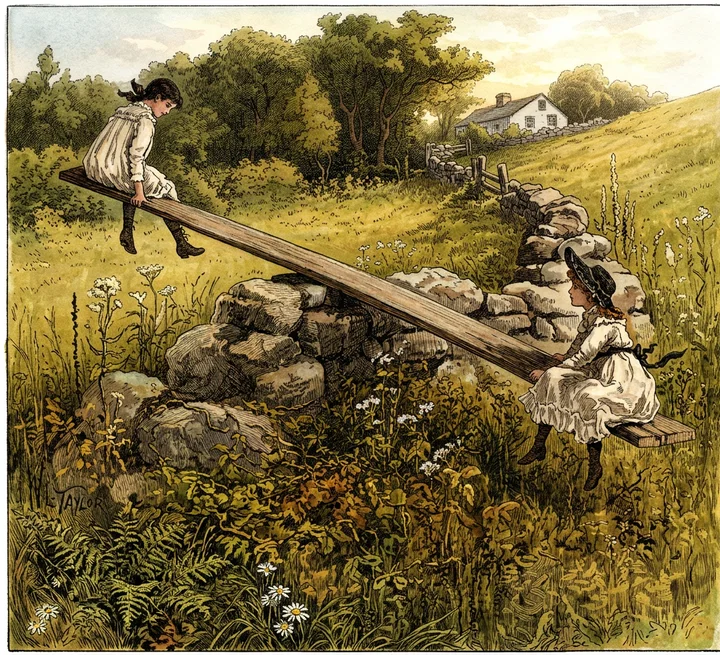
“Yes,” answered mama, glad that Teddy was so observing. She knew that if he continued to observe the objects in nature, and to learn the lessons they teach, he would some day be a wise and good man. She felt that he ought to know something more about joints, and now was just the time to tell him. So she said, “To-morrow we will learn about the habits of the Orioles, but now I have something more to tell you about joints. We have three kinds of movable joints in our bodies.”
“Three kinds! I thought they were all alike,” exclaimed Teddy.
“No, there are three kinds,” said mama. Taking hold of Teddy's arm, she continued: “Bend your forearm. See how it moves—just back and forth, and no other way. It is like a hinge on a door. For that reason it is called a ‘hinge-joint.’ The joint in the bird's leg is just like the one at your elbow. It is a hinge-joint.
“The joint at your shoulder is called a ‘ball-and-socket joint.’ This joint allows motion in every direction. See! I can move my arm about,—forward, backward, and sidewise. It is this kind of joint—a ball-and-socket joint—that allows the bird's wings to move when it flies.
“There is a little joint here at the wrist. It is called a ‘gliding joint,’ because the bones glide on one another in various directions.”
Mama then took some moist potter's clay, which she kept in a jar, and made a clay shoulder, with a ball-and-socket joint, so Teddy could see just what a ball-and-socket-joint is like. She also let him help her make a gliding joint, to represent the joint in the wrist. They had a picture of the wrist-joint to look at.
For his lesson next day, Teddy made pictures, with his brush and black paint, of the clay joints; and mama told him about that good man David, who said, “I will praise Thee; for I am fearfully and wonderfully made.”
LYDIA M. DROLL.