THE accompanying diagram shows the passage of the blood through the heart. The diagram is not strictly an accurate representation of the heart; but it was thought that as our young people are not all scientists, they might be able to grasp the idea more readily by a rough outline than by a finished sketch. Imagine, then, the heart cut in two, and the inner section laid open before you.
At each heart-beat the ventricles lift into the arteries about twelve ounces of blood, or about three hundred barrels in twenty-four hours. The blood enters the right and left auricles by the veins, and passes thence to the ventricles. The arteries receive the blood purified, and distribute it throughout the body.
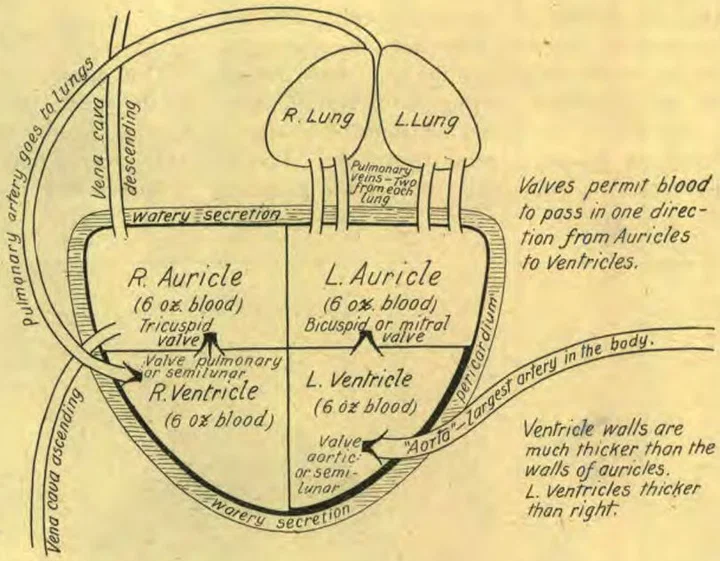
It will be easy to understand the diagram when we remember that veins bring blood to the heart, and arteries carry blood from the heart.
The aorta, the largest artery of the body, leaves the heart at the left ventricle, and sends off branches to different parts. These, in turn, branch off until they become so tiny as to be invisible to the naked eye, and finally end in a network of small blood-vessels called capillaries. A “skeleton leaf” is an excellent illustration of the way the veins are thus divided into a network of capillaries. These capillaries are very short, and they soon begin to grow into little trunks, becoming larger and larger until they form veins. These unite as they come near the heart, until two great veins are formed,—the vena cava ascending, which comes from the lower part of the body, and the vena cava descending ing, which comes from the upper part.
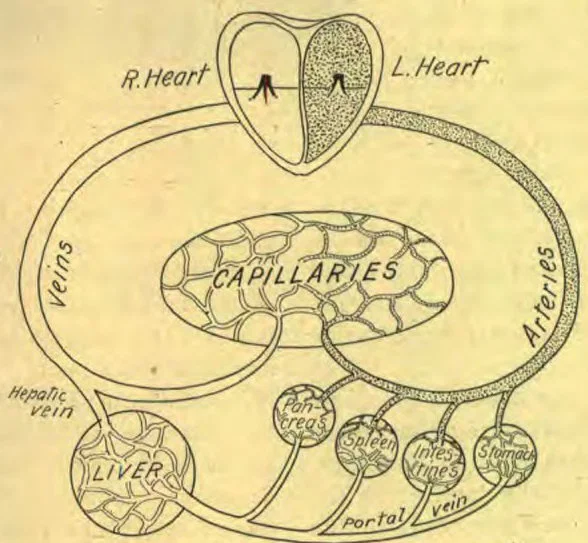
This explains the working of the blood in the heart. Now to consider the circulation through the body, we must first know that there are three circulatory systems,—the Systemic, the Pulmonary, and the Portal. We have already briefly noticed the Systemic system, but will emphasize a few special points. As the blood leaves the left ventricle, it passes through the arteries to the capillaries all over the body. Then the veins gather it up, and return it to the heart.
The blood sent from the left ventricle travels all through the body, returning to the heart again at the right auricle, from which it passes into the right ventricle. This movement of the blood from the left to the right ventricle is called the Systemic circulation.
The blood sent out by the right ventricle goes to the lungs through the pulmonary artery. It then goes through the four pulmonary veins into the left auricle, and thence into the left ventricle. This course of the blood—from the right ventricle through the lungs to the left ventricle—is called the Pulmonary circulation. Some of the blood that leaves the left ventricle by way of the Systemic circulation does not return directly from the capillaries to the heart.
A single large vein, called the portal vein, gathers up the blood that goes to the stomach, pancreas, spleen, and intestines, and carries it to the liver, where another capillary system is found. Here the blood is filtered, and, passing through the liver capillaries, joins the Systemic circulation through the hepatic vein. So you see that the blood passes through two sets of capillaries in its course from the left to the right side of the heart. This is the Portal circulation.
We are awed by the wonders revealed by this study, and our hearts must bow in reverence before the great Being who so wonderfully planned and executed his design in creating man. We ought to study what to eat to nourish this wonderful body, and how best to clothe it. We are our own keepers, in one sense, and we should know what goes into our stomachs—the great chemical laboratory where are prepared from the material furnished the elements that go to make good blood, that will carry nourishment to all parts of the body.
Exercise increases the strength of the heart, as all muscular power increases by action. The quality of the blood depends directly upon the character of the food. Fermented foods and drinks so paralyze the blood corpuscles that they can not work successfully. Tea and coffee seriously affect the nerves of the heart, causing palpitation, or fluttering. As many of the large veins of the extremities lie near the surface, the clothing should not be tight. Tight shoes or boots, as well as any tight bands about the arms, legs, waist, or neck, are very injurious.
One should be careful to get sufficient sleep, too, as during sleep the red corpuscles worn out during the day are replaced.
Violent emotions affect the heart seriously. Persons often drop dead in a fit of anger, or under the stress of some great excitement . We should learn to keep our emotions and our passions well controlled, following the wise Scriptural rule to be “temperate in all things,” and to let our “moderation be known to all men.”
MRS. M. D. McKEE.