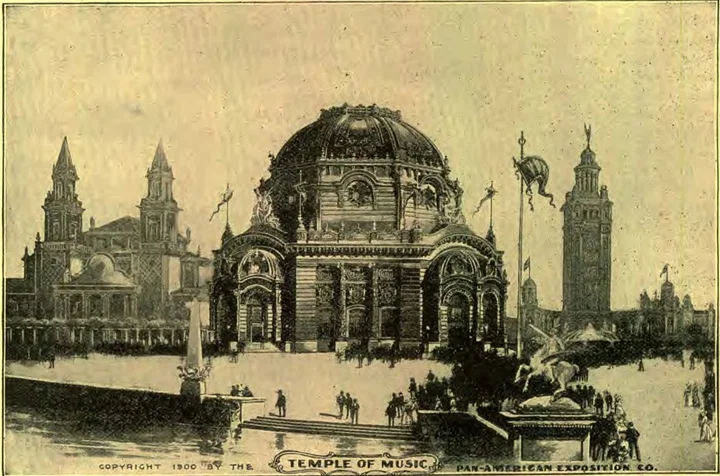
The Temple of Music for the Pan-American Exposition will cover a plot of ground one hundred and fifty feet square, and will be situated on the northwest corner of the Esplanade and Court of Fountains. The exterior of this handsome building will be treated architecturally after the style of the Spanish Renaissance. It will be octagonal in shape, with octangle pavilions at each corner. The main entrance will be through the pavilion on the corner of the Esplanade and Court of Fountains. Each of the façades of the main building will have a richly ornamented colonnade. Between the columns will be large window openings and ornamental panels, each bearing a portrait bust of some musical composer. The cornice, frieze, and balustrade of the main building will be designed in a florid adaptation of the Spanish Renaissance, and the balustrade will carry tablets bearing the names of noted musicians and composers. On the corners above the pavilions will be groups of statuary representing music, dancing, etc.
The chief features of the drum of the dome will be star-shaped windows resembling those seen in the ancient Spanish mission buildings. These windows will light the interior of the auditorium. The dome and the roofs of the pavilions will be richly gilded. Gold and brilliant coloring will be freely used in all the exterior decoration. The crown of the dome will be one hundred and thirty-six feet above the grade of the Court of Fountains, and the Temple and its pavilions will form a very attractive part of the landscape scheme of the entire group of Exposition buildings.
The auditorium, which will seat twelve hundred persons, will be a few steps up from the grade of the building, and in addition the restaurants and balconies will give a further seating accommodation for sixteen hundred persons. The other pavilions, in addition to the one used for the main entrance, will be occupied by the stage and by a fully equipped restaurant.
The flat-domed roof of the auditorium will be supported by eight massive piers. Between the piers will be large arches opening into the galleries, to the main entrance, and leading to the stage. Over each of the eight large arches will be a cartouch bearing an inscription indicating one of the grand divisions of music,—Oratorio, Grand Opera, Symphonic Music, Lyric Music, etc. The front of the galleries will be decorated with a frieze of singing cherubs.
In the Temple of Music will be erected one of the largest and finest organs in the United States. It will be an exceedingly beautiful and complete instrument, with all the latest improvements in organ-building. It will have four manuals and about fifty speaking stops, and will be voiced on three different wind-pressures. The action will be the most complete style of tubular pneumatic. The mechanical contrivances and combinations will be complete, and will include many varieties not hitherto used. There will be a number of couplers, pedal movements, and adjustable combinations of modern type. The case will be of Gothic design, to harmonize with the architecture and decorations of St. Louis Church, Buffalo, for which the organ is intended after serving its purpose in the Exposition.
An elaborate and complete system of heating and ventilating will be adopted for this building. Numerous and commodious entrances and exits will be provided, so that absolute safety to visitors will be assured. The interior as well as the exterior of the Temple of Music will be treated with a view to securing the best architectural effects.