We have seen how the horizon line itself is entirely dependent upon the position of the observer.
The point on the horizon where all receding lines appear to vanish, called the “vanishing-point,” or “center of vision,” is just as dependent upon the position of the observer as is the horizon line.
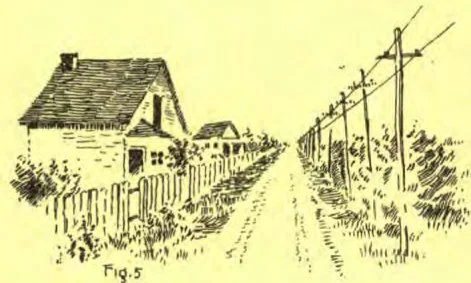
If we stand in the middle of any country road, which extends straight before us for some distance, as in Fig. 5, the wagon tracks go off directly in front of us. These lines, with those of the fence and the edge of the road, appear to meet at a point on the horizon. All the lines we notice proceeding in the same direction—the telegraph wires and the receding lines on the houses—seem to meet at this point also.
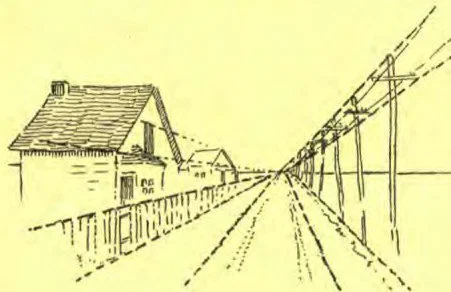
By drawing lines along all the receding lines in Fig. 5, we shall find that they all meet at one point. This point is the center of vision, or vanishing-point. By drawing a horizontal line across the picture at the same height as our point of vision, we can see where our horizon would be, were it visible.
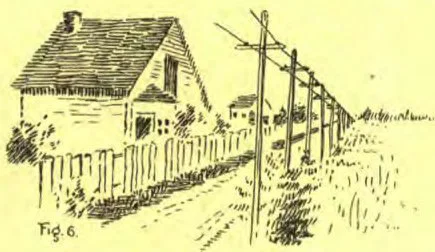
In calling this point the center of vision, it does not necessarily mean—the center of our picture; because if we step to one side of the road, as in Fig. 6, every line at once changes its direction. We can see more of the front of the houses than when standing in the middle of the road; and, again, all lines seem to meet at a point opposite our eyes, but more to the right, on the horizon line, thus showing that the center of vision does not mean the center of the picture, but the center of what we see.
If we walk along the street, and observe the direction taken by the receding lines of the buildings and pavements, we shall notice that all lines retreating above our eyes appear to run down, and all below the eyes appear to run up; and these lines, if continued far enough, will seem to meet at our point of vision on the horizon.
Suppose you stand at one end of the longest room you have access to, and test this principle in another way. Notice the ceiling and floor lines of the side-wall, as they go away from you. Does not the higher one appear to run down as it goes away, and the lower one to run up? and can you not imagine that if the wall was continued out as far as the eye could see, these two lines would seem to converge at one point?
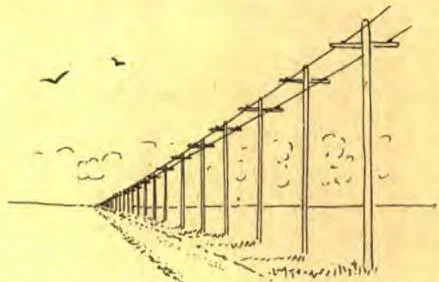
Stand near a line of telegraph poles. Notice how the lines formed by the top and bottom seem to draw together. Test this matter for yourself, until you are sure of the fact, and can point it out clearly to some one else.
PEDRO LEMOS.