In these days, when consumption is making such fearful inroads that it is regarded by some as one of the last-day plagues, every remedy is tried in the hope of effecting a cure, but of all the legions of medicines and nostrums now in use, none is found of lasting help. The greatest benefit is derived from a change of climate. In Europe it has for many years been the custom to send invalids, especially those having weak lungs, to the warm, sunny shores of the Mediterranean during the winter, and to the mountains and cooler regions of the North during the summer.
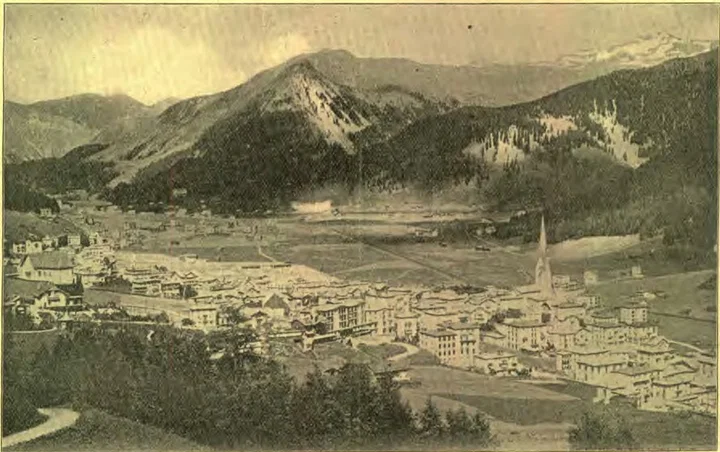
Of late years, attention is turning to elevated mountain regions, where there is plenty of sunshine, and dry, pure air; and at present, localities of this order that have gained some reputation are sought by thousands. Such a place is Davos. In the Swiss Alps are many high valleys more or less famed as resorts for consumptives; but Davos now ranks first. It is annually visited by about fifteen thousand persons, a large majority of whom are consumptives, from Switzerland, Germany, England, France, Russia, and nearly all other European countries.
Attention was first called to Davos as a favorable place for consumptives by the fact that natives of this valley who went to lower regions for employment, and were attacked with tuberculosis, soon recovered on returning to their mountain home. Physicians who observed this began to recommend the place for other consumptives, and these also found relief. As early as 1864, Davos enjoyed some fame as a resort for those afflicted with lung diseases; but owing to the prejudice of physicians, its popularity increased only gradually until recently. At the present time, however, it is enjoying a considerable boom.
Davos is near the Rhine Valley, south of Lake Constance, not far from the Austrian frontier, in the Alpine region known to tourists as the Engadine. The valley is five thousand two hundred feet above sea-level, and is about ten miles long, and nearly a mile wide. On both sides of the valley, mountains rise precipitously from two to three thousand feet; pine forests growing on these heights as far as six thousand five hundred feet above sea-level afford many winding walks for patients; and the numerous brooks dashing down the steep mountains furnish music to the lover of nature, and bring sadness to the heart of the lonely and home-sick.
Besides several large and well-equipped sanatoria (which the Germans in their native love of simplicity call “cure-houses”), numerous villas and pensions adorn the hillsides. Twelve physicians, several of them foreigners, are practising here. While it is generally admitted that the air is the chief remedial agent, there are various ways of treating patients. As in other places, the physicians here are “in one another’s hair,” as the Germans express it. Those of most experience and best success use little or no medicine, and prescribe a moderate, three-meal diet, and absolute rest in bed, not even allowing the patient to feed himself till all fever is gone. Others prescribe a certain amount of exercise; but nearly all are alike cautious about allowing patients to climb, for fear of hemorrhage. The majority keep their patients out on sunny balconies from morning till ten o’clock at night, well wrapped up, on reclining chairs; this they call the “lying cure.” Many follow the system of “stuffing” their patients, having them take food six times daily; in addition to three regular meals, some are advised to drink from two to three quarts of milk a day, the idea prevailing that the patient must be made fat.
Many patients who come to Davos in advanced stages of consumption are cured, though such must remain from one to several years. Some return to low altitudes to follow their former occupation, but many of these are obliged to return after a time; some find it necessary to live always in a high altitude, in order to avoid a return of the disease. There are some now living in Davos who came there as consumptives twenty-five years ago.
The purifying effect of the air in Davos is truly remarkable; this place might be termed a “washerwoman’s paradise.” Linen carelessly washed, and hung out full of spots, soon becomes pure-white in the sun; in fruit which has already begun to spoil when sent here, the process of decay ceases, and the decayed portion dries up.
But while the air, the Lord’s life-giving medicine, is doing so much to keep marked victims of the dread disease out of the grave, it is sad to see them counteracting its good influence by wrong habits of eating, drinking, dressing, and amusement. Such are working against the Lord’s healing agents. Could the principles of right living, as revealed in the gospel, be made known and followed in such places as Davos, how much good would result!
H. P. HOLSER.