NO DOUBT MOST readers of the INSTRUCTOR have heard or read of the giant redwoods, or “big trees,” of California. The redwood belt does not extend over the entire State, but is confined to comparatively few localities. Two groves of the largest trees have been secured by the United States government, and are protected as national parks. Everywhere else the redwood forests are being rapidly destroyed by the lumberman’s ax,—though the word “ax” is here used figuratively; for that implement is almost entirely replaced by the saw, even in felling the timber. The real instrument of destruction, however, is neither ax nor saw, but fire.
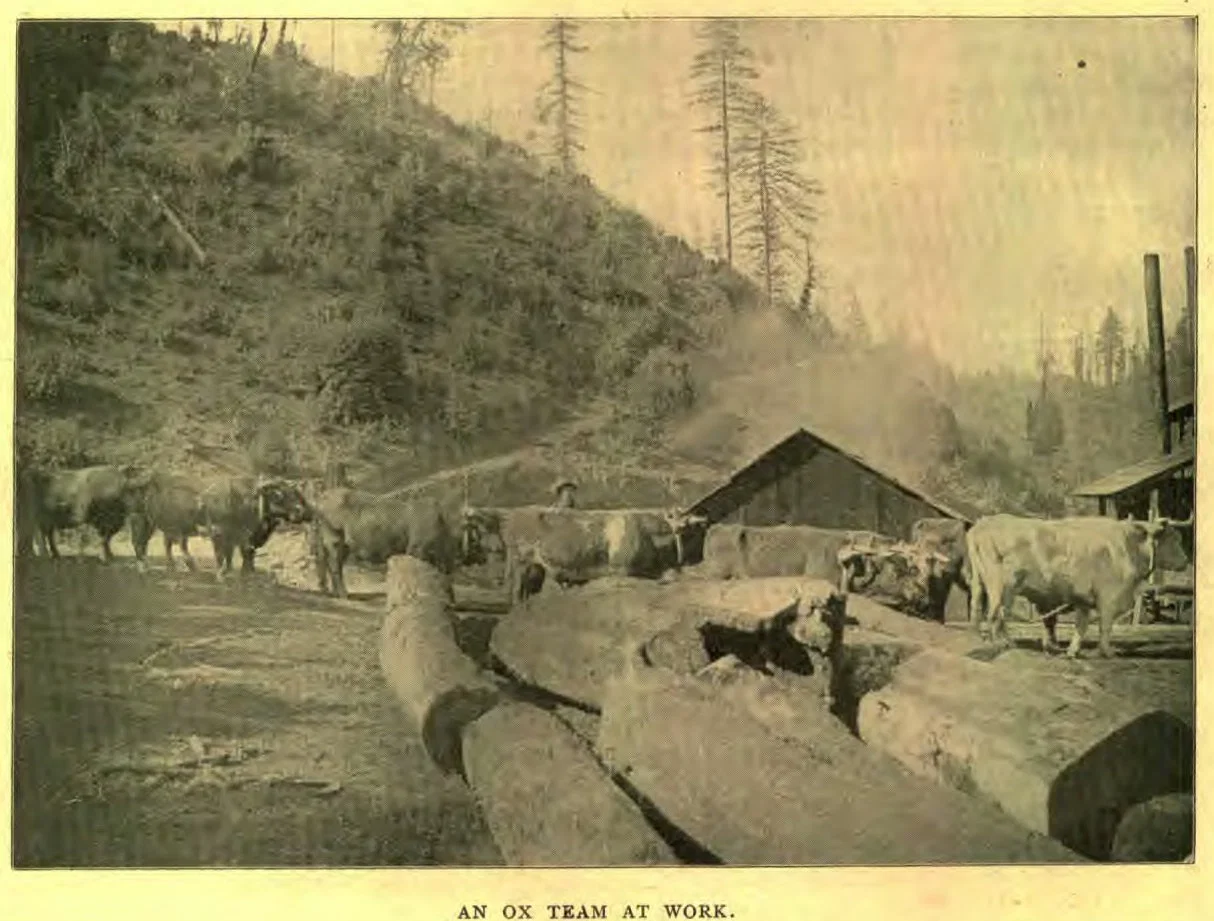
AN OX TEAM AT WORK.
The redwood prefers the valleys, and is seldom found growing at such high altitudes as its cousins, the pine and the fir. It is an evergreen resembling the fir, from which it can, however, be readily distinguished by its bark and needles. The bark is much more deeply creased than that of the fir, and is usually quite soft and spongy. Excellent pincushions are made of redwood bark by cutting it in sections, and mounting it in such a manner that the pins may be thrust in to follow the grain of the wood. In the fir tree the needles are round, and grow all around the twig in an irregular manner. Redwood needles are flat, and grow in two regular rows along opposite sides of the twig, somewhat resembling a feather.
When the forests occupy level valleys, there is seldom any undergrowth to speak of. It is often possible to drive a team and wagon for miles through a virgin forest, without encountering a fallen tree or other obstruction sufficient to turn one aside. It is a rare treat to wander through the cool, refreshing shade of such a forest on some hot summer’s day. The ground is covered with a carpet of needles so thick and soft that you can scarcely hear your own footsteps. Before, behind, to the right, to the left, the forest giants rise as straight and regular as the columns of some mammoth, long-forgotten temple. The silence is often so profound as to be almost oppressive. Not the twitter of a bird, the chirp of a cricket, nor the rustle of a twig is heard. In some spots the foliage is so dense that the sunbeams never penetrate it. During the summer months these forests are favorite camping resorts with the Californians.
If the trees grow on hilly or uneven ground, the conditions are often quite different. Sometimes fir or other trees grow side by side with the redwoods, and often the underbrush is so dense as to be practically impenetrable.
But be the forests on hill or in valley, it is all the same when the lumberman comes. Before him is the wonderful work of God, wrought through the laws of nature; behind are marks of the terrible devastation wrought by man’s insatiable greed.
Into the primeval forest comes a crew of men called “fellers.” They cut down everything as they go. Neither the three-inch sapling nor the twenty-foot tree is spared. Many of the large trees are cut ten, twenty, or even thirty feet from the ground. The “butt cuts,” or lower portions of the tree, are heavy and difficult to work. They are usually made into shingles, and scarcely pay for handling. I have seen “shingle bolts”—as the blocks are called before being sawn into shingles—fall into the water, and sink like a bar of lead. In contrast with the butt, the top of the redwood is, even when green, as light as thoroughly seasoned pine. It is so soft and brittle as to be worthless as lumber.
After the “fellers” come the “peelers,” who strip the bark from all the trees that are large enough to use for lumber. Next comes a gang of men with ox teams or a traction engine. They pile up the saplings, limbs, bark, brush, and top cuts of the trees, preparatory to burning them. When their work is finished, fire is called to their aid, and all this refuse is quickly destroyed. These great heaps of timber make mammoth bonfires; but they burn so rapidly that usually half a day is sufficient to complete the destruction, and leave the ground clear for the handling of the logs.
After the fires have burned down sufficiently to permit the men to go to work again, it is usually found that about one half or one third of the felled trees are on fire. But fire burns slowly in these unseasoned redwood logs, so the loss from this source is small. Big buckets of water and small force-pumps are called into play, and there is seldom any difficulty in extinguishing the fires, unless they have got hold of a log that has been partially split in falling. In the latter case it is sometimes necessary to cut a hole into the log until the burning hollow is reached. Water is turned into this hole until the fire immediately around it is extinguished. Then a man is let down through the hole to play the hose on the fire until he is driven out by the hot, suffocating air,—or perhaps I should say smoke and steam; for when a man is drawn from his unenviable position, he is ready to vow that there is not a mouthful of air in the log. Another promptly takes his place; and, as the fire is beaten back, the stays in the log become longer. But a crew of men will often work an entire day in extinguishing the fire in one log.
When the fires have done their work, the “sawyers” take hold of the timber, and saw each log to whatever length is demanded by the mill. Most of the large trees have what is called a “wind split.” This is a crack running through the middle of the tree to within six18inches or a foot of the bark on each side. A wind-split tree will usually split open its entire length when it falls. The trees that do not split in falling, if too large to be conveniently handled, are split with a blast of giant powder. When the logs are sawed and split into the required length and size, one end of each is hewn off like the prow of a boat to prevent it from gouging into the earth as it is being dragged to the temporary railroad, which has been laid as near as convenient to the timber.
A few years ago all the logs were hauled to the track by oxen; and the low flat-cars that carried them to the mill were drawn by horse-power. Now the traction engine has superseded the one, and the cable drawn by a stationary engine at the mill has taken the place of the other. This, however, refers only to the large mills, where timber is plenty, and several hundred thousand feet of lumber are sawed daily. In regions where there is but little timber, the mills are small, and there the picturesque cattle teams and horse-cars are still to be seen. A team of cattle contains from twelve to sixteen, and sometimes even twenty, oxen. It requires two or three men to handle them; but they are patient brutes, usually far more patient than their drivers.
It is an interesting sight to see a monster log drawn along by these oxen. The team is slowly maneuvered into position (for oxen will move slowly, and haste only makes confusion); the great log-chain is fastened to the log; and, with much cracking of whips, the cattle begin to move. The chain tightens, the yokes creak, and presently the log trembles, perhaps rolls a little, and then moves slowly after the patient, tugging oxen.