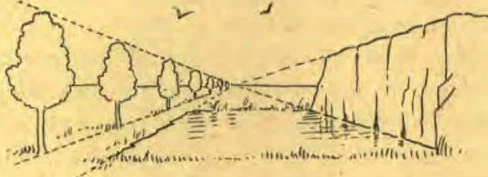
In this lesson we will study more of the objects to be seen in nature, for by so doing it will be easier for us to remember the principles of perspective. In the drawing below, notice how the square pond and cliff seem to be narrower as they converge toward the point of vision on the horizon; also how the trees appear to become smaller and smaller, and closer together, as they go toward the horizon.
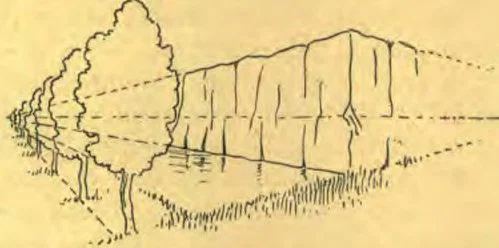
If the observer should stand so the corners faced him, instead of one of the sides, it would then be in two-point perspective, as below:—
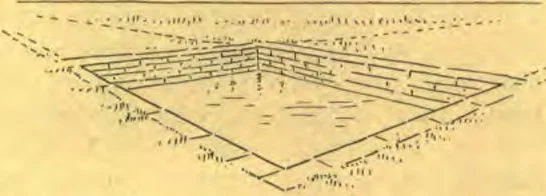
The next drawing will give you an idea of the perspective of a well or cistern in two-point perspective.
If it is impossible for you to get where you can study the perspective of nature in the open country, you can study the subject from indoor objects; for, as has already been said, there is perspective in everything we see.
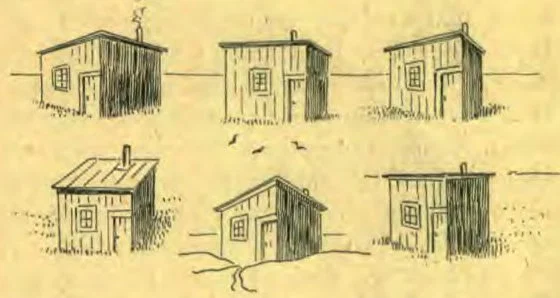
When drawing some object, it should be drawn in several positions, so that every point may be studied. Draw it not only as it can be seen in one position, but as it would look were you looking at it from above, below, and in other positions. The shed below is drawn in this way.
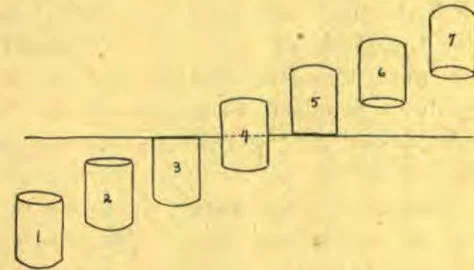
All curved lines above the horizon curve down, and all curved lines below the horizon curve up. For instance, if a cylinder is held opposite an observer, on a level with his eye, which would be on the level with the horizon line, it will be seen that the line formed by the top curves down, and the bottom line curves up, as in cylinder No. 4 in the accompanying illustration. When the top or the bottom comes on a level with the eye, or horizon line, it becomes straight, as Nos. 3 and 5; and the higher it is raised, the more of the bottom we see, as in Nos. 6 and 7. The more it is lowered, the more of the top we see, as in 2 and 1.
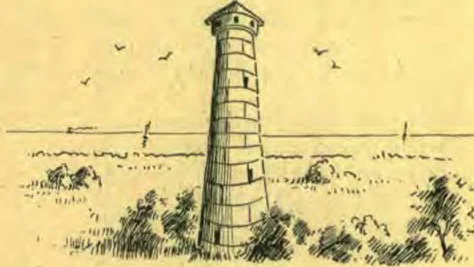
In the drawing below, notice how all the lines formed by the stones in the tower curve down above the horizon, and all the lines below it curve up. PEDRO LEMOS.