ONE of the earliest flowers of spring is the hepatica. Its buds and stems are well wrapped in heavy fuzz, which protects them from cold. Thus wrapped in winter clothes, the brave little plant pushes its way up through the dead leaves and even the snow. It may sometimes be found in its haunts by scraping away the snow, having been picked as early as December 9. Last year it was found in the vicinity of Battle Creek during the month of April.
When the fragrant pinkish blue or white flower appears, the only leaves in sight are the rusty leaves of the previous summer. The leaves are rounded, of three lobes, mottled with purple, and from the root. The plant is found chiefly in the woods or on sunny hillsides.
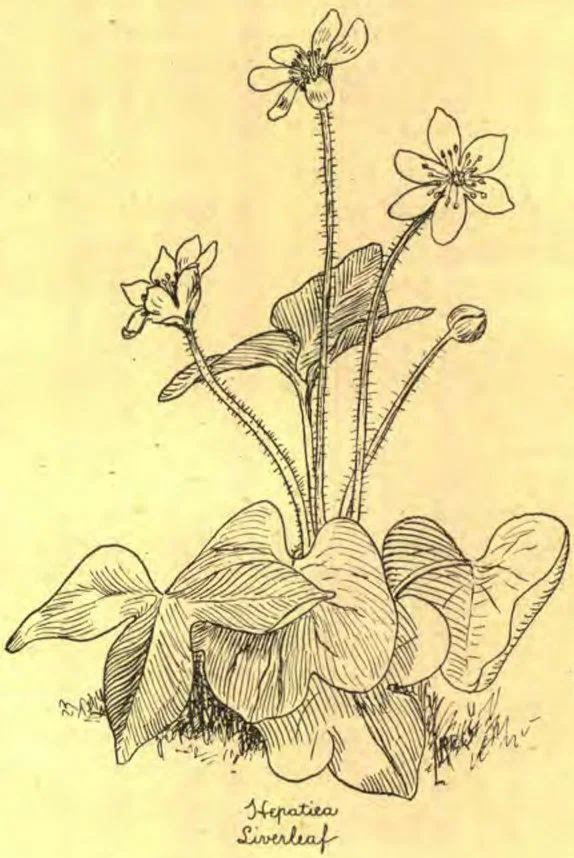
“Hepatica” is a Greek word for liver, and was suggested by the shape of the leaves. The plant has been used to some extent for liver complaint, as men supposed the shape of the leaves was nature’s suggestion of medicinal properties in the plant.
2—Sanguinaria Canadensis, or Bloodroot
This little plant belongs to the poppy family. It has a beautiful showy flower, which soon perishes. In early April it pushes up the curled tip of its rolled-up leaf, breaking its way through the earth and brown leaves. Inside the leaf, carefully shielded, is the young, erect flower-bud. As soon as the leaf has emerged, it unfolds; and the flower-bud rises above it, and opens its white petals to the sun.
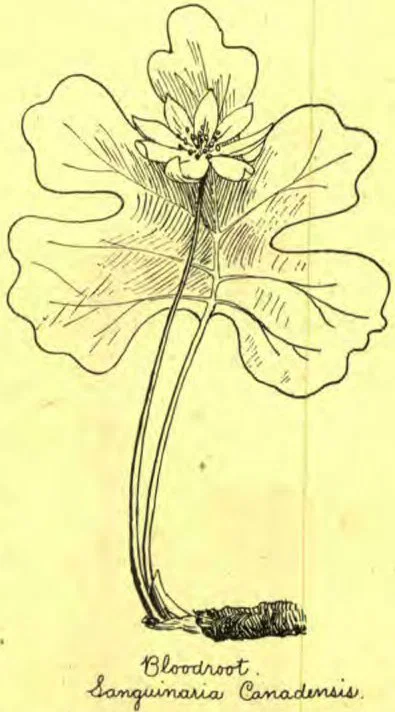
There is but the one leaf, which is quite large and round. Both flower-stem and leaf are from a thick root-stock, which is filled with an orange-red juice capable of producing a deep and lasting stain. The Indians used it for decorating their faces and tomahawks. This juice is a famous remedy for coughs and colds.
If any of our readers wish to make a more careful study of the plants of the northern United States, they will find special help in Mathew’s “Familiar Flowers of Field and Garden,” published by D. Appleton & Co., New York. Price, $1.75. This is an excellent work, with over two hundred original drawings.
A larger work, similarly arranged, but more complete, is published by Harper & Brothers, New York, for $2.50. In it over one thousand flowers, plants, and weeds are described in a plain, simple way, and there are about two hundred realistic and artistic drawings from natural flowers. These were drawn by Mr. Benjamin Lander, the eminent painter-etcher of New York, whose art productions are so well known in this country and Europe. These books have been arranged for those who have no special knowledge of botany or botanical terms. L. A. REED.