As we read this series of articles, we should remember that it is the beauties, and not the defects, that we are now to dwell upon. If this is done, we shall simply be brought to realize that the Originator of beauty, regardless of the traces of sin, has left some marks of his Eden handiwork in this extreme corner of his great vineyard.
If upon entering a garden that nature has profusely decked with her garb of flowers, we should mourn because of the entrance of sin, and continually look for its traces, the place would soon appear infested with the monster; the thorns would seem never so sharp, and the thistles never more prickly. But on the other hand, were we looking for the beauties, the defects would sink into their proper place in the background.
However, Southern California is by no means a garden of perpetual fruit and flowers.
South of Point Conception a range of mountains follows the inland turn of the coast; this range is met from the east by another mountain chain, and that by still others from the south, thus forming a natural fence around the greater part of this earthly paradise. The western side is protected from the dashing billows by a line of beautiful summer isles, which seem to echo the voice of their Creator, “Hitherto shalt thou come, but no further.” The land that is hemmed in by the mountains is a vast, dreary desert of sandy plains and barren mountains, seldom reached by the moisture-freighted clouds from the great Pacific. Travelers approaching the coast from the east are almost imperceptibly transported from this bleak, barren region, which knows neither song of bird nor the fragrance of flowers, into a valley radiant with perennial beauty.
This region is what is best known as Southern California proper. The fame of this part of the State, of which Los Angeles is the metropolis, and Santa Barbara and San Diego are the extreme northern and southern cities, reaches, one might almost say, to the ends of the earth. It is a land of perpetual snow—on the mountains twelve thousand feet high; and of eternal summer—in the valleys below. The climate is an element of value that is frequently placed in the background by the constant appeal to the senses. It possesses an annual mean temperature of about sixty-four degrees. During the summer months the temperature sometimes rises to a hundred degrees, and in the winter it may sink so low in certain localities as to give Jack Frost an opportunity to sway his scepter for a few short hours.
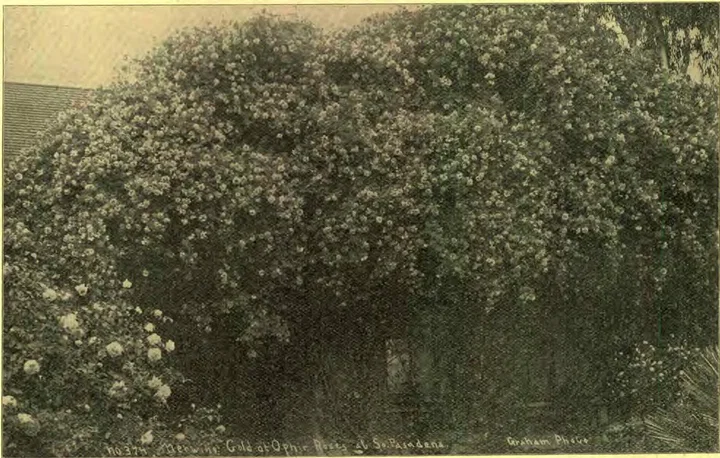
Southern California is a garden, in many corners of which flowers bloom continually. In some seasons we have a perfect riot of flowers. Calla lilies are cultivated by the acre, also carnations and roses, marvels of size, color, and perfume. In the illustration is shown a gold of Ophir rose-tree in full bloom. An estimate was made of the number of its blossoms, and it was found to have ten thousand roses on it at one time. Nothing was said to me about the thorns; it is not likely that they were counted. Could you have seen this tree, wrapped in its mantle of gold (some who live in Pasadena may have seen it), there would have been no room for a thought of aught but the beautiful.
This part of California depends largely upon fruits, grains, and the patronage of tourists for its prosperity. Having experienced three successive dry seasons, a failure of grain is expected this year; and where the irrigation is poor, fruit will not be so abundant as usual. Notwithstanding this, the tourists are flocking in by thousands, and the hotels and boarding houses are already filled with pleasure-seekers from the East. Twenty thousand is a fair estimate of the number who spent the winter months in this pleasure resort.
MRS. KATHLEEN WAGNER-GILMORE.