ASTRONOMICAL STUDY—NO. 4
Orion
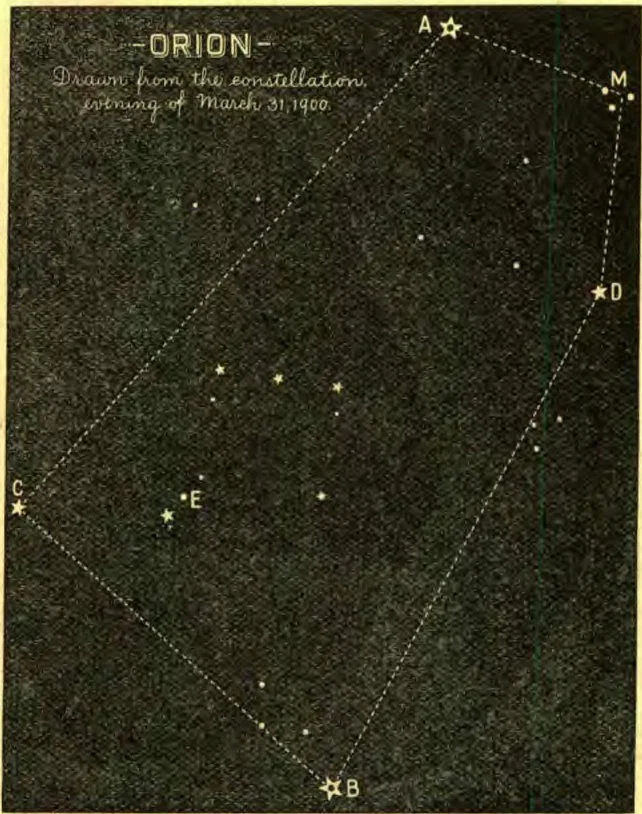
ORION, the most beautiful constellation of our northern heavens, is now the most conspicuous collection of suns to be seen, during the early evening hours, in our western sky. By noticing the accompanying illustration, no trouble need be had in definitely locating this remarkable portion of our field of study. We shall learn some very interesting facts regarding this special constellation before it sets too early in the evening to afford favorable observation. The Lord calls the special attention of his people to this constellation; the reason for this we shall better understand as we learn more about this subject. “Canst thou bind the sweet influences of the Pleiades [a small group of seven stars, known also as “the seven sisters,” lying a little north and west of Orion], or loose the bands of Orion?” asked the Lord of Job.
To the imaginative minds of the ancient astronomers, Orion was a gigantic being, bending upon one knee, holding in one hand the head of a slain lion, and in the other brandishing a large club, ready to meet the fierce charge being made upon him by the constellation Taurus, the bull,—whose flaming eye is the red or orange-colored star Aldebaran, lying still farther to the west. This worship of the twelve signs of the zodiac, mentioned in 2 Kings 23:4, 5 (please read), consisted of the most abominable heathen practices.
Orion is outlined by four principal stars and one group, as will be seen in the illustration, which shows the position of the constellation as it appears during April. “A,” Betelguese, at the upper left-hand corner, is a variable, orange-colored star, or sun, of the first magnitude; “B,” Rigel, at the lower right-hand corner, is also a star of the first magnitude; “C,” Saiph, a star of the second magnitude, marks the lower left-hand corner; while “D,” Bellatrix, also a star of the second magnitude, marks the upper right-hand corner of this remarkable constellation. The apex of the triangle, or head of the giant, marked “M,” is a beautiful cluster of lesser stars. Under the eye of our larger telescopes, this cluster becomes a bewildering blaze of glorious illumination. Near the center of the group is a line of three bright stars which, being nearly equidistant from one another, and, at this season, lying nearly horizontal, form a conspicuous part of the constellation; this is known as the belt of Orion. A little below, and forming a nearly perpendicular line with the constellation, hangs the sword of this mythical giant. This sword is composed of three stars, the lower one having a much smaller companion, which can be seen by the sharp eyes of our younger readers. The central star, marked “E,” is known as Theta of Orion. To every Christian who is looking for the soon coming of our Saviour to this earth again, this star marks an important point in the heavens; for it is here, we are told in that interesting little book, “Early Writings,” that the city of God will appear at the end of the one thousand years. To the naked eye, this star marks the location of what is known as the great nebula of Orion, which is so different from all other nebulae as to be a matter of much scientific investigation and comment.
In our next study we will spend the whole hour learning what we can of this interesting phenomenon. Compare the engraving with the constellation, and get the position of the different stars firmly fixed in the mind; for in a few weeks the sun will have reached a point, in his apparent eastward course in the starry vault, that will make actual observation of this group impossible before next fall, unless we sit up very late at night,—a thing we trust none of our class will do.
By the time the sun gives us that much-looked-for eclipse, on the morning of May 28, he will have passed so far toward the east in his yearly journey among the stars as to reach a point somewhat below and to the east of the Pleiades, or seven sisters, and to the west of Orion. It must be remembered, however, that as that eclipse is to take place in the morning, the portion of the heavens that we now study in the early evening will be in the eastern sky at that time of day. This seeming change in the direction of its location is due to the diurnal revolution of our earth upon its own axis, which simple problem will afford a pleasant hour’s study for some future evening.