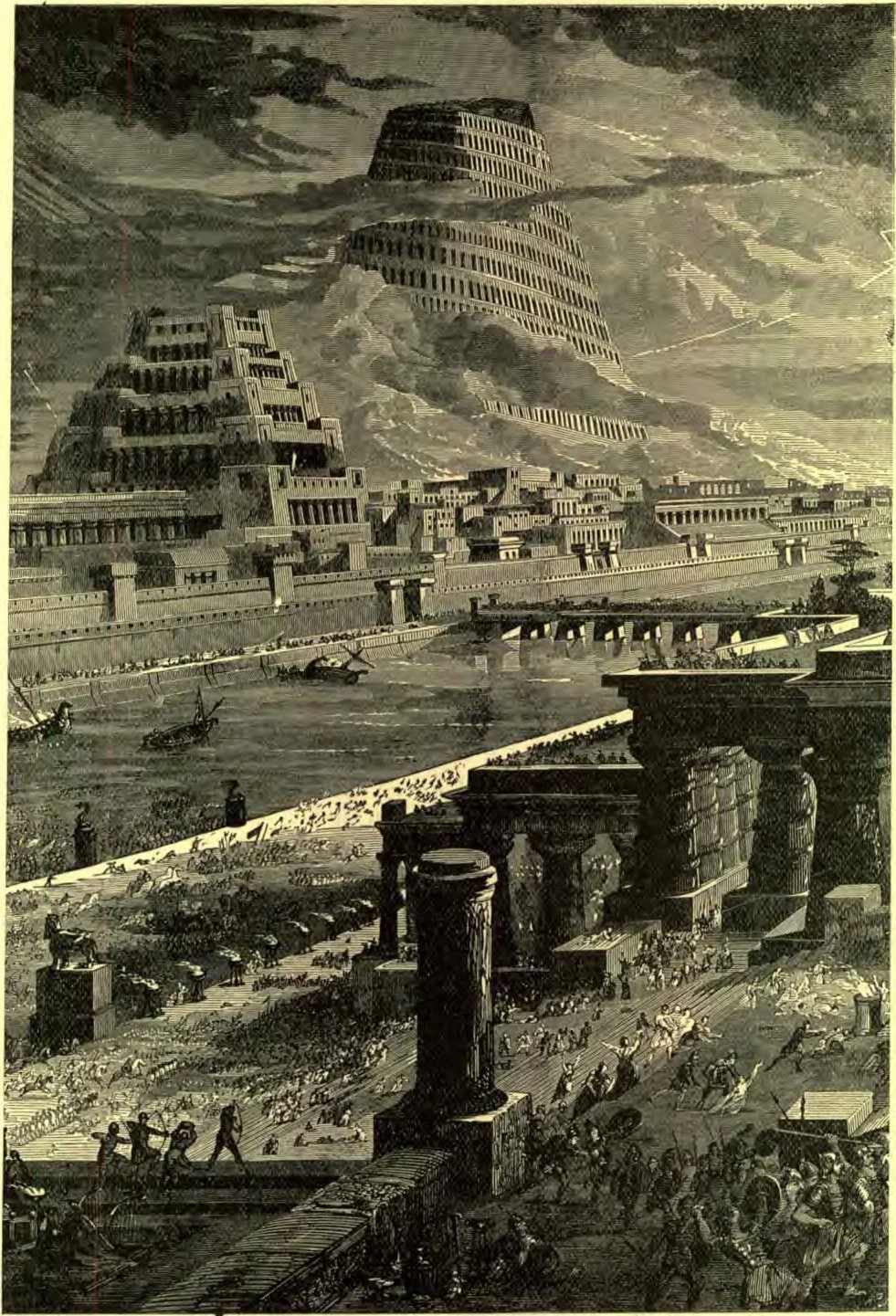
THE EMPIRE OF BABYLON

11%

Review and Herald Publishing Company · Battle Creek, Mich. · Dec 14, 1899

FromThe Youth’s Instructor, Vol. 47, No. 49.

Read the full edition

THE EMPIRE OF BABYLON

THE region of country known as “Babylonia” is identical with that of ancient Chaldea, being the alluvial tract between the rivers Tigris and Euphrates. Across the Tigris the country is no longer Babylon, but Susiana, known to the Jews as Elam; and therefore ancient Babylon was composed of the two great alluvial plains, one containing eighteen thousand, and the other nine thousand, square miles, or, in the time of Nebuchadnezzar, a region of twenty-seven thousand square miles. The Babylon of the Scriptures, however, includes, in addition, Susiana, or Elam, and on up the Euphrates to at least the city of Carchemish, westward to the Mediterranean, and southward perhaps to Egypt. The early history of Babylon, the capital of the empire, is so shrouded in uncertainty, and even mystery, that most that relates to it seems doubtful and problematical. The period when it became the capital of the nation was during what Rawlinson calls the “fourth monarchy.” Tradition insists that it was the largest and most magnificent city of the ancient world. Nineveh, which preceded it, was of even surpassing splendor, yet its circuit did not exceed three miles by about one and one-half miles,—an extent of territory not larger than that of thousands of small towns today.
The Babylonians were emphatically traders and merchants, navigating the Persian Gulf, and trading with Arabia, India, and Western Asia, traders coming down the tributary rivers. The main body of the people were, however, agriculturists, as the plains of Babylon were then the granaries of the world. The soil was rich, producing wheat, barley, and millet in abundance. Herodotus claims a yield of two, and even three, hundredfold, with wheat and barley plants often four fingers in breadth. The date, however, was the staff of life; and the dried fruit was regarded as the bread of the people, many of the poorer classes subsisting entirely upon dates and goats’ milk. The cultivation of the date was universal, and date groves dotted the landscape in all directions. Fish abounded in the marshy districts of the south, and many found remunerative employment in catching and drying them. The dried fish were pressed through a sieve, and made into cakes, or bread.
The government of the Babylonian Empire was similar to the Assyrian,—a loose organization of provinces, under native kings,—and, like Assyria, it failed to win the affection of the subject-nations because of its policy of exhausting and oppressing the conquered races. In time of peril the subject-nations often became a menace instead of a help, sometimes even taking sides with the enemy.
The religion of the Babylonians was identical with that of their predecessors, the Chaldeans,—polytheism, or plurality of gods, mainly astral, the sun, moon, stars, and planets being worshiped. The chief objects of worship were the gods Bel, Merodach, and Nebo, the first two being peculiarly the gods of the city of Babylon. In the temple of Bel at Babylon, as well as in temples in other cities, a great festival was held once a year. Numerous victims were sacrificed, and it was customary to burn a thousand pounds of frankincense on the great altar.
In civilization the Babylonians were originators, not imitators of other nations. They invented an alphabet; figured out the simple rules of arithmetic; invented instruments to record time; discovered the art of polishing, boring, and engraving gems; became passable sculptors, astronomers, and grammarians; elaborated a systematized code of laws; attempted an exact chronology; and made rapid progress in all sciences.
The luxurious living of the Babylonians is a matter of comment by all writers. They were brave and skillful in war, though cruel and savage in disposition. They were proud, passionate, and unprincipled, yet, strange to say, they taught and cultivated the practice of two virtues—honesty and calmness. “While rage boiled in their hearts, and commands to torture and destroy fell from their lips, etiquette may have required that the countenance should be unmoved, the eye serene, the voice low and gentle.” Their practice of honesty in deal won for them the trade of the world; but true honesty, aside from policy, and real gentleness, “were certainly not the attributes of a people who were so fierce in their wars and so cruel in their punishments.” W. S. CHAPMAN.
BABYLON TAKEN BY CYRUS.