Any one familiar with the great farming districts of the Western States would be likely to look with some amusement upon what he would see of farming operations in Queensland while traversing the country by rail. The people have not departed very far from the primitive methods employed by most English and Old-World farmers, who till their small patches of land on a sort of one-horse principle. Nevertheless, a large amount of produce is turned out in this way. Much of the small grain is harvested before ripening, and then cut into feed, called chaff, and thus sent to market in bales. Corn is more extensively raised here than in any of the other colonies, and always brings a good price. It is now selling for one dollar a bushel. What a treat this would be to our Kansas and Nebraska farmers! Potatoes are extensively raised, and can always be seen growing in different stages of development. Fresh garden vegetables of some variety are to be procured the year round. In the later winter months of August or September, frosts may come on the higher lands.
Fruit-farming is carried on to some extent, but pests and disease often rob the orchardist of his reward. In the warmer sections, pineapples, bananas, mangoes, oranges, and lemons are extensively grown. In the Brisbane market, bananas cost from two to four cents a dozen; and in the season, good “pines” may be had for twice that price. When a banana stalk has grown one bunch, it is cut down; but from its stock spring up other shoots, so that a plant is constantly bearing, there being no special season for the fruit. After a time the plants deteriorate, and require renewing; but they bear well for a term of years, during which they continually increase in size and capacity. The same is partly true of pineapple plants. The first crop produces one pine from each plant; but the number of plants increases with each crop, until the entire ground is a solid mat of bristling plants, well-nigh impenetrable, unless it be kept within bounds by vigorous training. Brisbane is said to be the center of the finest pineapple district in the world. Perhaps none but a Brisbaneite would say it; but we had a ten-pound pineapple on our table, bought out of a common lot.
Leaving the lines of railway, and penetrating the broad interior districts, one enters a region that might be regarded as a world of its own. It is the sheep world. Here on vast ranges live hundreds of thousands of these gentle quadrupeds, tended by a set of men, who, being cut off from the outer world, by long years of association have in some instances become assimilated to the society of their quiet companions. In northern Queensland shearing begins in early spring, and extends southward with the season, until nearly the entire year is occupied, and an army of men have sheep-shearing as their sole occupation. It is said that except at shearing time, many of the sheep-tenders never see human beings. Their food is left at certain specified places; and when it is required, they visit the repository to obtain it. Wool is brought to the railways by long teams of oxen or horses. The annual wool crop of Queensland brings not less than fifteen million dollars. The amount exported last year was 84,814,139 pounds.
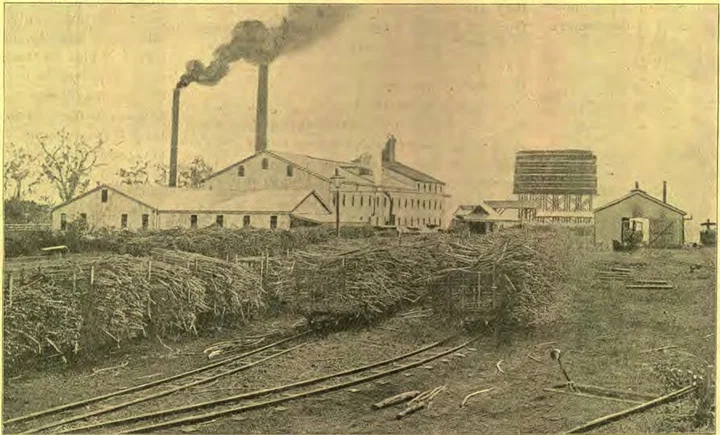
Another industry rapidly gaining ground along the coastal regions of Queensland is sugar-planting. For this labor, men are imported from the islands. These men are known as Kanakas, and their introduction and inhuman treatment have been the source of endless controversy. The latter feature is greatly modified by laws regulating the traffic, and controlling the treatment of the poor laborers, who, in the past, have been treated more as slaves and chattels than as human beings. The principal objection to their being employed now is on the part of white laborers, who think the work should be performed by themselves, at prices that would give white men a support.
Many branches of small farming could be profitably carried on in Queensland. Bee-keeping is one of these, though good strained honey can be had for four cents a pound. But bees work nearly or quite the entire year; and two hundredweight from one colony is not an unusual yield for a single season.
But for the lack of rain to which the country is exposed, Australia in general, and Queensland in particular, would be the garden of the world. The climate of Brisbane is, on the whole, a most desirable one. In the hot summer months the forenoons are sultry, but the evenings and mornings are delightful, or at least have been so up to the present time since our coming.
On one of the famous palaces in Delhi, India, is found this inscription: “If paradise be on earth, it is here, it is here.”
I would not quote that sentiment for Queensland. The if is so overtowering as to render the whole legend nonsensical. Paradise is not on earth. It will be: but “how unlike the present world will be the one to come.”
G. C. TENNEY.