Light is defined as “radiant energy,” propagated by the wave-like motion, or vibration, of a hypothetical something called ether. Ether is indefinable, immeasurable, almost inconceivable. We simply presume that it is capable of transmitting the wave-like motions of light and heat, and that it fills universal space.
Toss a pebble into the water, and immediately there spring up many little waves, which travel, in gradually widening circles, from their starting-point. Just so with the waves of light; only instead of creeping along at a snail’s pace, they move at the rate of more than one hundred and eighty-six thousand miles a second. When light-waves strike the surface of an object, they are reflected, or “bounced back,” and thus we are able to see the object. Some surfaces absorb light instead of reflecting it; these appear black to us, simply because we can see nothing in the space that they occupy. Other surfaces reflect light-waves of one sort and absorb those of another. This gives them color.
When not interfered with by some outside influence, light moves in a straight line. In the camera obscura, light is admitted at only a small aperture; consequently the rays coming from the bottom of an object move upward, while those coming from the top must move downward, to reach the interior of the camera. These rays all cross at one point, and each continues its course until intercepted, when it gives an inverted image, as illustrated in Fig. 1.
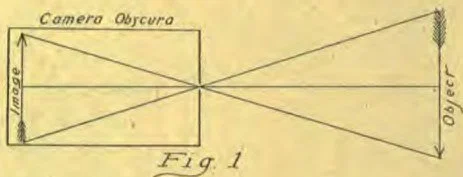
A simple experiment will clearly demonstrate this truth. Take an empty tin fruit can, which has had one end removed. In the middle of the other end make a hole with a tack or small shingle nail. Now black the inside of the can with boot-blacking, or anything convenient, to prevent reflections. Cover the open end with oiled paper, and the camera obscura will be complete. In order to see the image formed on the oiled paper, it will be necessary to cover your head with a dark cloth, just as the photographer covers his in focusing. Unless the object is well lighted, the image will be dim and indistinct.
Cameras, as now made, are truly marvels of convenience and compactness. But good photographs depend more upon the care and skill of the operator than upon the tools with which he works. All that is necessary to take a prize-winning picture is a light-tight box, with a small hole at one end, and a sensitive plate at the other.
Although photographs may be taken without a lens, the lens is, generally speaking, of greater importance than the camera. I advise my readers to become reasonably expert in photographing with a lens before they attempt to photograph without one.
A perfect photographic lens will condense every light-wave that reaches it from an object, and of them form an image of the object, which is its exact counterpart, except in size. An absolutely perfect lens has never been made, but some come sufficiently near perfection for all practical purposes.
The action of a lens in forming an image is quite simple, and it should be understood by all who expect to use one intelligently. Figure 2 illustrates the manner in which a simple form of lens affects light-waves. A is a point on some object, from which the light-waves are reflected. B is a plano-convex lens. C is the point where the light-wave is condensed to form the image.
As the wave leaves a, it grows larger, but only that part of it is shown that will ultimately reach the lens. The middle of the wave strikes the flat surface of b first. As it moves through glass much more slowly than through air, the ends of the wave “catch up,” and it becomes more nearly straight. The back of the lens being curved, the ends of the wave emerge first, and run ahead of the middle, so that when it finally does get free from the glass, it is curved in the opposite direction. Before it can regain its former curve, it must come to a point, which it does at c. The image is made up of countless numbers of waves of light, reflected from every point of the surface of the object, and condensed to a corresponding point in the image.
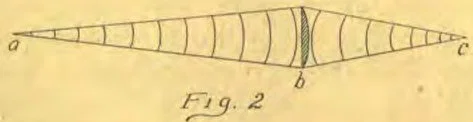
The light-waves do not affect one another, no matter how often their paths cross. But if they are intercepted at any point, either in front or behind c, they will remain crossed, and the resultant image will be indistinct. The farther from c the image is intercepted, the less distinct it will be.
Now if a is moved farther away, the waves of light will be much flatter when they reach b, as they will be arcs of a larger circle. The nearer flat they are when they reach the lens, the more curved they will be when they leave it, and the sooner they will come to a point. The farther a is from b, the nearer c will be, until a has been removed so far that the light-waves are practically flat when they reach the lens. After this point has been reached, c remains stationary, no matter how far a is removed. When a has reached this point, the distance between b and c is the focal length, or equivalent focus, of the lens.
The focal length of a lens is proportionate to the curvature of its surface. It will be seen, by referring again to the drawing, that if the lens was thicker in the middle, the light-wave would be still more curved when it had passed through. It would, consequently, come to a point sooner.
If any of my readers have found this article rather dry and hard to understand, I advise them to study it carefully, until they do understand it. Photography has been made a pastime by many; but if I did not believe that at least some of the INSTRUCTOR family would make it a study, I would not write another word.
J. EDGAR ROSS.