In drawing outdoors from nature, there are some difficulties that one does not meet in drawing from still-life groups, or in drawing indoors. The light changes; the shadows remain in one place hardly long enough for the beginner to draw them; there is the constant swaying of trees and vines in the wind, and the fluttering of one’s paper: yet in spite of all these difficulties the student will realize that the most crude efforts bring with them a deeper delight than a finished study of still-life or any indoor work.
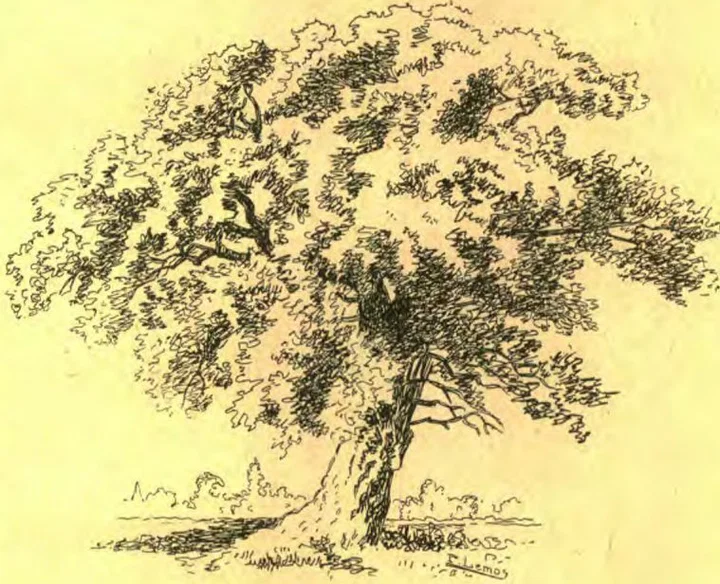
It will be best in the beginning for the student to take only the most simple subjects, such as a group of trees, or several old buildings, or a road. If these are too difficult, a single tree, a vine, or the corner of some building will do, until he becomes familiar with the work.
Many hours must be spent in the study of trees alone, to insure a good drawing of them. The individuality of trees is as strong as that of persons. The different species differ in form, color, and foliage; while no two, even of the same species, have just the same manner of growth. These all need careful study.
One of the most important matters in drawing is to know how to place upon paper the subject one is about to draw. The interesting scene may become flat and unattractive if drawn on a scale too large for the sheet of paper, or if drawn too high, too low, or so close to the edge of the paper as to leave no margin for possible needful additions. All sketches or drawings should be placed so as to leave an ample margin on all sides. If, after the drawing is made, there proves to be too great an expanse of paper, it can be easily cut down to a suitable size; while the opposite difficulty — the addition of an inch or two to the margin — can not be so easily remedied.
Having decided on your subject, sit so that you can see it from the best point of view. This point being once chosen, keep to it. Many an otherwise good picture has been spoiled from the inability of the artist to draw his choice of subject, and that alone. The temptation is strong to add, to this side and that, points which in themselves are interesting, but which, if added, will detract from the general interest of the picture. No more should be put in the drawing than is essential to complete the idea to be expressed. Parts that are not necessary to complete the idea should be omitted or suppressed. To suppress these parts, we should make them lighter, or in outline, so that the main idea shall be seen first; then the suppressed, or secondary, parts will be seen without interfering with the main idea.
Make your drawing at the time when the shadows are most interesting,—a point that can be determined only by previous observation. Shadows are strongest in the afternoon, so that for some the afternoon is the most desirable part of the day in which to sketch.
Having placed your drawing, and sketched in the main forms, it will be best to outline all the shadows carefully; and no matter how much they change afterward, keep your drawing of such shadows within the limit of the penciled indications. This will prevent a mistake frequently made in outdoor work; namely, the different shadows in one picture appearing as if cast at different times in the day.
All the houses, sheds, roads, and windows that enter into outdoor sketching must conform to the principles of perspective with which we first started. Houses are only big blocks, so to speak, and all their vanishing lines retreat in accordance with the principles that govern the elementary forms. Use such knowledge with judgment, however, lest your drawing become too architectural and stiff.
PEDRO LEMOS.