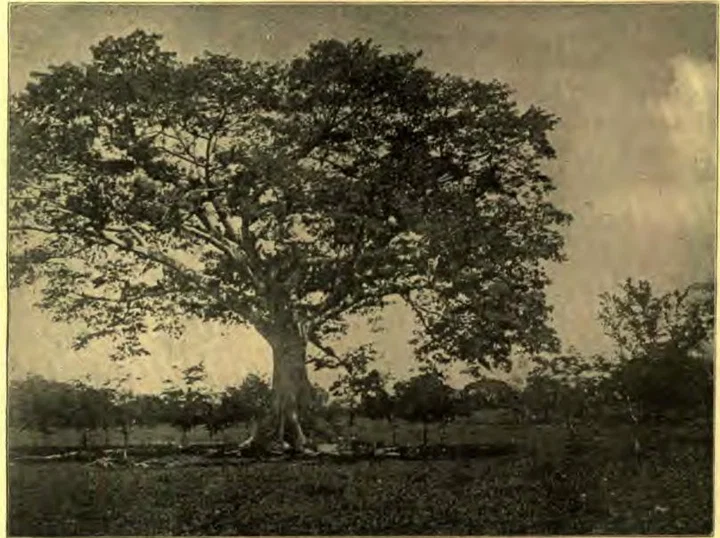
ONE of the most noticeable trees of the West Indies is the ceiba, or, as it is commonly called, the cotton tree. It is usually quite symmetrical, and presents a stately appearance. One peculiarity that distinguishes this tree from its companions is that it usually has no branches low down; often the first branches are as high as fifty feet from the ground. Some of these are as large and long as an ordinary tree. Another peculiarity is a barrel-like bulging a short distance from the ground, making the circumference of the trunk larger there than at the base. This is more noticeable, however, in those trees that have no spur roots running out from the trunk partly above ground. These spur roots are an almost universal characteristic of the tree. Another thing that distinguishes the cotton tree from most other tropical trees is that it is deciduous. Most trees in the tropics shed their leaves gradually, at the same time putting out new ones, so that they are always green. But the cotton tree sheds all its leaves, and then almost immediately puts on its new green coat. As a rule this change takes place in March or April.
The ceiba bears a boll, somewhat similar to that of the cotton plant, which bursts in May and June, and scatters far and wide its long, silky down, full of small, light, flat, brown seeds not unlike those of the milkweed. As far as I can learn, scarcely any use is made of this cotton.
The leaves of the ceiba are small, narrow, and pointed, perhaps four inches long to one wide, and arranged in star-like clusters. The bark is smooth, and has a purplish-gray tint, which is very attractive. The wood is white, and comparatively soft, somewhat like that of the cottonwood of the United States. It is mainly used for canoes. This is done by felling a tree, and hollowing out the trunk. Some of these canoes are over forty feet long, and are supplied with small masts and sails.
Not long ago we took the measurements of a large cotton tree near Santa Cruz, Jamaica. We had no means of accurately determining its height; but its girth, nine feet from the ground, was forty-four feet. The first limb was fifteen feet in circumference, and we counted sixteen limbs between two and five feet in diameter. The longest of these was one hundred and twelve feet in length. The longest spur root, and there were several, showed above ground for thirty-eight feet from the tree trunk. You can know that the shade of such a tree covers a considerable extent. A tree nearly as large stood not far away.
As the shade was so dense, we could not get a good picture of this stately old monarch, but found one in an open space, which we took for you, and which gives you a good idea of the form and general appearance of these trees.
As one passes along the roads, he can see these trees in every direction; often their limbs are covered with common orchids, and the trunks draped with rootlets growing down from parasites lodged among the branches. Sometimes these roots wrap themselves around the tree, and grow so large and strong as to choke it to death. Then the tree rots away, leaving the parasite to fill out the top, cover up the trunk with its roots, and finally be the tree itself. Thus it literally crushes away the life, and usurps the place of a once sturdy tree,—a good illustration of how a bad habit, if not promptly checked, will eventually ruin and transform into worthlessness what might have been a strong, symmetrical, useful character.
ANNA AGEE HALL.