BEFORE proceeding to shade a drawing, always see if the outline is correct; for it is useless to begin shading before the outline is completed or true, or to think any amount of shading will make a correct drawing from a poor outline.
It is natural for the untrained eye to notice details separately, and not the whole form, of which the details are a part. It is easy to see the eyes, nose, mouth,—any particular feature of the human head,—but difficult to see these parts together as a unit, as a single form; and yet this power should be acquired, as one possessing it can draw with ease and accuracy.
An aid in seeing objects as a unit is to view them through half-closed eyes, making the object look blurred, so that the details are eliminated, and the mass is plainly seen.
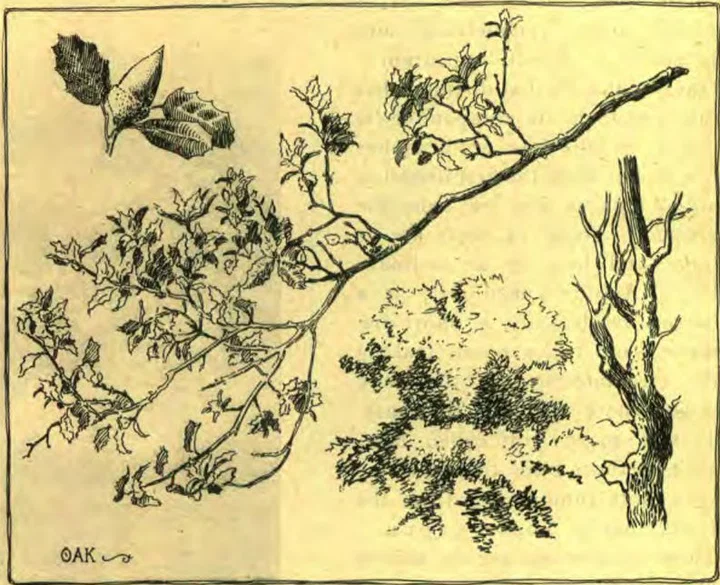
We often allow our knowledge to deceive our eyes. For example, when drawing a tree, our knowledge tells us that the foliage is composed of individual leaves, and using that knowledge in drawing, we try to represent the individual leaves, and of course fail. Unless we are very near the tree, we can not see the leaves separately, but only the mass of leaves taken together. The whole is of more importance than a part; therefore it should be the aim to represent the tree as a whole,—to draw the general shape, and then add some of the details.
It is a good plan, in drawing trees, to take first a single branch of the oak, ash, or whatever tree you wish to represent, and, sitting near enough to see the details, draw it just as accurately as you can, again and again, until you are familiar with its leaves, bark, and method of growth. Then, moving to a position some distance away, take as your subject a larger portion of the tree; study the masses of foliage, the color, the light and shade; and when these have all received careful attention, move still farther away, and consider the tree as a whole. In the illustration you will see how I have made a study of different parts of an oak. Accompanying the last lesson was a drawing of the entire tree.
Remember that in drawing any large form there is danger of sitting too near it. Distance obliterates details, and broadens the masses; therefore it is best to be well removed from your subject, so that you may think of its form as a whole rather than of its details. After such study as this, it would be well to take an entirely different tree, and pursue the same course, afterward comparing your sketches, and making such corrections as an increasing knowledge shall suggest.
When walking along, notice the shape of the side of a building or any inclosed space; notice the shape of a leaf, plant, flower, shrub, or tree. Notice the form of a distant mountain, hill, or plain; of a wood, a field of grain, a meadow, or a clump of trees. Learn to group the form inclosed by lines. Cultivate the habit of observation; and in a short time the power of seeing any number of objects as a unit will be acquired. Drawing will then receive a new light, and be far more interesting and simple than would be otherwise possible. As soon as we recognize figures that we are acquainted with, their complicated form ceases to a large extent to appear complicated. All forms, however complicated, are composed of other simple forms, or figures, which, if recognized, will make the drawing of them easy. You can not study too carefully the simple forms of any object you wish to draw.
In your drawing use whatever medium best suits your work; and if unsuccessful for a long time with one, try another. Many find a rather soft pencil satisfactory; others can express themselves best in charcoal; while still others prefer pen and ink. Remember that whatever you work with is, after all, only the medium through which you express yourself; and that it is far more important to have something to express, founded on close observation and careful study, than to make beautiful lines, or shades that are without an intelligent meaning.
PEDRO LEMOS.