A VISIT TO JEYPORE

7%

S. D. A. Publishing Association · Battle Creek, Mich. · Sep 26, 1895

FromThe Youth’s Instructor, Vol. 43, No. 39.

Read the full edition

A VISIT TO JEYPORE.

IN FOUR PARTS.— PART IV.
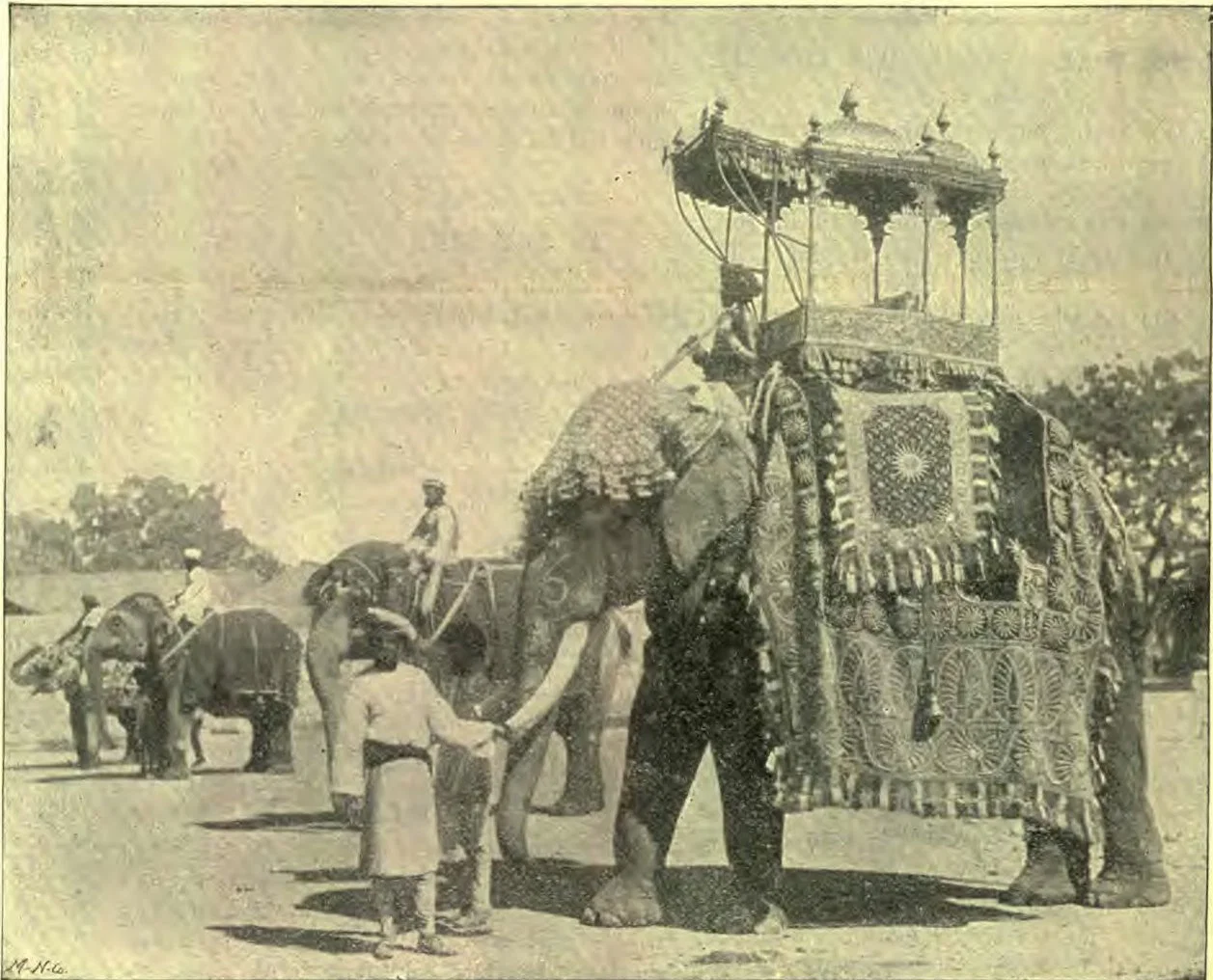
By far the most interesting place to visit is Amber, the ancient capital of the kingdom, situated a short distance from the modern city, on the margin of a small lake surrounded by mountains. To visit this antique city, permission of the political agent is requisite. Having called upon him the previous day, he readily granted me permission, kindly furnished a guide, and had two of the maharajah’s royal elephants on the following morning at the foot of the mountain in readiness to carry three American tourists from St. Louis and myself to the maharajah’s famous Amber palace.
THE MAHARAJAH'S ELEPHANTS.
The drive from the hotel to the foot of the mountain was very pleasant. The morning air was cool and refreshing. We passed a number of very magnificent tombs, the largest of which we stopped to see. It was built of white marble. Labor and money were not spared in its construction. Immense sums are often spent on these tombs, as an expensive tomb is considered by a Hindu to be a sure passport to heaven. The tomb known as the Taj-Mahal, of Shah-Jehan and his wife, is perhaps the most beautiful and most costly building on earth. It is said that twenty thousand men were twenty-two years building it.
We next passed a shallow lake filled with the sacred crocodiles. It is quite possible that in bygone years many devout Hindu mothers sacrificed their infants to the ancestors of these ugly animals. Since English rule has become supreme in India, such inhuman religious customs have been suppressed by law.
Upon our arrival at the mountain, we found that two of us were enrolled for each elephant. My lot fell to the one called by the natives the “lady elephant.” In obedience to the command of her keeper, the lady elephant kneeled down, and a small ladder about ten feet long was placed at her side to enable us to mount. We were soon seated in the howdah. The command to hold fast was very appropriate, for the huge beast in regaining her feet seemed to do it by great sudden jerks. The movement experienced on an elephant’s back is a gentle churning, combined with a slow twisting; and a person is apt to think that should the elephant fall, it would be a long way to the ground; but there was no danger, as the sagacious animal carefully found her way. We passed several precipices; if she had fallen then, we would probably have been dashed to pieces on the rocks many feet below.
For a short distance our road wound through a mountain forest; then it made a sharp turn, and we suddenly came upon the mysterious valley of Amber. It has been described thus: “Picture to yourself a deep crater, the sides of which are covered with a thick, somber jungle, in the center of which rises a green mound forming a pedestal for a fairy-like and dazzling marble palace, beside which the wonders of Seville and Granada would appear insignificant; and around the palace lies a silent and deserted town whose smallest houses are palaces.”
Near it is a beautiful lake, in which the sunlight reflected the foliage, the palace, the fort, and many features of the mountain side most beautifully in its sparkling water.
This lake also swarms with crocodiles; but tradition has it that a prisoner who was to be offered as a sacrifice to the god Kali, in attempting to make his escape swam across the lake unhurt by the crocodiles. The Hindus attributed this to the special protection of the gods, and conferred great honors upon the prisoner. Near the palace is a small temple where a goat is daily offered up to Kali as a substitute for the human being offered every morning in bygone ages. We arrived at the temple too late to see them offer the goat, though the blood was still fresh upon the floor and slaughtering weapon. As to what they did with the goat after it was killed, I was unable to learn. Most likely it was cremated, as the Hindus do not eat flesh.
The palace is a very large building after the Indo-Saracenic style. The superior richness and beauty of its architecture and its ornaments make it a building of rare beauty.
The only human beings to be seen in this desolate city were the native servants who have charge of the palace; but when the time came to give baksheesh, we were convinced that there were quite a number of them. From the top of the palace we had a good view of the city, which wore the appearance of being abandoned to doleful creatures.
The surrounding hills, furrowed by ravines opening on the lake, and covered more or less with temples, houses, and streets, many of the buildings partly gone to decay, present a picture which forcibly recalls the description of Babylon after its fall, as depicted by the prophet Isaiah.
WILLIAM LENKER.