There is probably no other tool in use among mechanics that has half the capacity for usefulness, or of which half so many applications can be made, as the steel square. A mere list of the operations that may be performed with it, and of the purposes for which it may be advantageously employed, would occupy more space than we can devote to this article. This familiar tool has been underrated, and is entitled to more attention than is usually given to it. In the hands of the mechanic, it is a calculating-machine of wonderful capacity.
In the study of the square, we will first give the names of the parts of the square itself, and then notice the marks and scales on it. The long part is called the blade, the short arm is called the tongue, and the connection between the blade and the tongue is called the heel. The blade is twenty-four inches long, the tongue from fourteen to eighteen inches. The blade in a perfect square is two inches wide, and the tongue is an inch and a half wide.
The first marks that we will notice will be the division into inches and fractions of inches. The heel of the square is the point from which it is most convenient to measure, both along the blade, and also on the tongue. In numbering inches, therefore, we begin at the heel, on the blade and the tongue respectively. The inch-marks on the inside edge begin numbering with the interior angle.
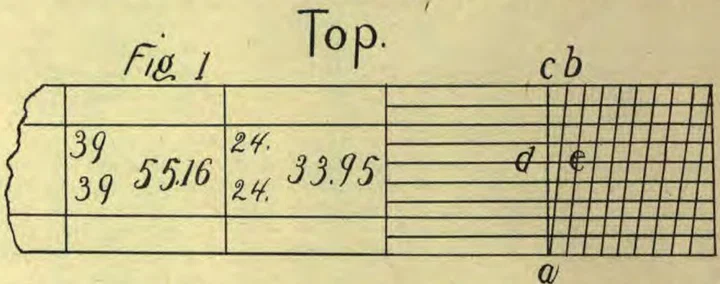
The blade of a good square has a row of figures, beginning with the outer end, between the other two rows of figures, which adapts this part of the tool for use in measuring the depth of mortises, etc. The different edges of the square are variously divided into fractions of inches. The outside edge on one side of the square is divided into sixteenths, while the inside edge is divided into eighths. The edge on the opposite side of the square is divided into twelfths, and is used as a scale for drafting,—an inch to the foot, each twelfth representing an inch. The fine lines ruled longitudinally on the tongue between the inch-marks 2 and 4 are parallel lines divided into tenths. The diagonal lines between 2 and 3 are also one tenth of an inch apart. By these lines the workman is enabled to find hundredths of an inch. As you will see in Fig. 1, from the line where the line starts at a to b, the distance is one tenth at b from c, and following up the line from a to b, the second line would be one hundredth, the third line two hundredths, and so on up to ten hundredths. Every time you move to the next line on the right, you gain ten hundredths more.
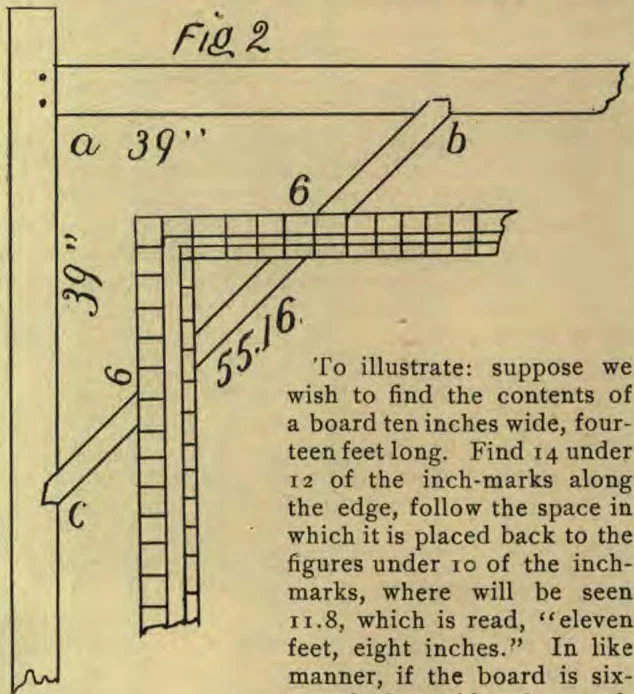
In Fig. 2 we have an illustration of practical work. If you were putting up a timber frame of any kind, and wished to frame in a brace, you would need to know exactly how long to cut the brace. The space from a to b and from a to c is called the run. The run from a to b is thirty-nine inches, and from a to c thirty-nine inches. To find the length that the brace should be cut, look on the tongue of the square, and notice the figures, as shown in Fig. 1: 39/39. 55.16. The thirty-nine inches is the length of the run, and the fifty-five inches and sixteen hundredths, the length of the brace from c to b, or four feet, seven inches, and sixteen hundredths of an inch. To find the measure as found on the square, run from the bottom line, Fig. 1, at a, up six lines to d. From d to e on this line is six hundredths of an inch. By adding another space at the right, you have the sixteen hundredths of an inch, which, added to your four feet seven inches, gives you the length of the brace. You will find the figures on the square for any run you may want. The length of the brace is found in the same way.
To get the bevel to cut the shoulder of the brace, lay the square across the brace, as seen in Fig. 2, an equal number of inches on the blade and the tongue. It is not customary in coarse framing to pay any attention to the hundredths; but in fine work, where needed, this gives an exact measure.
The parallel rows of figures along the blade of the square constitute what is called a board measure. The manner of using it is as follows: Under 12 of the inch-marks along the outer edge of the blade will be found the figures 8, 9, 10, 11, 12, 13, 14, 15, which represent the length of the plank or board to be measured. The contents in feet and inches will be found under the several inch-marks on the outer edge of the blade, corresponding to the width of the piece to be measured.
To illustrate: suppose we wish to find the contents of a board ten inches wide, fourteen feet long. Find 14 under 12 of the inch-marks along the edge, follow the space in which it is placed back to the figures under 10 of the inch-marks, where will be seen 11.8, which is read, “eleven feet, eight inches.” In like manner, if the board is sixteen inches wide, the result (under 16 of the inch-marks) is found to be 18.8, or eighteen feet, eight inches. Many other examples might be given.
Try to lead a life as square and true as the tool you work with.
W. K. LOUGHBOROUGH.