The most important river in Great Britain is the Thames, on which is situated London, the nation's capital and the world's metropolis. The total length of this river, from Thames Head to London Bridge, is one hundred and seventy miles, and to Sherness, at its mouth, two hundred and twenty-eight miles. Because of its comparatively level course, its source being only three hundred and seventy feet above the level of the sea, it is navigable almost its entire length.
At Lechlade, twenty-four miles from its source and two hundred and fifty feet above the sea, navigation may properly be said to begin. From this place to Teddington, nineteen miles from London Bridge, this commercial use of the river is carried on by means of locks. Of these there are thirty-two below Oxford. The length of the locks is about one hundred and thirty feet, and a vessel of sixteen feet beam can pass through them as far up the stream as Oxford, to which place a small steamer also runs. There are many excellent opportunities for boating along the river, and both sail- and row-boats are numerous. With some friends the writer enjoyed a pleasant hour's recreation in this way while visiting at Reading, about halfway between Oxford and London.
The action of the tides is seen in the last fifty miles of the river. From its mouth to London, the tide travels in about two hours, reaching Teddington in two hours more. At London the depth of the river at high tide is thirty feet, but at low tide it is only twelve feet, with a corresponding decrease in width. This is at London Bridge; but below that point the depth and width increase rapidly. Deep-sea steamer navigation begins but a little below, while vessels of any size come as high as Deptford.
From London to the sea, traffic on the river is great. One does not notice the crowding so much a few miles below the city, where the width allows plenty of room for navigation; but as the narrower part is approached, in coming up the river, it seems almost impossible to get through the floating babel. We came up the river on a large excursion steamer, and darkness began to settle on us before we reached the city. For several miles we ran at half speed; and as we entered this conglomerate mass, the speed was still further reduced, till we moved no faster than a walk. As it grew still darker, a sailor was stationed at the bow of the boat, to keep a sharp lookout. He continually called out the condition of the course, and his words were repeated by an under officer stationed at the front of the higher deck. This officer could be heard by the captain on the bridge, still higher. Many heavily loaded barges were floating down with the tide. These were especially difficult to avoid, because, not having power of their own, they could not be controlled like a boat that can be quickly reversed, or whose speed can be varied. Just as we passed several large boats, which shut off our view for a few minutes, the man in front called out that a barge was headed directly for the ship's bow. As our boat was at this point close to the river's bank on our right, and the barge was coming down upon us at an angle from the other side, it seemed almost impossible to avoid a serious collision. After the facts were made known to the captain, and he could himself see the boat, not a word was spoken; but all concerned at once did their part to avoid the difficulty. The engineers were signaled to stop; the steamer was turned asp. 558 far as possible away from the coming barge; and several sailors threw the ends of large ropes over the side of the boat, at the place where it was seen that the barge must strike. The barge, too, was turned somewhat down stream; and as she struck, the ropes relieved the blow so that no damage was done, only a dull thud being felt and heard as the smaller boat was turned aside, and passed by. When the danger was passed, our captain called out to the skipper of the barge, “What do you want—a damage?” The question implied that the careless skipper had allowed his boat to get in the way of the large steamer, hoping to be run down, and thus open the way for collecting damages, which he doubtless would try to prove were much more serious than they really were. The steamer would of course be held more responsible than the unwieldy barge.
As we approached the Tower Bridge, the smoke-stack of the steamer was lowered by sliding the top part into the bottom, something as a telescope is closed. The tide being so high that there was still danger of its striking, the whole pipe was turned backward, and we then noticed for the first time that it was arranged with hinges for this purpose. We afterward noticed that all the smaller steamers that run up the river have the same arrangement for passing under bridges.
Tower Bridge, the one farthest down the river, was opened in 1894, it being found necessary to relieve the immense traffic on London Bridge, a little farther up. As sailing boats with high masts have the right of unrestricted navigation as far up as the old London Bridge, it was found necessary, when Tower Bridge was built, to make it movable, so that these boats could pass it, although they could gain only a short distance farther up the river by so doing. This requirement was accomplished by building the center span in two sections, which just meet at the middle when down level. These are so arranged that they can be raised to an almost perpendicular position, thus allowing boats to pass between them. The number of boats making this opening necessary, however, is comparatively small. In one month, July, 1895, the bridge was opened only ninety-four times, or an average of three times a day. London Bridge is built of stone, and is of course stationary, as are all the other bridges above it.
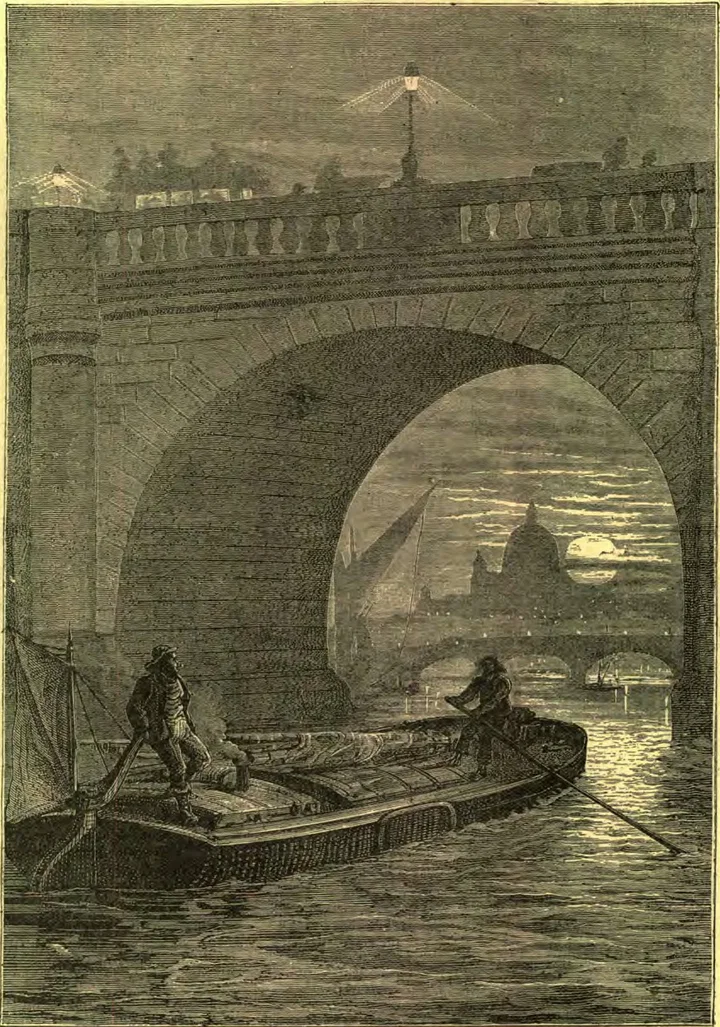
Our illustration shows a barge passing under Waterloo Bridge, which crosses the river from the great Waterloo Station of the London and Southwestern Railway to Victoria Embankment and the Strand. Farther down, Blackfriars Bridge can be seen; and a little farther to the left are the huge outlines of St. Paul's Cathedral, with the rising moon just behind it. There are ten bridges crossing the Thames in London, besides three tunnels,—two for railways, and one, now almost abandoned, for foot-passengers. Notwithstanding all these means of passing from one side of the river to the other, some of the bridges are crowded with an almost continuous line of vehicles during the day.
It can not now be told who first sailed up the Thames. Much of the local history of the river and its surroundings is lost in antiquity, English literature not dating back far enough to preserve a record of events that would be very interesting to us in this age. But we are told that Julius Cæsar visited London fifty years before the time of Christ; and since his time the stream has always been one of the greatest highways of humanity, constantly increasing in importance.
H. E. SIMKIN.