A few years ago, while myself and a companion were spending our vacation in the mountains of Oregon, we decided to make the acquaintance of the White River glacier. Some of our friends, attempting to dissuade us from our purpose, assured us that it was “only a gorge filled with ice,” and would in no way repay us for either the work or the danger attending a trip upon or across it. But we were determined to see it for ourselves; so we left camp early one morning with blankets, provisions, a life line, and a camera on our backs.
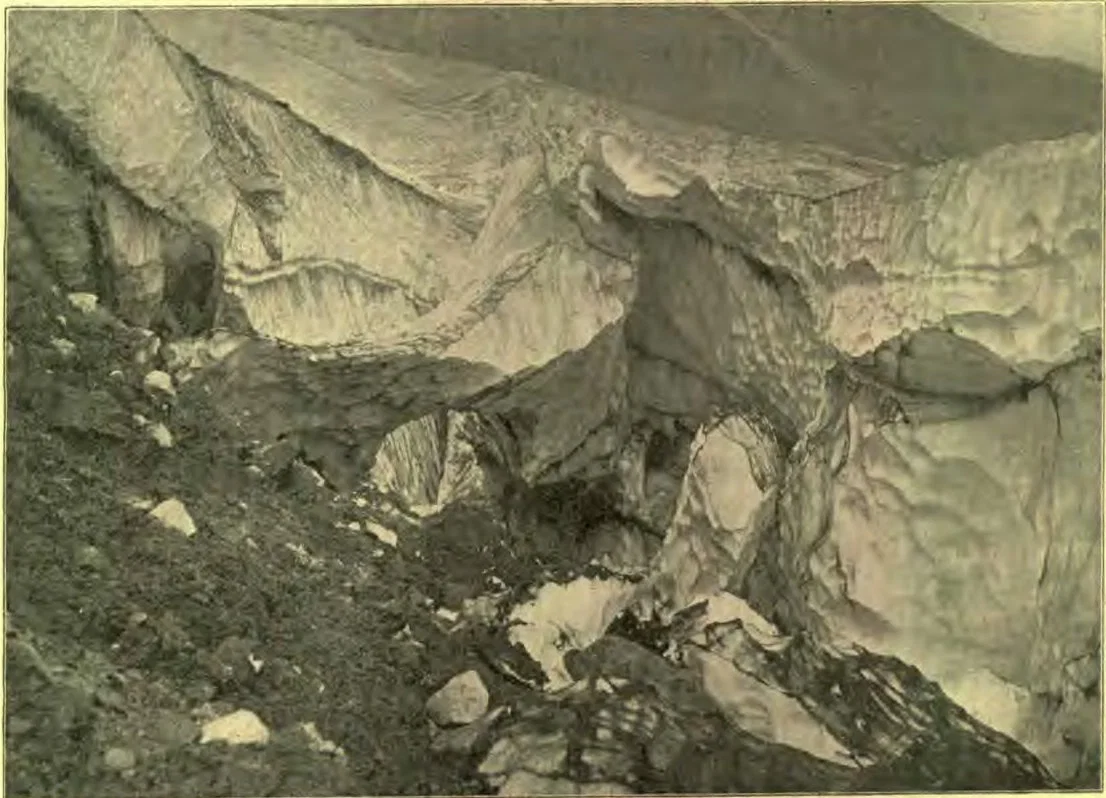
A BIT OF THE WHITE RIVER GLACIER.
That night we camped at timber line on Mt. Hood, within a mile of the glacier’s mouth. We were very tired from the long day’s tramp and the heavy packs we carried,—too tired to get supper or cut fir boughs for a bed; so we spread our blankets under a pine tree, where the earth was covered with two or three inches of dry pine needles, and went to bed hungry.
We slept too late next morning to see the sun rise; but when we did get up, we felt as fresh as if we had rested all the day before. My companion gave the mountain air credit for our wonderful refreshing; but I was inclined, from my experience at other times, to give the credit to going to bed with empty stomachs.
The day was before us, and the glacier near; so we took our time about getting breakfast, and then began leisurely to ascend the mountain. We climbed down one side and up the other of rocky cañons; waded through long stretches of sand; and scrambled over great boulders, which seemed to have been thrown into our path for no other purpose than to make progress difficult. Sometimes we would cross patches of snow that the late summer’s sun had not yet succeeded in melting. Then the walking was more easy.
About ten o’clock we reached the edge of the ravine in which the glacier flowed. In a moment the difficulties of the trip were forgotten in the admiration and awe inspired by the terrible, desolate grandeur of the scene that met our gaze. It was “only a gorge filled with ice;” but what a gorge! and what a mass of ice! From where we stood, the entire length of the glacier, as well as miles of the cañon below, could be plainly seen. At its head the glacier seemed little more than a stone’s throw in width, while at its mouth it was probably a quarter of a mile across. Its entire length was seamed and scarred in a wonderful manner. In some places the seams, or crevasses, as they are called, were so regular that they resembled the rolling waves of the sea. At other points great icebergs were thrown together in wild confusion. Sometimes one of these would fall with a terrible crash, followed by a low grumbling, grinding noise as the ice adjusted itself to the new position.
Years ago the glacier extended far below its present limits. Now the great ravine that it then cut out is empty, save for the turbid little White River, which bears away as water all the glacier’s ice. At its head one can readily vault across the White River, and it seems almost incredible that so much ice should yield so little water. But the motion of the glacier is so slow that it is measured in inches a month, while that of the river is reckoned in feet a second.
Where we stood, the sides of the ravine were too steep to make the descent to the surface of the ice practicable; so we followed the glacier about a mile up the mountain side until we found a more favorable place.
The photograph here reproduced shows a bit of the great ice river at the place where we reached it, and took our noonday lunch. At the edge of the glacier there is very little motion, so most of the peculiar formation here shown results from the melting of the ice.
After lunch we fastened the life line around our waists, and began to make our way out toward the middle of the glacier. The life line was about twenty feet long, and we walked far enough apart to keep it from touching the surface of the ice. As we were careful to avoid the most dangerous places, and take no unnecessary risks, it was not called into use; but had one of us lost his footing on a steep incline, or fallen into a crevasse, it might have been a life line indeed.
We spent several hours upon the glacier. Sometimes, as we crossed an ice-bridge, we would pause a moment to look into the dark and seemingly bottomless crevasse below. On the top the ice was as white as freshly fallen snow. A few inches below the surface, it was almost as clear as the natural or artificial product handled by the iceman. As the eye follows the walls of the crevasse downward, the ice assumes a greenish tint, which deepens until it is lost in the darkness below. When the direct rays of the sun creep into one of these crevasses, the walls sparkle and glisten like a great mass of emeralds, diamonds, and pearls. Such a sight (I saw several that day) always made me think of the foundation walls of the New Jerusalem, and wonder if the Creator had not left some of his great works that we might have a faint idea of the glory that awaits the faithful.
As we were leaving the glacier, we discovered an ice cave that led downward under the ice. We followed along the steep, rocky floor of the cave, toward the middle of the glacier, until we were in total darkness, and only gave up when our fingers became so numb from the terrible cold that we were no longer able to light matches to see our way. We had been in the cave only a few minutes, but nothing was ever more welcome to me than the sunlight and warm air that greeted us as we emerged from2its icy gloom. We were soon warm again, but how our fingers did tingle and burn!
Just before sunset we reached our temporary camp, tired, indeed, but feeling well repaid for our visit to the “gorge filled with ice.”