THERE are several species of the Trillium, but all have the same general appearance. The plant as well as the flower is built on the plan of threes; hence its name. There are three leaves on the stalk, forming a whorl, and in a number of the species the leaves are triple-veined. There is but one flower at the end of the flower-stalk, or, as botanists state it, the flower is terminal, solitary. The perianth, or floral envelope, consists of three green sepals and three petals. The color of the flower is usually white, sometimes marked with pink or crimson.
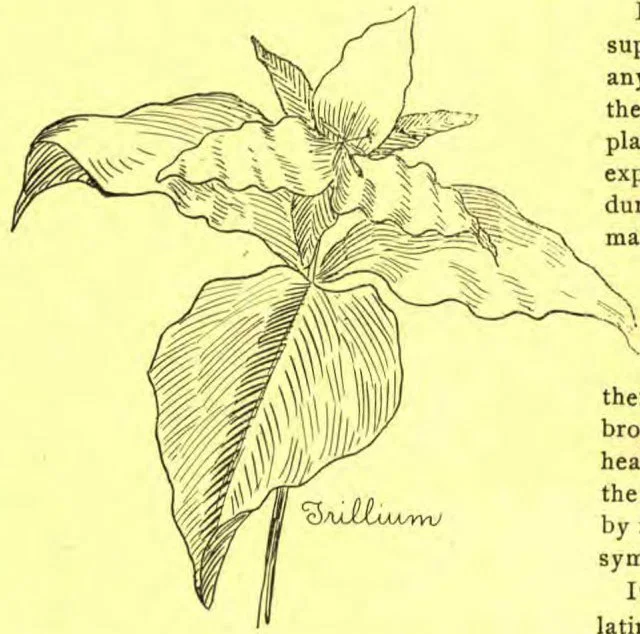
The largest and finest of the Trilliums is the Large White Trillium, or Trillium grandiflorum. It is of a beautiful waxy white, inclined toward pink as it grows older. It is almost invariably found in the woods. The leaves are quite broad.
The Painted Trillium is not so large as the preceding. The edges of the petals are very wavy, and there is a V-shaped crimson patch of color at the center of the flower. Schuyler Matthews recommends a study of this patch under the microscope.
The Trillium erectum is of a dull madder-red color. The leaves of this Trillium are netted-veined, while the two preceding are triple-veined. The Trilliums are poisonous to the taste. In all three there are six stamens, and one pistil with three divisions; thus we see that the plant rigidly adheres to the plan of threes—three leaves, three sepals, three petals, six (twice three) stamens, and a pistil with three divisions.
10 — Spring Beauty
One would hardly suppose that the little pink spring beauty is a kind of pusley, but so it is. The flowers are white or pink, veined with a deeper shade. The flower-stalk, bearing several blossoms2 grows from between two broad, grass-like, thick, dark-green leaves. The flower has five petals, two sepals, five stamens, and one pistil with a three-lobed style. If you will examine a rose, cherry, or plum blossom, you will notice that there are five petals and five sepals. But the spring beauty departs from this plan by having but two sepals back of its five petals. The flower closes in cloudy weather, and when it is picked; but in the latter case it will revive if placed in a tumbler of water, and set in the sunshine. L. A. REED.