6.—ECHINODERMATA.
We have now reached a division of the animal kingdom much more complicated in structure. Much as we have admired the skill of the tiny lime-builders in the formation of their beautiful shells, we must confess that the animal itself, like the amœba, is a frail and helpless being; and the first advance in the sponge is one rather of architecture than of individual existence. But in the lasso-thrower we begin to detect the rudiments of the senses and organs, which become more and more distinctly marked as we ascend the scale of life. The minute ears and eyes of the little jelly-bell enable it to appreciate, in a small degree, at least, the world around it, and to live a free and independent being.
In this division we have still further developments.
Here we find a tube-like digestive canal; they walk as well as swim; a sharp eye keeps a keen look-out on all things around; a battery of nerves and complicated muscles gives a more distinct individuality than any we have studied in the past.
This small division of life is commonly represented by four beings: The stone-lily, the starfish, the sea-urchin, and the sea-cucumber. These are representatives of families which also include some other smaller animals. They all develop from true eggs.
Only a few years ago four little jelly-bodies, we will imagine, were swimming about on the smooth waters of a quiet bay. They had each been hatched from the egg not long before, and were destined to become the four distinct animals enumerated above. At birth they were all very much alike, but each pursued a very different course of development.
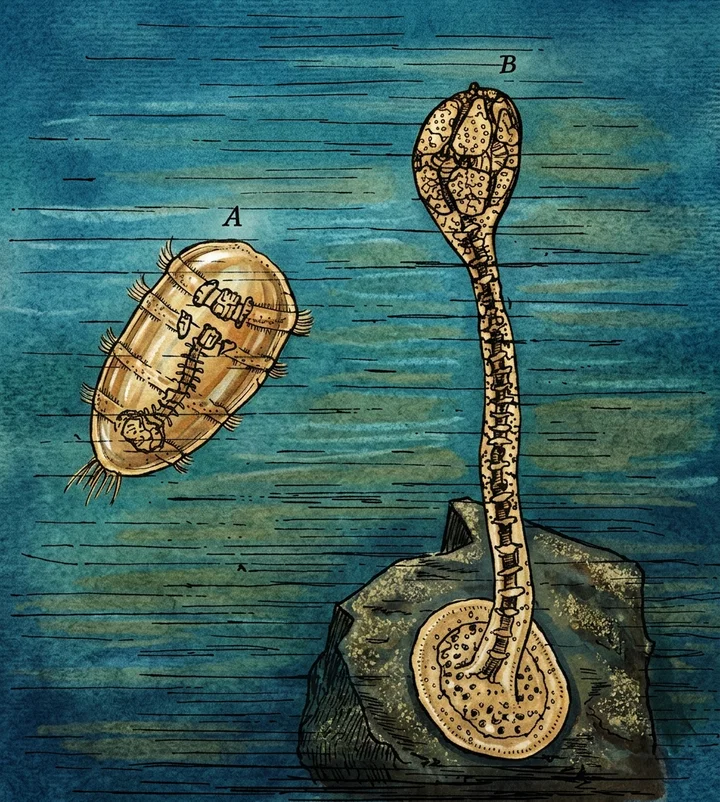
No. 1 had not swam about for many hours as a mere jelly-drop before lime-plates began to form in its tiny body, arranging themselves in the shape of a cup, and below these other and smaller plates took up the form of a stalk. After a time the jelly-body began to shrink together, and the whole sank to the bottom of the sea, where it was fastened to a rock by a stony lime-plate, and remained fixed, looking like a stony plant; hence its name,—stone-lily.
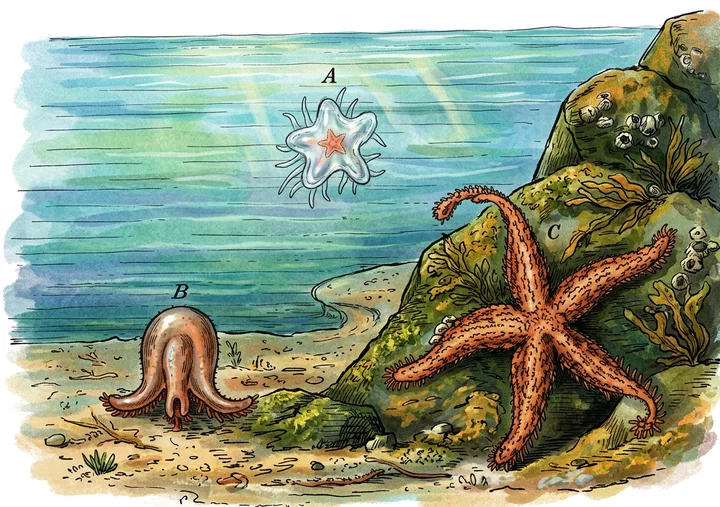
No. 2 followed much the same road for a short time, but soon took a number of curious shapes, and swam about briskly, while over his back was formed a net-work of lime, and a number of small, soft, transparent tubes grew under its body. After a time the whole sank to the bottom, swallowed its little jelly-body, and became a tiny yellow rosette with five knobs sticking out of it. The creature glided quickly over the rocks. It went on growing for two or three years, the five knobs lengthening into pointed rays, till it became the common five-fingered starfish.
No. 3 took a different path from the preceding. It had long, thin rods in its body, all pointing one way, so that it looked like a painter’s easel. At the top of the easel little plates of lime began to form a tiny round box with prickles all over it. By and by this box inclosed the jelly-body, leaving only a thin film over the shell; and sinking to the bottom, a tiny sea-urchin, it burrowed a hole for itself in the sand.
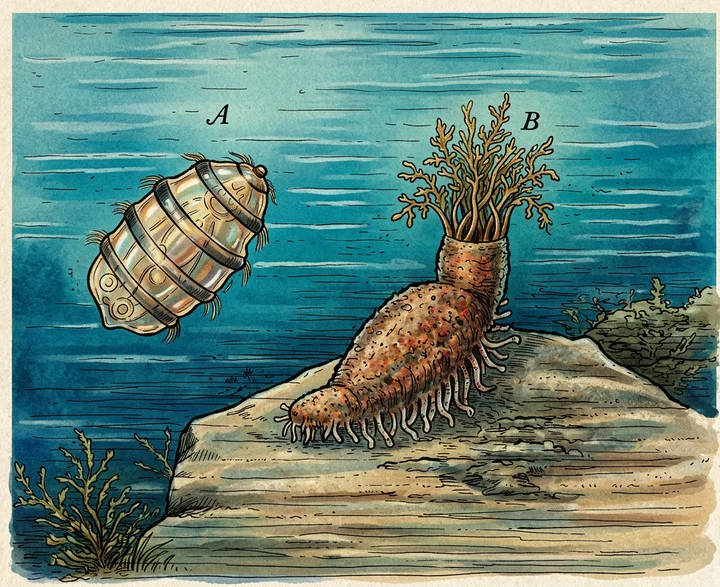
No. 4 formed nothing solid, but growing a stomach and feet, stretched itself out in the shape of a tube. Then it put out some leaf-like tentacles around its mouth, while a few little lime spikes formed in the skin. Sinking into a crack in a rock, it became the worm-like creature called the sea-cucumber.
Now we will study them from a different point of view. The stone-lily is now almost extinct, only one species yet remaining,—the Medusa’s head, so called from the many arms that wave about its summit, which bears some resemblance to the fabled head of Medusa with its burden of venomous serpents.
The preferred abode of the starfish is not in the water,—except to secure the proper amount of oxygen to breath,—but in the solid ground beneath. It can swim, although it is really a creeping animal, and loves to poke about on the sandy bottom with its mouth down to the ground, sucking up mussels and shell-fish for food. But how does it glide along so smoothly? If you were to examine the grooves under each of the five rays, you would see hundreds of tiny transparent tubes waving in the same direction. In this way the body is drawn along like a canopy resting on the heads of more than two thousand bearers.
The sea-urchin (Echinoidea), though not conspicuous for its beauty, leads a very interesting life. It walks by means of little tubes, like the starfish, aided by the tiny spines which cover its body. They have a kind of ball-and-socket joint, and rotate continually, which helps to propel the body. The animal looks like a hedgehog rolled up in a ball. But perhaps the most interesting thing about thep. 199 creature are the little snapping claws at the end of each spine. We would naturally think that these were to catch little animals for food, but this is not the case; they are to protect the body against the small animals which would otherwise get down between the spines, and feed on the soft parts. The sea-urchin is used as an article of food by the Italians.
We have now reached the fourth and last form of life in this division,—the sea-cucumber (Halathuroidea). This animal is not so helpless as it appears; for in its skin are strong muscles by which it can draw its body in and out of the crack in the rock where it hides, much as a worm crawls. The sea-cucumber is a greedy creature, and often eats too much. When it suffers from indigestion, it proceeds to disembowel itself by vomiting up its interior viscera, its stomach, and even its tentacles, which it casts away, so that there is literally nothing left but an empty tube. Having reduced itself to a mere sack, or skin, it cannot eat, because it has no stomach, and it cannot walk, because it has no means of locomotion. It therefore remains perfectly inactive for some months. At the expiration of this period the tentacles begin to grow anew, and in a few weeks the animal has regrown a new set of the important organs which it had cast away.
T. J. ALLEN.