Since last May we have been living on a farm at Avera, Raiatea, and have enjoyed our quiet country life among the hills. Raiatea is next to the largest island in the Society Group. Tahiti, which is the largest of the group, is one hundred and twenty miles from this place. For several years we have felt that we needed a farm, where some of our most promising young people might be given an all-round education, and prepared to work for the Master. Our whole object in getting this farm was to provide a place for a school of this kind. It is situated about six miles from Uturoa, the settlement, and a mile inland. We are surrounded with quiet, beautiful scenery, and the farm is just the kind of place the Spirit of prophecy says is best for our schools. Our nearest neighbor, who is a white man and a Sabbath-keeper, lives about a quarter of a mile away. Our native neighbors are still farther away, as they never go far from the beach to live.
When we bought the farm, there were no buildings on it. The house in which the previous owner had lived was burned during the war between the French and the natives, three years ago.
As there are about four thousand cocoanut trees on the place, and the principal use of the nut is for making copra, one of the first things to do was to build a copra-house. Perhaps all do not know that copra is the dried kernel of the cocoanut, and is the chief export of these islands. It is shipped to Europe and to the United States, where its oil is extracted, and used for manufacturing purposes. Brother Stringer came up from Tahiti to build the copra-house, and it was finished the first of the year. It is made with a drier, where the nuts are well dried with artificial heat from a furnace. We can also use the drier for fruit, corn, or anything of that kind, and have experimented in drying bananas with the best of success.
We make copra about once a month. During the month, as the ripe nuts fall from the trees, they are gathered in piles, and afterward hauled in a cart to the copra-shed. We seldom pick the nuts from the trees, but use only those that have fallen. Those who have seen a cocoanut tree, or the picture of one, know that it is not easy to climb; for it has a smooth trunk with no limbs, and the leaves and nuts are all together at the top. But as the nuts always fall soon after they become ripe, it is unnecessary to climb for the ripe ones.
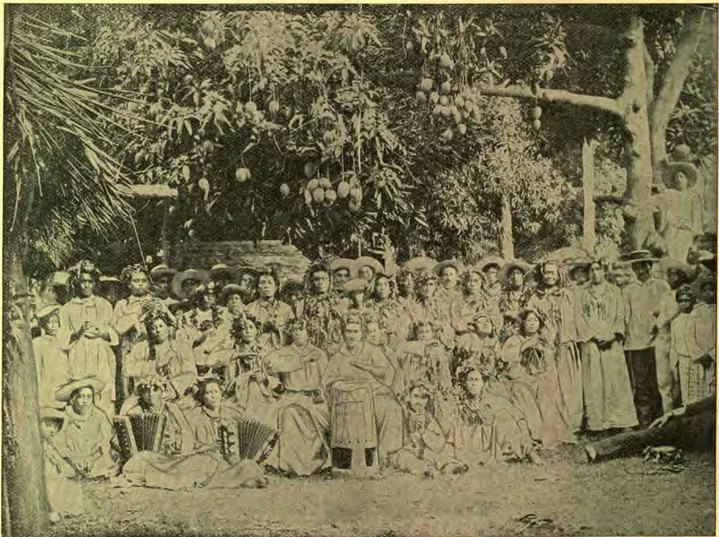
When the time comes to make copra, we have several workers dig the meat out of the nuts as they are cut. One or two men split the nuts open with an ax, while the others dig out the kernel with small iron instruments made for the purpose. We do not husk the nuts, as the meat is taken out anyway; but some husk them, then break the nut in halves, and dry the meat in the shell, removing it afterward. Some nuts are found that have lain so long on the ground that they have begun to grow. The hollow in the center of the nut, where the water was, is then filled with a white, spongy substance, which is very palatable. It is tender and juicy, and is delicious eaten just as it is when taken from the nut; it is also served in other ways by baking or boiling.
The meat that has been taken out of the nuts is carried in boxes to the drier, and spread on racks, where it is dried by the hot air from the furnace beneath. The fuel used for the fire is the husks of the cocoanuts. If the fire is kept burning day and night, the copra will be dry and ready for sale in forty-eight hours.
There is no more useful tree in the islands than the cocoanut, and we have found our trees a great help to us in more ways than one. The money that the copra brings in helps in making improvements on the place; and there are many other ways in which the nuts can be used. From the grated meat we make a sort of milk, which is rich in fat, and is an excellent substitute for cow's milk. Water can be added to thin it to the desired consistency; we use it like cream in shortening and flavoring all kinds of food, and believe it to be quite wholesome. When made thin like milk, it is insipid to drink as a beverage; but if prepared with little or no water, so that it is quite rich, it makes a good substitute for cream to eat with bread. If salted, it somewhat resembles butter in taste. In fact, its flavor is much more like good, fresh butter than is the rancid, canned butter that we get here in the stores. The butter used here is shipped in from the United States, New Zealand, and France, and of course is seldom fresh. Yet such strongly flavored grease is liked so well by the natives that when they can obtain it, they use it lavishly.
A fine oil is extracted from the meat of the cocoanut, which can be used for everything for which oil is required. The meat is also much used for feeding fowls and other domestic animals.
When the nut is still green, the meat is tender, and can be eaten with a spoon. It then has the appearance of, and a flavor somewhat resembling, the cooked white of egg. The inside of the nut is filled with sweet, clear water, which nearly every one enjoys drinking. As the nut matures, the water is absorbed by the growing kernel, so the ripe nut contains but little water, and that little is strong in flavor.
Cocoanut shells are used for making charcoal with which to heat flatirons. These ironsp. 114 are large, and have a cavity inside to hold the charcoal with which they are heated. This coal is kept burning during the ironing process, to keep the iron hot. As stoves are very scarce here, these irons are the best kind for the people.
A piece of the husk makes a good brush for washing vegetables, woodwork, and many other things. Ropes and door-mats are also made from the fiber of the husk.
I can not take time to tell all the ways in which the cocoanut is useful, but will tell you of some other native trees next time.
MRS. B. J. CADY.