There is probably no flower that blooms earlier than the skunk cabbage. I suppose the children will hardly care to call the peculiar blossom of this plant a flower, for it looks more like a huge curly leaf. This seeming leaf is called a “spathe,” and it envelops and shields the true flowers, which are within, and which are arranged on a fleshy club called a “spadix.”
The leafy spathe is shell-shaped, veined with purple. The real leaf is from one to three feet long, but appears later than the flower, and grows from a short root-stock. The leaves are clustered at the roots, and are almost as broad as they are long.
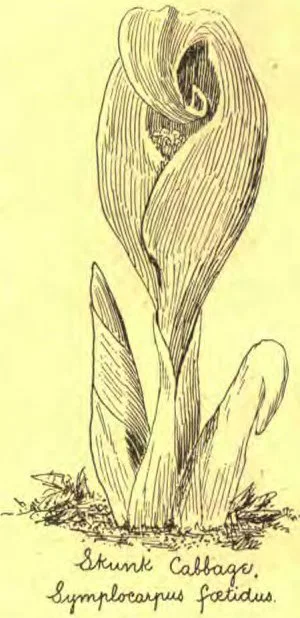
The early Swedish settlers near Philadelphia called the plant “bearweed.” Its peculiar odor has been termed a “skunk and garlic combination.” The children love to kick it over, as the odor is thus increased for the moment.
One would hardly suppose this plant to be a relative of Jack-in-the-pulpit and the beautiful white calla, but such is the case. Its green spadix corresponds to the arching pulpit of Jack, and to the white cup of the calla.
4—Arisaema Triphyllum, or Jack-in-the-Pulpit
“Jack-in-the-pulpit Preaches to-day Under the green trees Just over the way. Squirrel and song-sparrow High on their perch Hear the sweet lily-bells Ringing to church.
“Come hear what his reverence Rises to say In his low, painted pulpit This calm Sabbath day. Fair is the canopy Over him seen, Penciled by nature’s hand, Black, brown, and green. Green is his surplice, Green are his bands; In his queer little pulpit The little priest stands.”
We know that Jack-in-the-pulpit must be a strictly orthodox preacher. It is not every one who understands or cares to listen to his sermons. Some one says that his text is Cant. 2:11, 12: “Lo, the winter is past, the rain is over and gone; the flowers appear on the earth; the time of the singing of birds is come, and the voice of the dove is heard in our land.” But I am sure he sometimes takes his text from Matt. 6:30: “If God so clothe the grass of the field, which to-day is, and to-morrow is cast into the oven, shall he not much more clothe you, O ye of little faith?”
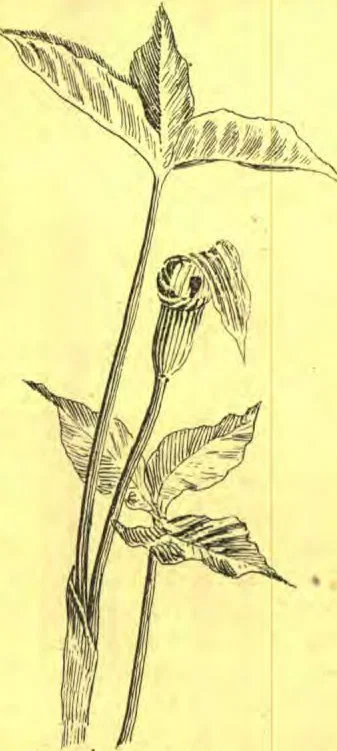
The plant grows from a corm, or solid, bulb-like root, which is turnip-shaped and filled with farinaceous matter. The root loses its acridity on being boiled; and as it was occasionally used as food by the Indians, it is sometimes called “Indian turnip.”
There are usually two leaves on long petioles, divided into three ovate, wavy, margined leaflets.
In time Jack loses his pulpit, and is changed into a thickset club, studded with brilliant red berries. L. A. REED.