The Latin Alphabet.
The ancients believed letters were invented by Cadmus, and that he taught them to the Greeks; but the Egyptian monuments have shown us that letters were not invented at all. We now know that before men used letters, they wrote by means of pictures, and that letters are, in fact, a sort of pictures; though those who use them long ago forgot this, and made them badly. Many people since the Greeks, and even some men of great learning, have supposed that certain letters, or kinds of letters, were invented by somebody; but this is not easy to believe; for though it is easy enough to invent new letters, it is almost impossible to get everybody to use them.
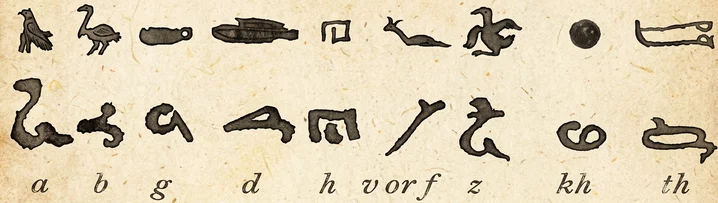
The pictures which were the Egyptian letters were not very artistic; they were rather stiff-looking—what an artist would call “conventional.” They were written upon different materials, but those that have come to us were mostly either carved on stone or written with a reed upon papyrus,—a kind of primitive paper. Those carved in stone were, of course, made slowly and carefully, as letters are that are cut on stone in these days; but those written on papyrus, being made more rapidly, and being also written with ink, were not likely to be so well shaped; and as one scribe copied after another, and not after the stone-cutters, the pictures became so very bad that they no longer looked like pictures at all. Indeed, they were not pictures, they were letters; for they no longer stood for things, but for words and sounds. A picture of a lute, for example, stood for the word “nefer” and also for the sound of n. Most of us have seen this done in rebuses, where the word “amen” may be represented by A and a picture of some men, though the second syllable of the word has no connection with the word “men.”
These Egyptian letters were learned by the Phenicians,—the people of Tyre and Sidon,—who were great traders, and were used by them in their business letters, and in notes, bills, and ledgers. The ships of Tyre went to every part of the Mediterranean, even to Spain and western Italy; and everywhere they traded, they left their letters behind them. This was the origin of the Greek alphabet.
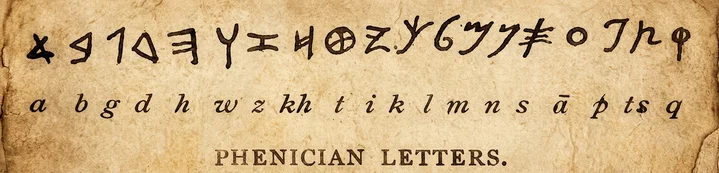
The earliest Greek writing we know is found on monuments. It is quite different from the writing on papyrus, or even from the Phenician letters; for the carefully cut forms and sharp angles have returned with the return to stone, though the pictures have not. The Greek letters look more than ever unlike the early picture-writing, and are rather geometrical, with squares, straight lines, and crosses.
Out of one of these Greek alphabets grew the Latin,—the alphabet we use to-day. The earliest Latin writing is much younger than the early Greek; it is, indeed, of about the same date as the Greek of classical literature,—the Greek that is read in schools. The early Latin letters are not very different from our ordinary capitals. There were no small letters till late in the Middle Ages.
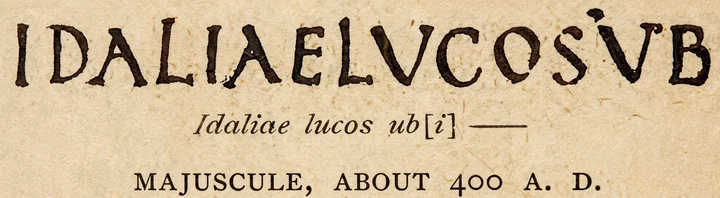
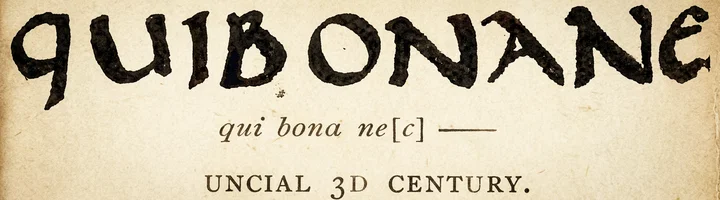
The old square capitals are called “majuscules,” and were copied directly from the monuments. This is why they have sharp corners and straight lines. In cutting or scratching on stone, it is easier and more natural to make straight lines than curves, easier to make angles than turns. But in writing with a pen or pencil, it is not at all easy to make straight lines; and the large, fine majuscule capitals soon began to give place to letters in which curves and turns took the place of straight lines and angles. This sort of writing was called uncial,—inch-long,—because the letters were still large, compared with those that followed.
All this is true only of book-letters, which were made carefully, and were often very beautiful, usually much more so than our letters printed from types. But for one book transcribed, hundreds of letters were written, and thousands of pages of notes, memoranda, accounts, and other such writings were made. These were seldom on parchment, generally on wooden tablets covered with a thin coat of wax. They were written hastily, as we write to-day, and the letters were made in the easiest way possible. This is called the “cursive,” or “running” hand. There was also another sort of writings,—records, deeds, mortgages, and the like,—that were copied somewhat carefully, by scribes, in what is called the “charter” hand.
It is natural for human beings to grow weary in well-doing. Good results of any sort cost labor and time. When excellence of a certain sort is much sought after, men will take pains to do their best in that way; but when interest dies out, effort flags, and poor work is the outcome. So it came about in the natural course of things that scribes began to imitate the cursive writing, which was so much easier than the old majuscule and the uncial; and a new style, small and round, became the common book-hand. From its smallness, this kind of writing was called “minuscule.”
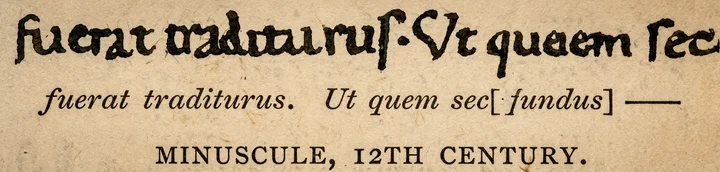
The scribes, who, in the Middle Ages, were invariably monks, took pains to make the first letter of a paragraph, a sentence, or an important word, plainer and more handsome than usual. The first letter of a chapter was made very beautiful with gold and colors, and many hours, or even days, were sometimes spent on a single initial. For these more carefully made letters the handsome majuscules were used. Thus it came to be the rule to use two styles of letter on the same page,—one for ordinary running work, and another, larger and finer, at the beginning of sentences and of certain kinds of words.
At about the time that the world became well settled in this custom, the invention of printing came, and froze the book-hands into type, so that further growth was prevented. Thus we still use the old majuscule letters at the beginning of sentences and of some words, and the newer minuscules in all other places.
The cursive style, however, went on developing, altered only by the growth of time and the change from reeds to goose-quills and from quills to pens of metal, and is now the only style of writing much used, because our books are all printed from types.
C. B. MORRILL.