THE YOSEMITE VALLEY

8%

S. D. A. Publishing Association · Battle Creek, Mich. · Feb 14, 1895

FromThe Youth’s Instructor, Vol. 43, No. 7.

Read the full edition

THE YOSEMITE VALLEY.

PART II.—THE FALLS.
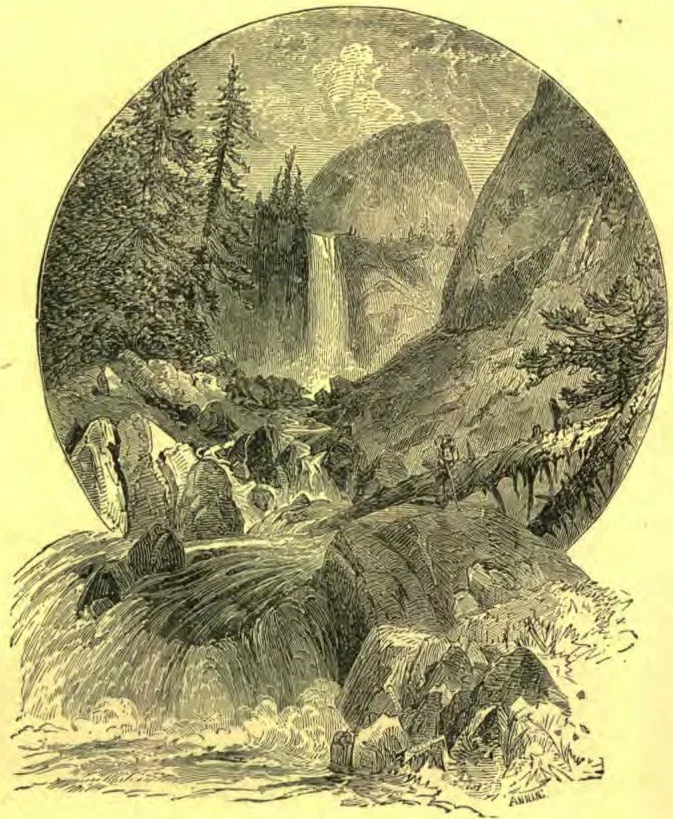
The highest waterfall in the world is the Yosemite Fall. The entire descent of this fall is two thousand five hundred and fifty feet. It is divided into three distinct divisions,—the upper, the middle, and the lower. The upper fall is a straight shoot of one thousand five hundred feet. The middle fall is a series of cascades descending about six hundred and twenty-six feet. The lower fall is a straight plunge of four hundred feet. At the beginning of the upper fall the river is about thirty-four feet wide. The water in its downward course catches the air in its fall, and then strikes a ledge of rock projecting from the mountain side. This produces an explosion, which sounds like peals of thunder, or heavy cannonading in the distance. Late in the season the river gets so low that tourists may go behind the upper fall with safety. A trail runs up to the top of the fall. It is a grand sight to go up to the end of this trail, and look down into the valley. Horses in the valley appear to be the size of sheep.
VERNAL FALLS.
VERNAL FALLS.
Bridal Vail is the first fall to greet the eyes of the tourist on entering the valley. The water here takes a plunge of six hundred feet, and is about forty feet wide at the top. There is a strong current of wind coming in from behind the fall, which strikes the foamy sheet of water, and makes overlapping folds in its downward course, thus causing it to resemble at a distance the soft, filmy folds of a vail. A beautiful rainbow may be seen in the spray of the fall about four o’clock in the afternoon.
The Sentinel Fall is on the same side of the valley as the Bridal Vail Fall—the south side. It takes its name from the Sentinel Rocks close by. Toward summer the stream that feeds this fall generally disappears.
The Ribbon Fall is on the north side of the valley, above Bridal Vail Fall. It has an almost vertical descent of two thousand feet, and then makes a further bouncing descent of over a thousand feet. Late in the season this fall nearly disappears.
The Royal Arch Fall is on the north side of the valley. The fall is fed by melting snows around the North Dome. It is a small stream flowing smoothly over an immense projecting rounded ledge of rock, and makes a fall of two thousand five hundred feet. This fall disappears early in summer.
The Nevada Fall has a descent of six hundred feet, and is at the head of the valley. There are water rockets that shoot out from the main body of water, and break near the bottom. Professor Whitney says that is the grandest waterfall in the world. Half way between the Vernal and the Nevada Fall is a bridge that crosses the river. Between the bridge and the Nevada Fall is the Diamond Cascade, so called because the water in its descent strikes huge rocks, and is thrown into the air, and breaks into crystal drops of various sizes.
Vernal Fall is about two miles below Nevada Fall, and is about eighty feet wide at the top. The Merced at this point falls about three hundred and fifty feet. Just before the water falls, the river expands, and bears the appropriate name of Emerald Pool. A little farther up the stream the river-bed is so smooth that the water presents a smooth surface for a short distance, and is given the name of Silver Apron.
Cascade Fall is at the extreme lower end of the valley, and is about five hundred feet high.
DOULY GRAY.