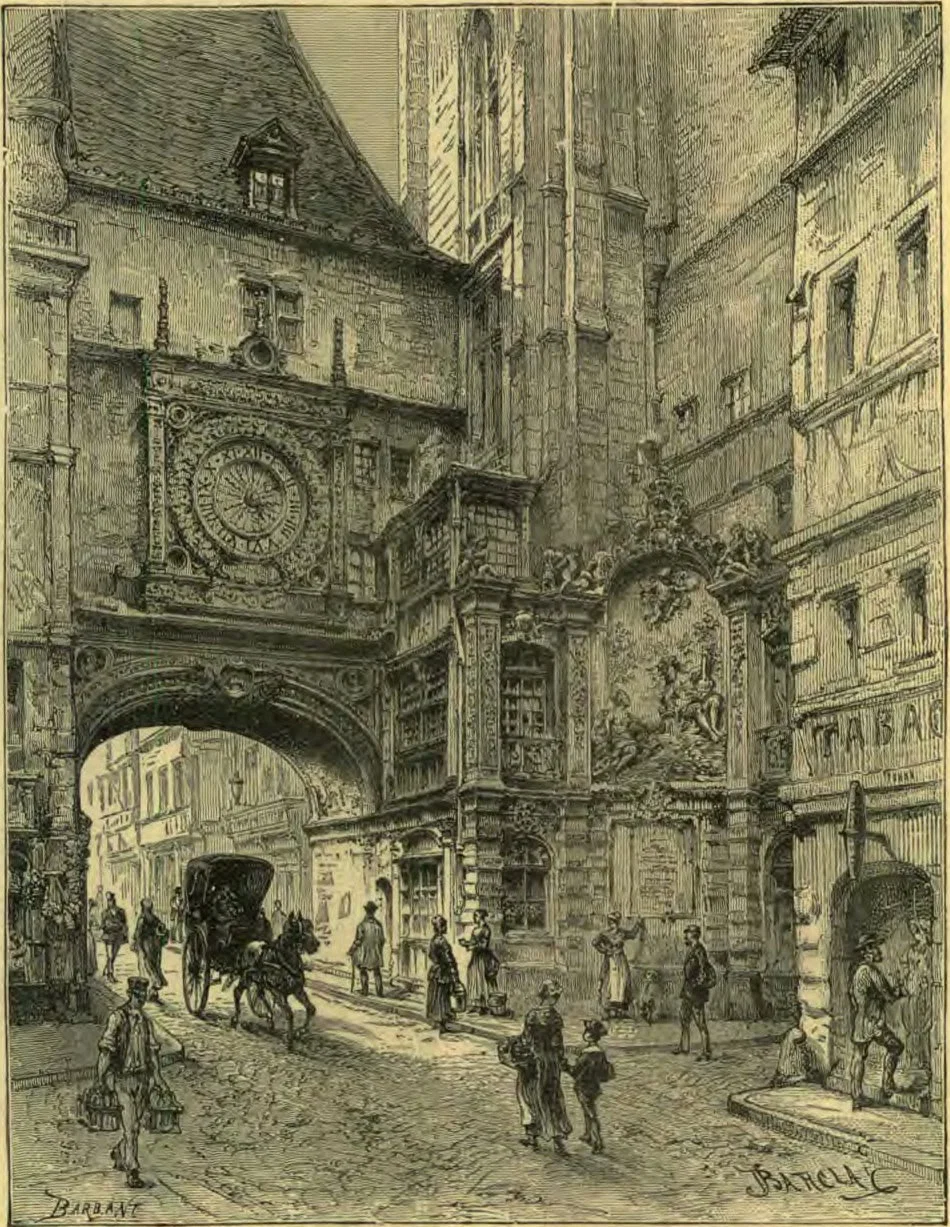
Before we come to speak of this marvel of skill and durability, we will cast a glance at the city and environments where this great curiosity is kept. Rouen, formerly Ratumakos (the Rotomagus of the Latins) is poetically located on the right bank of the Seine, eighty-four miles north-west of Paris, and fifty-six miles east-southeast of Havre. With its feet as it were in the waters of the river Seine, the main part stretches out upon the slope facing in the south, in full view of this beautiful stream, which describes right here most graceful curves, meandering through vast and ever-verdant meadows, and flowing gently downward until it reaches the sea. Rouen is a place of great antiquity, and existed before the conquest of Gaul by the Romans, who gave it the name Rotomagus. Viewed from the adjoining heights, no provincial town in all France presents a more magnificent aspect.
In the ninth century it was pillaged by the Normans, who made it their capital. After the Norman Conquest, it long continued in the possession of the English, who finally lost it in 1449, just eighteen years after the inhuman sacrifice of Joan of Arc, or the Maid of Orleans. Its extensive manufacturing industries make Rouen the Manchester of France.
Its cathedral is a vast and imposing structure, with its front flanked by two lofty towers, and almost covered with images and sculptures. Its interior is four hundred and thirty-five feet long, one hundred and four feet broad, and eighty-nine and one-half feet high. The choir50has on its pavement small lozenge-shaped tablets of marble, marking the spots where the heart of Richard Coeur-de-Lion (the lion-hearted) and the bodies of his brother Henry and his uncle Geoffroy Plantagenet were interred. There are other public buildings of vast dimensions, such as the archbishop’s palace, the court-house, etc., etc. In the Place de la Pucelle is a monument erected to the Maid of Orleans, on the spot where the heroine was committed to the flames at the age of twenty, May 31, 1431, amidst the clamors of assembled thousands before whom she was quickly consumed to ashes, dying with the name of Jesus upon her lips. Corneille, Fontenelle, and other eminent men were born in this city.
Rouen has several suburbs, of which St. Sever, on the left bank of the Seine, is the most extensive, being largely composed of manufacturing establishments and smelting works whose lofty chimneys seem to wish to rival the towers, pyramids, and steeples on the opposite bank, where, surmounting the altitude of the somber cathedral, we see the singular spectacle of a railroad toward the sky. A series of lovely hills in the immediate environments hang like a grand necklace as it were about the city and its annexes of suburbs and villages. Up the stream, on the left, as we face the east, are the picturesque yet pointed, high, and menacing rocks of St. Catherine, running out to the very border of the Seine; on these borders the valley of Darnetal, enriched by two little water-courses. In the west, and as it were a side-piece to this valley, lies the charming vale of Bapaume, aggrandizing the Seine with the waters of its brilliant and large river.
All these waters, be it as fertilizers, as sources of motive power, or as in the case of the Seine itself, as a maritime highway, compose in a large measure the hidden means whence grew the wealth and prosperity of Rouen for many generations. During the last century its growth has been no less marked. Its population—largely of ancient Norman stock—according to the census of 1891 was one hundred and twelve thousand three hundred and fifty-two; but no doubt the actual population now is considerably more. But to come to its clock.
This masterly mechanism is said to be the most ancient if not also the most beautiful in the world. For the last five hundred years it has been in service, never once stopping or in any way getting out of order, some trifling repairs excepted. It is the work of a skilful native artist, Jehan de Felins, whose history has been preserved to us through the thoughtfulness of another, a skilled watchmaker, M. Hainaut, of the same city.
Although the latter may have been equally skilful, and was surely more learned and advanced in his art, the time-piece of Jehan de Felins is none the less a marvel of solid and delicate workmanship. During five centuries it has not undergone more than one single modification, which was a compensation pendulum, attached more than a century after Galileo discovered the isochronism of the same. This improvement was not introduced until the year 1712, but it did not involve any other change in the ancient mechanism. One single part only has suffered, and this is the rope chain connecting the hands with that portion of the wheelwork which causes the former to move on the dial. But this rope chain was not the work of Jehan de Felins; it belongs to a much later epoch.
“This clock,” says M. Hainaut, “does not seem to become worn out in any way. It runs uninterruptedly, when all the rest from the same period of time are no more.”
THE GREAT CLOCK IN ROUEN.
What sad and what glorious hours did this clock chronicle! Its imposing wheelworks had revolved about forty-two years when Joan of Arc was burned at the stake, for which shameful deed its hands, alas, may have given the signal.
Some few of its wheels are more than a meter (39.36 inches) in diameter. They are of brilliant steel, and highly polished in places. M. Hainaut thinks that in spite of its great age it is very likely yet to survive the greater part of modern clocks.
The authentic history of this time-piece is known to-day down to the most wearisome details, and a list is kept of those watchmakers who successively had the care of it, from the inventor, Jehan de Felins, down to the present actual keeper, covering about twenty names in all.
This Jehan or Jean (John) de Felins is undoubtedly not to be compared for either skill or scientific attainments with the manufacturers of chronometers and other instruments of precision, in our own time; but he shows us what one may achieve even though deprived of extensive knowledge or unusual advantages, by working thoughtfully, thoroughly, and perseveringly. For this clock, which is altogether in primitive style, has now been running over five hundred years with precision and without showing any wear of the machinery whatever. Its wheelwork still looks new, and might yet run a number of centuries more, and that, as Mr. Hainaut says, “in such a way that this, the most ancient tower clock in all France, will also be found to be the youngest and the most durable as to service, even after having existed so long already.”
In closing we may add that the watchmaker Lepaute (1709-1789), who has posed before the world as the first inventor of horizontal time-pieces, is simply deceived; for Jehan de Felins had practically carried out the same principle more than four hundred years previously.