HORTICULTURISTS have abundant reason to feel a lively interest in the great Pan-American Exposition to be held in Buffalo in 1901. In the embellishment of the grounds the architects have planned to use trees and shrubs, foliage and flowering plants, in quantity to dazzle the lovers of fine horticultural displays. The extensive area of the Exposition grounds affords abundant room for the elaborate display of color that is contemplated. There are nearly three hundred and fifty acres in the Exposition site, of which about one third are the improved lands of Buffalo’s beautiful Delaware Park. Upon the park lands many thousands of dollars have been expended from year to year in maintaining and improving the variety of rare shrubs and trees.
Lying directly north of the park lands and upon a higher elevation, is the remainder of the Exposition plot. Included in the plan for the arrangement of the buildings is a magnificent court three thousand feet long, with a transverse court one thousand seven hundred feet from east to west, besides subordinate courts. All these open spaces are to be beautified with palms and other tropical plants in tubs and vases placed near the surrounding buildings and beside the fountains and pools. To these will be added formal flower beds, and sunken gardens of elaborate arrangement, wherever their presence will enhance the beauty of the courts.
The water features of the Exposition include a Grand Canal more than one mile in length, which completely encircles the main group of buildings. Lagoons with sodded banks and shaded with a variety of trees, shoot off from the main canal at various points, and add their beauty to the landscape effect. The entire outer wall of the Exposition grounds is to be a bank of solid foliage. Many thousands of trees, shrubs, and cuttings have already been planted, in preparation for the elaborate horticultural features. Large trees, which fortunately were already upon the Exposition site, have been preserved by transference to places where their stately shafts of green would heighten the color effect in contrast with the brighter hues of the buildings.
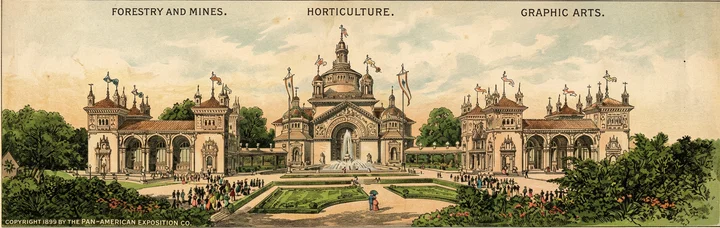
The building to be devoted to the Department of Horticulture, of which Mr. F. W. Taylor is chief, is two hundred and twenty feet square. It has two arcaded wings sweeping from the north and south façades to the eastward and connecting with other buildings to form a semicircular court. West of these arcades are the conservatories, in which will be displayed the palms and other plants of tropical origin. The arcades leading from the main building will be kept gay the entire season with flowering and ornamental plants. The large building will be used for the display of fruits and various other exhibits pertaining to horticulture.
The exhibits to be made by the leading florists of the United States will be situated south of the Horticultural Building. To these displays some six or seven acres of land will be devoted. William Scott of Buffalo, a prominent florist and well-known contributor to literature upon flowers, will have charge of the floral exhibits. Several prominent horticulturists have already entered for the competition of 1901. In these displays there will be over five hundred beds in which will be shown every popular flower known, from the low-growing verbena to the stately dahlia and hollyhock. There will be numerous specimens of the summer climbers, conspicuous among which will be the new varieties of the gorgeous clematis.
The water gardens, of which there will be a number in various parts of the grounds, will be important and attractive features, and will include in their displays, besides the mammoth Victoria Regia of the Amazon and the Nilumbiums of the Nile, many Nymphæas never before exhibited. When at their best, there will be special exhibitions of roses, dahlias, gladioli, sweet peas, chrysanthemums, and other popular flowers. Exhibits from all the large growers of the country are assured.
Horticulture has made wonderful strides within a very few years, and many of the floral specimens that will be seen at the Pan-American Exposition were not in existence at the time of the World’s Fair at Chicago. The displays of the now popular canna will surpass anything yet seen either in America or Europe. One may therefore confidently expect this Exposition to be, from the view-point of the horticulturist, the most brilliant ever held.
MARK BENNITT.