Probably all our readers know that the Koran is the sacred book of the Mohammedans. It fills very much the same place with them that the Bible does with us. I do not mean to say that it is capable of giving its followers the true joy and peace that the word of God gives to the Christian; but it is all they have.
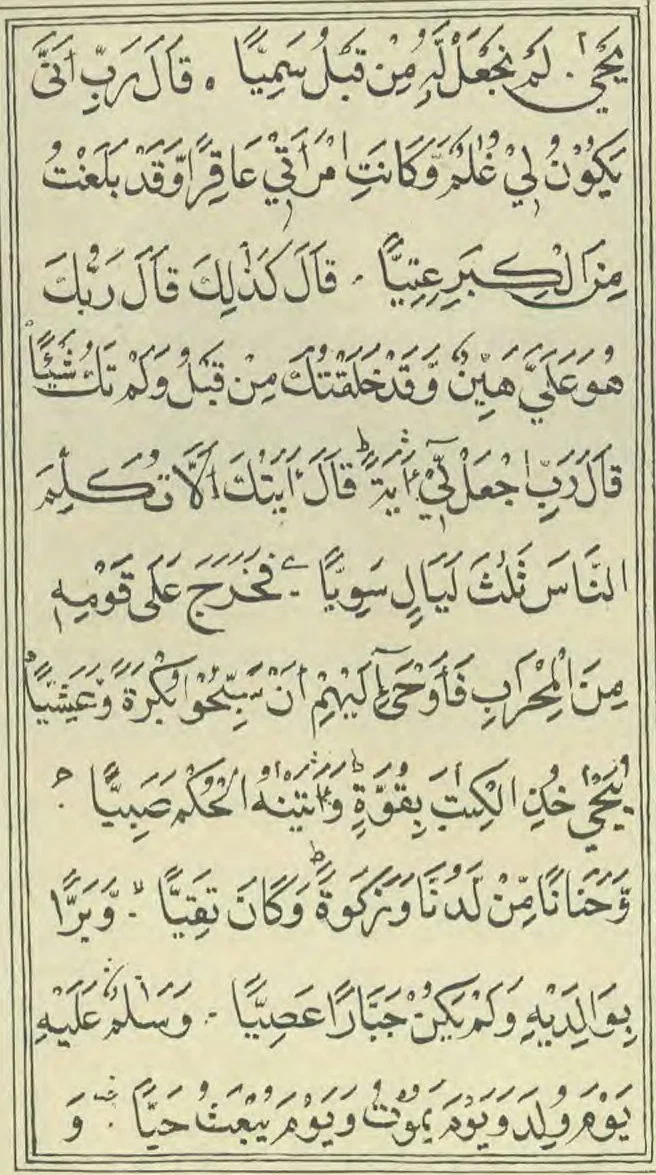
We give you here a picture of a single leaf of this book, whose followers are numbered by the million, written in the native tongue of the Mohammedan.
At the World's Fair in Chicago, the writer saw a large, thick-set, black-eyed, bronze-complexioned man behind a stall, where he kept for sale all sorts of curios from his own far-distant India. Among the rest, he offered some leaves of peculiar-looking paper, which appeared yellow with age, covered all over with strange characters in ink,—red and black,—a representation of which you see in the picture.
These little fragments he was parceling out for five cents a leaf to the “heathen infidels,” as all good Mohammedans believe those to be who are not followers of Mohammed. On one side he had written his name, “Pundet Golend Purshad; Priest; Delhi, India.”
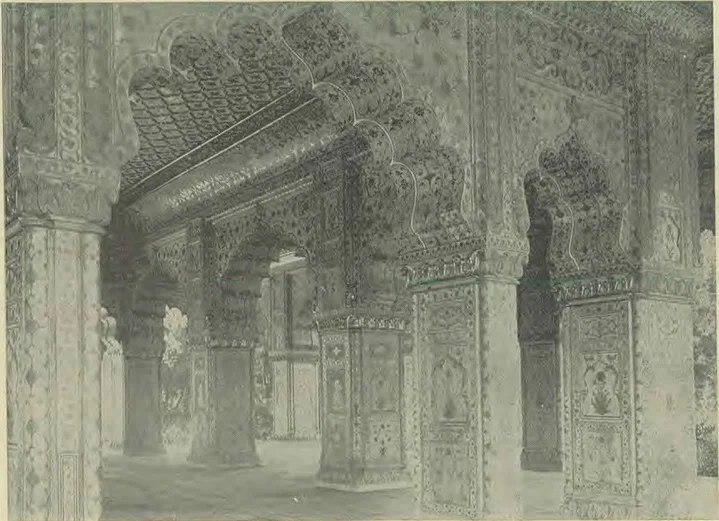
It is in the city of Delhi that the great palace of Shah Jehan stands. This palace is famous for its wonderful inlaid work and delicate carving. In the audience-hall of this building the visitorp. 222 silver, and scarlet. In the middle of this grand room stood a marble platform, now moved to one side, which supported the famous peacock throne. It was called thus because it represented the spread tail of that fowl. Its cost is said to have been nearly thirty million dollars. Of course it disappeared long ago, and the buildings themselves have been marred by robbing them of their most precious gems. . . .
“The Hall of Judgment, though of grander proportions and conception than any of the others, is of baser material, being made of brown stone inlaid with marble. But it contains the emperor's seat of judgment, constructed of beautiful marble in the form of a pavilion, with the floor raised ten feet. Before his majesty sat the prime minister upon a marble seat; he received sentence from the emperor, and conveyed it to the accused. In those days it was regarded a slight thing to sacrifice life.”
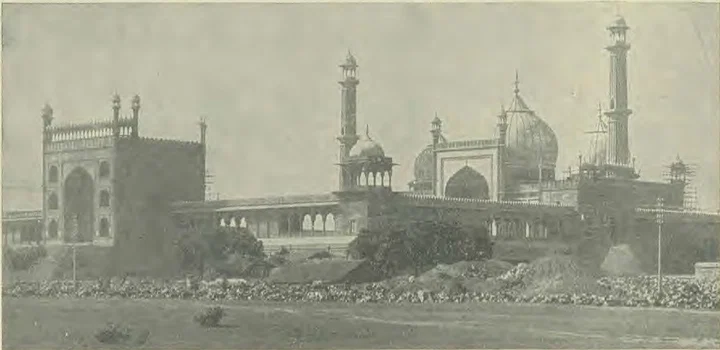
In the same book is given also a brief description of the famous Pearl Mosque situated at Delhi, as follows: “The Moti Musjid, or Pearl Mosque, built for the emperor's own use, is a veritable pearl of pure marble. It received its name on account of its costly carpet inwrought with pearls. For the use of the common people the emperor built outside the Fort the Jumna Musjid, or Great Mosque, which will accommodate many thousands of worshipers. Its floor is reached by forty steps from the street, the lower ones being one hundred and fifty feet long. This building is mostly of sandstone, but the floor of the court is composed of black and white marble. In a cloister a priest keeps charge of some precious relics, which he shows for backsheesh. Among them are writings by Mohammed's son and grandson, over twelve hundred years old. He has an old shoe of the prophet, a footprint in stone, and a hair from his beard.”
In Delhi, also, stands a massive pillar, called the “Minar,” which was erected in the nineteenth century. This is two hundred and thirty-eight feet high, and its stairway, which winds to the top, is draped with inscriptions from the Koran. This book contains one hundred and fourteen chapters, called suras. The word “koran” means to read, or the book to be read. In some respects we may learn lessons from its followers. Their reverence for this volume is so great that they never allow themselves to carry or to hold it below the girdle, and they will not even touch it unless purified for the occasion. A zealous Mohammedan is, in fact, very much pained to see a copy of his sacred book in the hands of an unbeliever.
However, in this, they would do well to learn a lesson from the Christian, who finds his greatest delight and pleasure in placing God's blessed book in the hands of as many of his fellow men as possible. He reasons truthfully that the lower down man is in the moral scale, the more he needs the blessed gospel to uplift him, and teach him the truth as it is in Jesus.p. 223
The Koran teaches that there is “one God, and Mohammed is his prophet;” that Jesus Christ and Moses had the same mission; that is, that they both were teachers and prophets, but that Mohammed was the equal or the superior of both.
Thus you see the beautiful doctrine of the atonement taught in the precious Bible is made of no account. How thankful we should be that we know the truth, that there is “no other name” under heaven whereby we must be saved, but the blessed name of Jesus.
As I saw this man eagerly trying to sell a few leaves of the Koran to the people who could not read one word of it, for the paltry consideration of a few pennies, I thought of the contrast between this man and a love-inspired missionary of Jesus Christ. The former, for the sake of receiving a little of the wealth that perisheth, was peddling out minute portions of that book which a true Mohammedan believes to be the direct revelation of God, but which was entirely valueless to any who is unacquainted with the language in which it is transcribed; but the latter—the Christian—considers it his highest joy to go to far-off countries, often at the peril of his life, and there spend weary years, far from home and loved ones, with only the one hope before him,—the hope of inducing the people to read the blessed book that he has carefully prepared for them in their own tongue, so that their lives may be influenced by it, and that they may become true followers of the meek and lowly Saviour of sinners. Ah, there is no gospel like the gospel of Christ's love. It will warm the coldest nature; it will break and subdue the hardest heart. There is nothing like the cross of Calvary to uplift fallen humanity, to take inherent selfishness out of the heart of man, and to place therein the seeds of purity and love.
Let us thank God every moment that instead of the Koran of the Mohammedan, we have the Bible of the Christian, which opens up for all mankind a pathway of grace and mercy,—a pathway to the shining skies.
MRS. L. D. AVERY-STUTTLE.