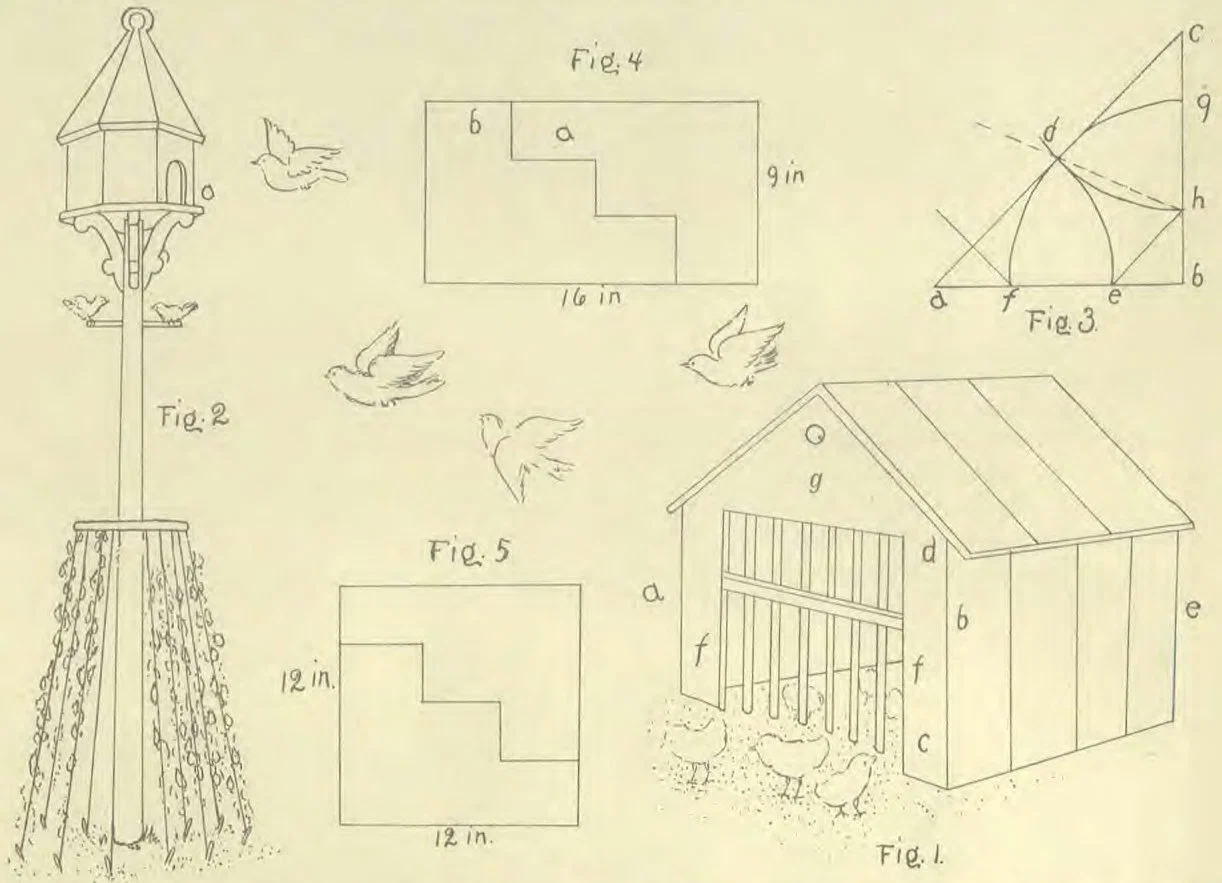
Well, boys, in our illustrations this week you will see a dove-cote and a chicken-coop. It is well to provide suitable homes for our feathered friends. The coop illustrated by Fig. 1 makes a comfortable abode for the chicks. In this coop is no floor. The measurements are: from a to b twenty-four inches; from b to e, across the sides, twenty-four inches; and from c to d twelve inches. The roof is what we call a half-pitch roof; that is, it is just as much higher in the center above the sides as one half the width, or twelve inches. The sideboards on the front, marked f, should be two inches and a half wide. Put a board across the top, as seen at g, and bore four holes in it for ventilation. In the back side of the coop make four similar holes, and put in a door about seven inches wide and eight inches high, through which the hen may be let in and out.
Across the opening in front, and about five inches below the board marked g, put a stick seven eighths of an inch by one and three-fourths inches. Bore six holes three fourths of an inch in diameter in this stick, and put in six round sticks, letting them run down to within an inch of the ground. This will make a neat coop.
In Fig. 2 you will see a dove-cote. I love to have some place for the birds; for they are great favorites of mine. I never shot one in my life. I have often thought what a happy day it will be when, with the curse removed, we shall hear the little immortal songsters warble their praises in the new earth.
To make the dove-cote here shown, you will need a pole sixteen feet long, and three or four inches in diameter at the lower end. If you will burn the lower end of the pole in a fire so that it will be a coal on the outside where it goes into the ground, it will last a good deal longer. I have some three-by-four-inch scantling posts that I served in this way, and set them out for grapevine trellises twenty-three years ago, and they are good yet. Shave your pole smooth, and nail on to the top of it a board about two inches larger than the cote will be. Saw out some brackets, and put under the board. About half-way up233the pole bore two holes, and put two round sticks through, as shown. Nail a nice barrel hoop on to the ends of these, drive some little stakes into the ground, and run some strings up to the hoop, for morning glories.
The floor of the house is octagonal. Fig. 3 shows a simple way of laying out an octagon of whatever size you may wish. Make the lines a b c of equal lengths and a right angle. Draw a line from a to c. Set one point of your compasses at a, and the other on the line a c at d. Then strike the circle down to e. Put the compass point at c, and strike down to h. A line from h to e will give you one section of the octagon.
For the sides get out eight boards six inches wide and about nine inches high. In one board cut a hole about four inches wide and six inches high, for an entrance (see a, Fig. 2). The edges of the boards should be beveled. Set your bevel on the line e h d (see Fig. 3) to get the right bevel. Nail the sides to the octagon bottom. You will need to put two screws through this bottom, to hold it to the board nailed on top of the post, as you could not nail the house on after it was made.
For the roof get out eight pieces about ten inches long and six inches and a half wide at the lower end. Taper them to a point, and nail them on, as shown in Fig. 2. These boards will need to be made narrower on the under side, to let them come together tight upon the upper side. Put a ball upon the top, and the cote will be complete when it is nicely painted. In Figs. 4 and 5 you have an answer to the last puzzle given you. The board twelve by twelve inches and the other nine by sixteen inches each contains one hundred and forty-four square inches. Cut the plank as marked in Fig. 4, and place a over b; you will then have Fig. 5. W. K. Loughborough.