The class is marched down the center of the room in twos, then one each way. As they come round to the center, instead of turning to come down to the teacher, they pass on around the room, “weaving” in and out by clasping hands in this way: the ones who lead the lines, clasp right hands first; then they pass on to the next person, clasping left hands. The third persons clasp right hands; the fourth, left hands; and so on until the last person is reached, when the lines will have crossed each other. They can then march around the room until they meet, and the same exercise may again be taken. It is necessary to take short steps, and have plenty of room between the pupils. The special benefit to be derived from this exercise is chiefly in the alertness necessary to keep the line intact, and to act on the moment the individual part required. It is not easy to have this done accurately without considerable practise. When the teacher wishes to abandon this exercise, as the lines meet, she orders, “Down the center, two abreast!” or “Down the center, single file!”
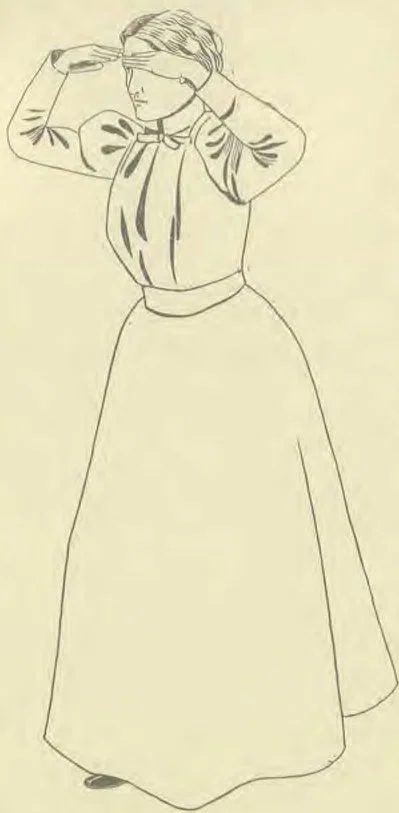
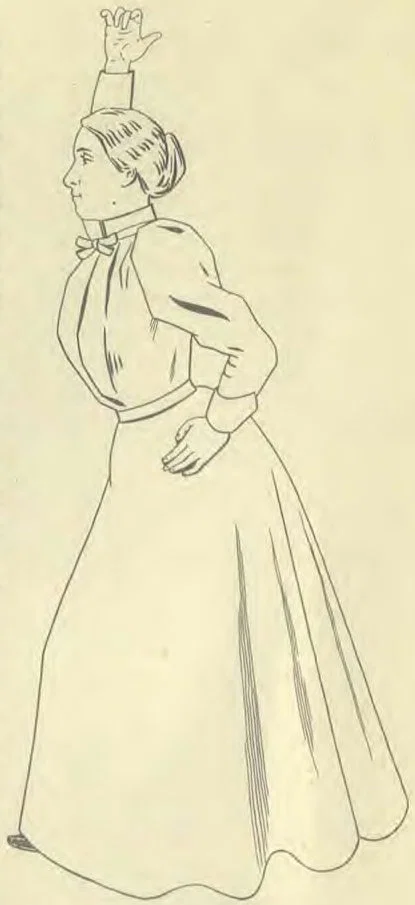
For “statuary walk,” class should be in single file; music, very slow march. Class take position with right foot forward and body inclined well forward, but trunk erect, left hand on hip, right hand as shown in the accompanying cut—this on count “one—and.” On next count, order, “two—and;” the body is erect, with hands at side. These orders should be given very slowly that there may be time for the body to be poised like statuary, allowing the exercise of muscular control to be manifest. It will be noticed that those who do not have this control, will “wabble” about, unable to hold the body in the attitude described. This movement should be taken with the right foot forward, and right arm poised overhead, for several steps, or until the class has marched around the room once or twice. Then order, “Change hands and feet! one—and—two—and!” etc. Then the exercise is the same, except the change of left foot forward, and left hand poised over head, and right hand on hip. The third order for the statuary march is, “Right foot forward! Both hands up!” as in the illustration. Care should be taken to be easy in these movements, avoiding strain or stiffness, and to pay attention to the time. The teacher can assistp. 234 the pupils in keeping time, by sharp spats of the hands, accenting each count. After marching with the right foot forward, change is made to the left, position of hands the same. The teacher should insist upon perfect symmetry of line in this class work, as, when properly taken, this exercise is not only a beautiful one, but is beneficial in many ways.
The “clasp-hand march” is a simple figure, but may be introduced by way of variety and also because of some beneficial movements in its execution. Class marches around the room in twos. On reaching the “rear center” of the room (room diagram will explain this term), the order is given, “Down the center, two abreast!” On reaching the teacher, she orders, “One each way!” As class marches around to “rear center” again, instead of coming close together in twos, the lines turn, on the order, “Down center! clasp hands! pull!” and come down the room about five feet apart, or allowing space enough in which to clasp hands and pull apart as they march down the center of the room. Care should be taken to keep the lines straight, and each should pull hard, but not enough to break the symmetry of the lines. On reaching the teacher, she orders, “Hands drop! One each way! march close to rear!” Each line turns back, marching close to the pupils in line, the leader of the left line turning to the left, and the leader of the right line turning to the right, both lines marching back, and meeting at “rear center.” They now clasp hands and pull apart, marching down the center again. Instead of marching back as before, the order is, “One each way, diagonally to rear!” The leader of the right line turns sharply to the right, with the eye on the corner of the room, diagonally opposite; and the leader of the left line turns to the left, marching diagonally to the rear, each leader then turning about, facing each other, marching on until meeting, when the leaders clasp hands, as follows (the others doing likewise as they meet in couples): the leader of the left line, with the right hand clasps the left hand of the leader of the right line, holding their hands straight up as far as possible, while the other hands are clasped loosely in front. Thus they march down the center of the room, as the order is given, “Down center, together! clasp hands! upward thrust!” The figure can be repeated if desired. Then order, “Single file! fall in!”
MRS. M. D. McKEE.