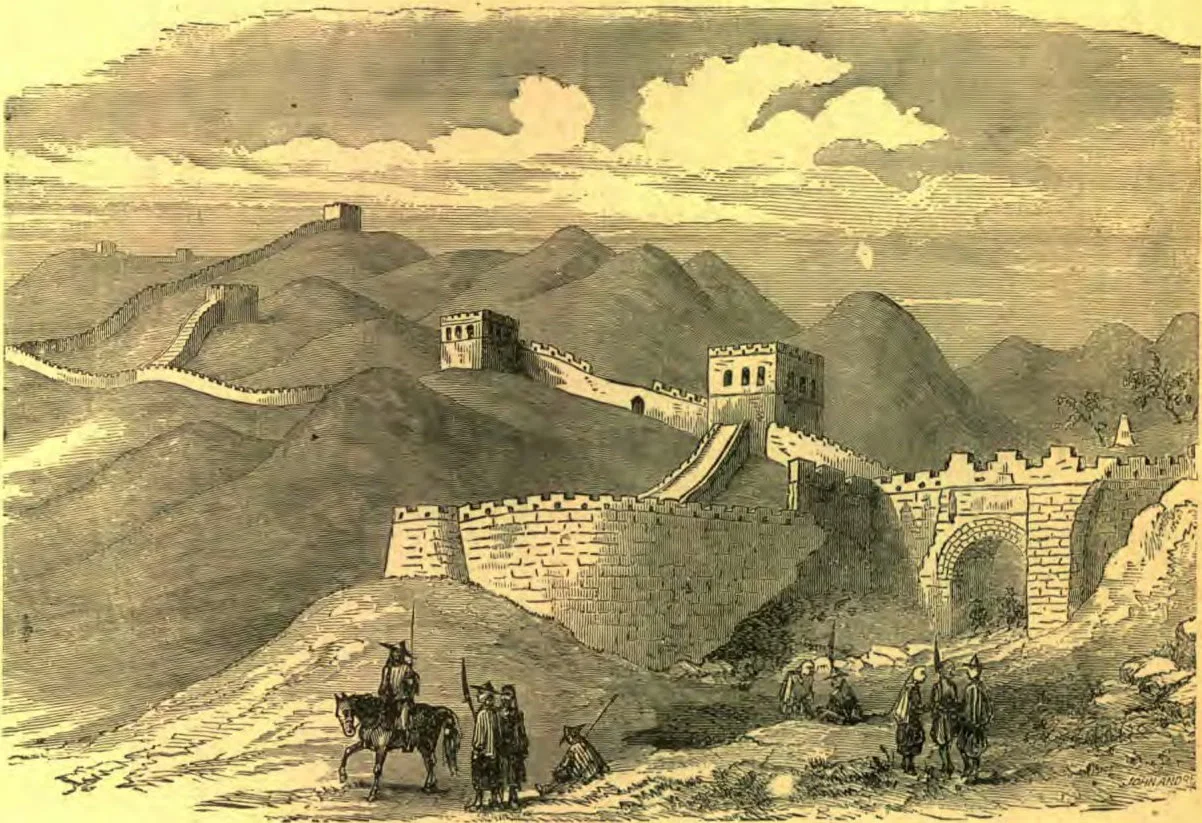
WHILE the present experiences of China in its war with Japan place its people in a not at all enviable light before the world, it is due to them to recognize their natural love of peace as well as their habits of perseverance and industry, which have characterized them from of old, and led them to rear vast structures for the generations that should come after, manifesting a persistency and patience that might well challenge the admiration of all the rest of the world. One of these monuments is the great wall of China, built within an almost incredibly short space of time, by Chi-Hoangti, the first emperor of the Tsin dynasty, about 220 B. C., now over twenty-one centuries ago, as a protection against the Tartar (more correctly Tatar) tribes, or the Hiungnu ancestors of the Mongolians,—at that time China's most terrible enemies. For Mongolia was not originally a part of the Chinese empire, as it is to-day; and so this great wall was stretched along the boundary line of the two countries from the Gulf of Liaotung, north of Tin-yu at the northern extremity of the Yellow Sea, over mountains and across valleys and plains, away to the river Thola at the extreme northwest border of China, a straight distance of nearly thirteen hundred miles. The actual length of the wall was no doubt at least two thousand miles, counting various sinuosities and the double and triple walls in some places,—as, for instance, north of the provinces of Pechili and Shansi.
THE GREAT WALL OF CHINA.
Every foot of the foundation of this immense structure was of solid granite, the sides brick, and the interior filled with earth. Including the parapet, or breastworks, its average height, as well as its mean width, was over twenty feet, the base being about twenty-five, and the top averaging fifteen feet in breadth. Others give the average height at thirty feet, no doubt counting in the height of the bastions, or towers, which were found at intervals of about one hundred yards, rising from twenty-five to fifty feet above the ground, being forty feet square at the base and thirty feet square at the summit. Between these towers along the top of the wall were breastworks on both sides, so that the defending forces could pass from one tower to another without being exposed to an enemy from either side. In some few places the wall is built up against a precipice, having a descent of one thousand feet or more. Small streams are arched over; on larger ones the wall runs to the water's edge, the end being crowned by a tower, and then begins again with a tower on the other side. Scattered all along the top of the wall were sentinels within communicating distance of one another, so that no enemies could approach without having their arrival signaled all along the frontier. Every gate in the wall had its garrison, and every mountain-pass through which the wall was built had its military camp. In the vicinity of the wall towns were built and agriculture developed, all along the line, in order to supply the needs of the soldiery at the shortest notice.
When we consider the fact that this wall must, with the dimensions as above given, have contained over one hundred and sixty million cubic meters of solid masonry, we may gain some slight conception of the enormous amount of labor put forth in its erection. Several hundred thousand men are believed to have perished while at work in its construction, so that it cost as much in human lives and treasures as a great war, but may nevertheless justly be regarded as the greatest work ever wrought by human hands, the Grand Canal of China and the Pyramids of Egypt not excepted.
And no doubt to ancient China the wall, in spite of all it cost, was worth more by far than ever it took to rear it, since the hordes of Mongolians must have found in it an insurmountable barrier for a great many centuries, thus putting an effective stop to their marauding expeditions in the direction of China; and should the theory be true, which is at least quite probable, that the Huns and the Hiungnu Tartars have the same origin, it will account for their appearance in the west, after their way in Asia had been thus effectually barred.
The end of the great value of this wall was destined to come, however, when Jengis Khan, that is, “the greatest chief” (1164-1227 A. D.), the great conqueror of Asia,—whose path is said to have been strewn with at least five million dead,—forced his way into China through this mighty rampart (1210 A. D.), took Pekin (1215 A. D.), and in a few years gained possession34of the northern provinces. From this time on the wall ceased forever to be of any strategic value. For long stretches it has now almost wholly disappeared. Millions of tons of material have been torn from it, and deported for other purposes; and what may still be seen of it is mere patchwork compared with the original structure. And yet the time had been when it was a crime punishable with death to so much as scratch it with a pin; but those days will never come again.
In closing, we would again remind the thoughtful reader that this wall was evidently built in the interests of peace; and surely a nation which can rear such a stupendous work as that to avoid the horrors of war and protect their people from barbarian assaults, is deserving of respect. A people so diligent, industrious, and frugal as the Chinese have again and again shown themselves to be, deserve better treatment than they have received even from those who consider themselves their betters, and style themselves Christians,—no to mention their pagan neighbors at all.