“Paul Revere’s Ride,” “King Robert of Sicily,” the “Legend Beautiful,”—what household words these are! What schoolboy or girl does not know them?
But how many school boys and girls know that the old tavern described by Longfellow in his Prelude to these and the rest of the charming tales,—the Wayside Inn in Sudbury,—is still in existence, only about twenty miles from Boston, and may be visited by any of them who care to make the pilgrimage?
It is a most interesting place, not only on account of its Longfellow associations, but on the strength of its real old colonial self. Houses that date back over two hundred years are not so common in New England as in Old.
The ancient hostelry had never been in the hands of any other family than the Howes from its first building till about the time of our Civil war. In Revolutionary days the reigning Howe was Colonel Ezekiel, of the Continental army. You shall hear a bit of a story in which he figures later, if you like. In Longfellow’s time it was Squire Lyman Howe who was the landlord, and who tells in the “Tales” the story of Paul Revere’s ride. Now the old name belongs with the place no more. The Howe arms hang framed in the parlor indeed, and the custodian, whose grandmother was a servant in the tavern in old times, will tell you stories in which the name figures, but that is all.
But the gambrel roof and dull pink of the old walls still rise as hospitably out of the surrounding green sea of meadows as if the old race of landlords were there to welcome the wayfarer. Great trees throw their shadows over the inn. Across the road at the foot of a hill crowned by a tangle of woods stands the great barn where the breezes blew through the wide doors, and “the wattled cocks” strutted to and fro. How quiet it all is in the June sunshine, as the white clouds drift through the blue overhead, and their shadows slip silently over the grass! Where have they gone, the “panting teams” and their crowd of noisy drivers, the travelers, the tramps, that used to make the busy life of the Wayside Inn? This was the country road between Boston and Worcester in the old days, and important enough before steam and the iron roads came to change everything.
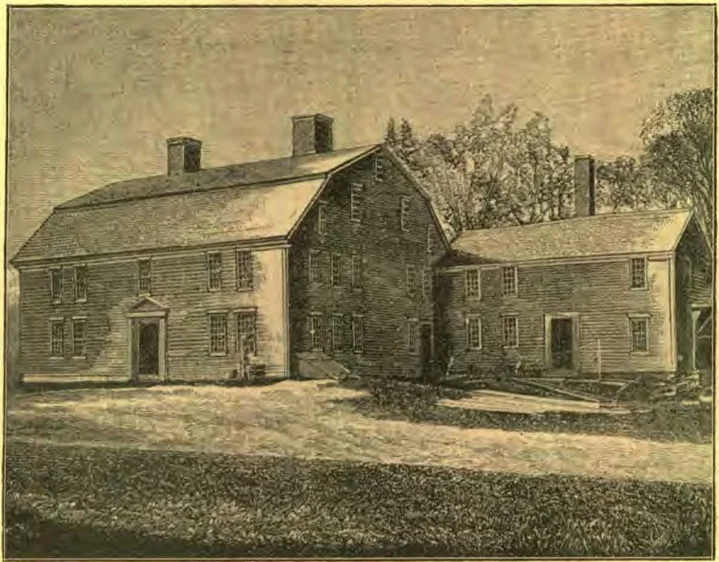
Within are—
“Stairways worn and crazy doors, And creaking and uneven floors, And chimneys huge and tiled and tall,”
as Longfellow describes them. Across the hall from the foot of the stairway to the wall runs a three-barred wooden gate, to keep the teamsters’ dogs from the back of the house.
On the left is the parlor described as where the tales were told. It is wainscoted, and a great wooden beam crosses the ceiling. There is an open Franklin that may have held the “fire of wood,” before which the musician stood, the fair-haired, blue-eyed Norwegian, Ole Bull; there is a copy of the landlord’s coat-of-arms upon the wall, but the sword that hung over it, borne by his grandsire— “Down there at Concord in the fight,” is gone; there are the windowpanes bearing Major Molineaux’s rhymes scratched upon them, but they are no longer in the windows; they hang framed over the chimney-piece. But where are the old spinet, the somber clock, “fair Princess Mary’s pictured face”?—scattered, gone, with the merry party Longfellow described so lovingly.
In the dining-room at the rear, Washington once lunched. In the state chamber up-stairs, papered with ancient bluebells of Scotland, and so low-studded that you may touch the ceiling with your hand, Lafayette once slept.
A special little stairway leads out from the bar-room into the upper hall, entering it by the side of a door leading into the bar-room chamber. This is the largest of all the sleeping-rooms, and suggests state guests far more than the Lafayette room; but it seems that it was by no means so distinguished. Its walls were lined with beds, placed around it in a hollow square, to be occupied by those same teamsters whose dogs were shut out by the gate. The teamsters mounted to their chamber from the bar by their own little secluded stairway, and thus teamsters and dogs alike were kept in their proper places.
Up-stairs in the great old garret, you may see a rough ladder leading to a small loft still higher up. “Room No. 10” it was politely called in the days when it was littered with straw, and tramps were allowed to find a night’s lodging there instead of in the barn.
Just to the right of this ladder an open door shows the rough boards of a small, unfinished room. One window gives it daylight, and the only furniture it contains is a sort of bunk or berth on stilts, scarcely long enough for a child, and a short, stout ladder by its side to use in mounting it. A forlorn little square pillow in the berth suggests that it might have been slept in once.
And so indeed it had been. When the slaves of Massachusetts were liberated during the Revolutionary war, there was a poor old deformed slave belonging to the Howes of that day, probably to Colonel Ezekiel, who received his freedom among the others. It was quite worthless to him, however. “Portsmouth Azimuth”—if that was his name, “Ponto,” at any rate, by abbreviation—knew he was too old and useless to earn his living elsewhere; so he told the colonel he would be obliged to keep his old slave for the rest of his days. “You’ve eaten the meat,” he said; “now you must pick the bone.”
And the colonel consented. Ponto lived at the Wayside Inn until death came and took him away. The berth on stilts, the ladder, and the quaint story you have just heard, are the memorials he has left behind him.—The Wellspring.