When we study the structure of plants through the microscope, we meet at every turn most marvelous revelations. The first discoveries made with the microscope were during the years immediately preceding 1700, and they produced a profound impression.
Swammerdam, a Dutch philosopher, became nearly insane at the wonders revealed to him by the instrument. At last he destroyed his notes, concluding that it was sacrilege to unveil, and make plain to the eyes of man, what God had intended should never be seen by human eye.
Of course there is nothing in God's universe which he attempts to hide from the true inquirer after knowledge. But if he should hide the mysteries of his way, no man alive could ever uncover them.

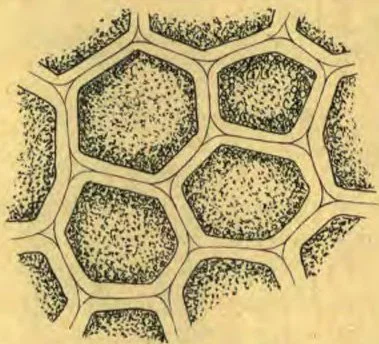
Under the microscope the tissues of plants appear like honeycomb,—built up of a large number of cells. And as in the honeycomb some of the cells are often empty, and some filled with honey, so in the cells of plants, some appear filled with a slimy substance, while others are empty.
Besides these honeycomb-like structures, we observe little tubes and fibers arranged in various ways, and bound together with strands and membranes and into pith and wood. By divisions and subdivisions, these cells increase in number.
Further investigations show that within these cells is a body of “gelatinous, slimy consistency, which lives in the cell-cavity, like a mussel or a snail in its shell.” Scientists call this body “protoplasm,” and by them it is considered the basis of life.
Whatever theories they may have about it, the known facts are these: All activities in the plant, all motion and work, are wholly dependent upon this watery material. That which we know by the name of “life” is seated only in these protoplasmic bodies. It is truly marvelous—the building of elms and oaks, the rearing of their huge trunks and limbs in air, the ramifying of their countless roots in earth, all the mighty work of the plant, by the action of the little slimy bodies in the cavities of the tree. They are almost as thin as water, as frail and delicate as anything we can imagine; and yet here is the Shekinah of God's power. Here God condescends to manifest that marvelous energy which men call the power of growth.
That we may comprehend something of the mighty power of plant-growth, I offer the following remarkable illustration: “In the Agricultural College at Amherst, Mass., a squash of the yellow Chili variety was put in harness in 1874, to see how much it would lift by its power of growth.
“It was not an oak nor a mahogany tree, but a soft, pulpy, squashy squash, that one could poke his finger into, nourished through a soft, succulent vine, that one could mash between finger and thumb. The squash was confined in an open harness of iron and wood, and the amount lifted was indicated by weights on a lever over the top. There were, including seventy nodal roots, more than eighty thousand feet of roots and rootlets. These roots increased one thousand feet in twenty-four hours. They were afforded every advantage by being grown in a hotbed. On August 21 the squash lifted sixty pounds. By September 30 it lifted a ton. On October 24 it carried over two tons. The squash grew gnarled, like an oak, and its substance was almost as compact as mahogany. Its inner cavity was very small, but it perfectly elaborated its seeds, as usual.
“The lever to indicate the weight had to be changed for stronger ones from time to time. More weights were sought. The students scurried through the town, and got an anvil and pieces of railroad iron, and hung them at varying distances. By the 31st of October the squash was carrying a weight of five thousand pounds. Then, owing to defects of the new contrivance, the rind was broken through, without showing what might have been done under better conditions. Every particle of the squash had to be added, and find itself elbow room, under this enormous pressure. But life will assert itself.”
All this marvelous growth was by the means of cells. It was wholly the work of the protoplasm. The protoplasm is a thin, watery nothing, compared with solids; but in it is exercised an energy that is the power of Almighty God. “It is God that worketh.” God uses the weak things of the world to confound the mighty.
L. A. REED.