TO MOST people who have not resided in the Orient, it sounds like luxury to hear the missionaries talk of the servants they employ; but there never was a greater illusion, as those who have had experience can testify; for a cook in India, Malaysia, or China is just as much a necessity as the food that he spoils in the process of preparing it for the table.
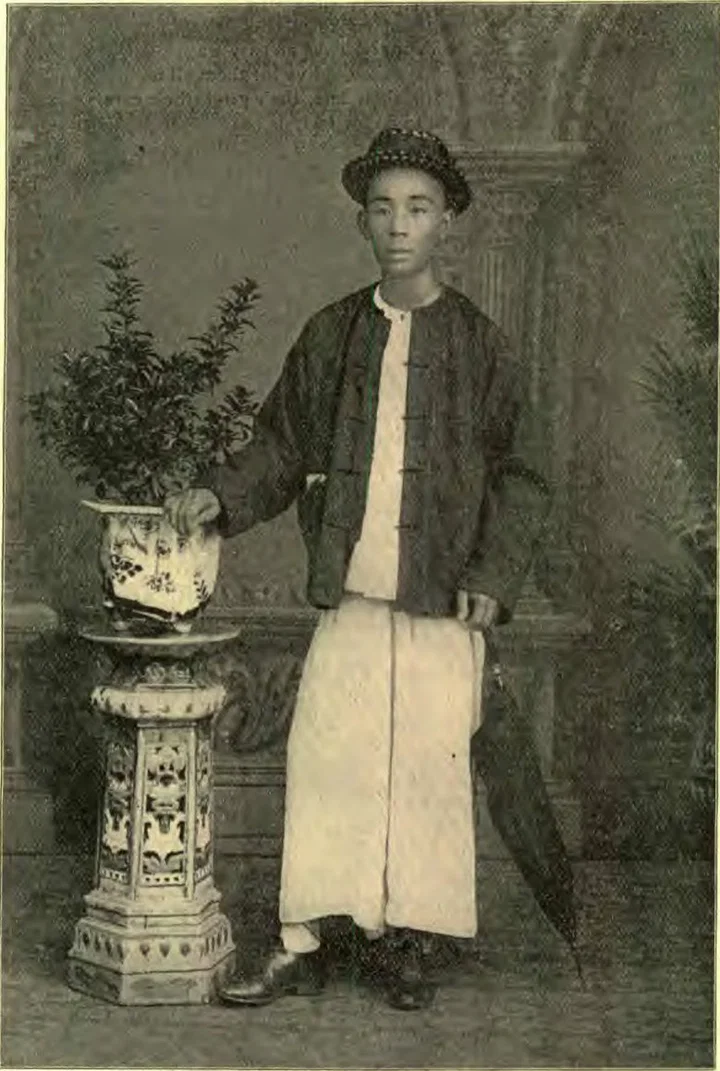
The man who confronts us in this picture appears to be quite a “swell.” You will observe that he is dressed in a semi-occidental, semi-oriental garb. His extremities are European in their attire, while that which comes between is a modified form of the Chinese dress. He carries also a European umbrella; and although the artist who has taken his picture is a Chinaman, as the flower-stand and vase testify, he has used some European scenery for the background. This young man bore the euphonious cognomen of Wee Tow Gee. He was our cook on our return in 1893. He called himself a Christian, and attended the Christian services at our Chinese church; but the surreptitious way in which our provisions disappeared, and the unblushing manner in which he would charge us twice and three times what things actually cost in the market, led us to heavily discount his piety. But as Chinese cooks go, he was a very decent fellow. He moderated his thieving to a degree that made it possible to bear it patiently, and really seemed to try to cook our food without killing us altogether, and succeeded to our tolerable satisfaction.
Chinese cooks do some strange things when you are not watching them, and Tow Gee was no exception. By way of illustration, he persisted in washing the dishes in cold water, and wiping them on an incomparably dirty towel, although hot water was available, and clean dish-towels were furnished. He had a kitchen table, but he preferred to mince the meat and prepare the vegetables on a board placed on the kitchen floor. We could have borne this digression from the standard ethics of culinary art if the floor had been like the average floors in this country. But such was not the case; it was a tile floor, and was very, very dirty.
One day Mrs. Munson, after having for the fortieth time told the fellow to prepare the food on the table, descended rather abruptly into the kitchen, and at a distance saw him squatting on the floor with a molding-board, preparing some dough for a chicken-pie. He glanced up in time to see her before she turned the corner to enter the cook-room, and slowly arose and placed the molding-board and the dishes he was using on the table. My wife scolded him, but she knew it was of no use. One of our neighbors, Mrs. Benjafield, also had a Chinese cook; and she was in the habit, as some foolish women are in the East, of invading the precincts of the cook-room. She entered the place one day unexpectedly, and beheld the cook moistening the top crust of a meat-pie, which he had just rolled out, with a mouthful of water, which he squirted through his teeth. Mrs. Benjafield was a woman of some temper (in the right sense), and there was a very interesting time in that cook-room for about five minutes. But as she could not speak Chinese, and the cook did not know English, and as neither of them knew much Malay, the poor woman derived little satisfaction beyond seeing that the pie had a fresh crust, that was not inoculated with germs from the cook’s mouth.
In Singapore, or any other Eastern port, if one keeps one eye half open, he will see a great many things that will spoil his appetite, and tempt him to embark on the first steamer for a more civilized quarter of the globe. The Chinaman himself scruples not to eat anything that has life; and he can not understand why the Orang puteh (white man) is so particular about his food. In Sumatra some years ago, a number of Dutchmen living on the tobacco plantations arranged for a feast, an important feature of which was a boiled imported ham. The servants were Malays, and consequently Mohammedans. The Mohammedan hates swine as a Christian is supposed to hate the devil; but the poor fellows had to prepare and cook the ham. The dinner hour arrived, but the ham did not. Wondering at the delay, one of the young men ran down to the cook-room to hurry up the servants. In passing the window of the room, unobserved by the servants, he saw them all squatting in the middle of the floor, with the ham upon a trencher in their midst. While they were wrangling with one another, and disputing as to which of them should carry the vile and hateful thing into the dining-room, they punctuated their compliments by spitting upon the ham, as an expression of their disgust. The young Dutchman retreated unseen, and related what he had just witnessed. The half-dozen Hollanders descended upon the cook-room, seized the unsuspecting followers of the false prophet, and locked them up in a strong room. They then placed the ham within, and notified them that they would never get out until they had eaten it—and they kept their word.
An incident occurred in Singapore, on one of the small roads along the seashore, which will illustrate the aversion with which the Malay regards pork. The principal means of locomotion is the jinrikisha, about which I have already written. These vehicles are invariably drawn by Chinese coolies, who solicit every foot-passenger they meet for hire. Two Malays had taken a jinrickisha, and had gone out four miles from town and dismounted, and were about to depart without paying their fare,—a common occurrence in Singapore,—when the Chinaman laid violent hands upon them to restrain them. The result was an assault upon the poor coolie, and a good drubbing, administered by the Malays with their walking-sticks. He took top. 446 his heels, but was pursued by an angry crowd of Malays, who, by this time, had their blood up, and were determined to wreak vengeance upon this swine-eating Chinaman. There was a lively foot-race for the best part of a quarter of a mile, until the Chinaman met one of his countrymen, who was an itinerant pork-vender. The ’rickisha coolie was no raw recruit, or he would not have known how to meet his pursuers. But he had lived long enough in Singapore to learn the prejudices of the Malays, so he seized a long strip of fat pork about as wide as a man’s hand, and perhaps an inch and a half in thickness, and turning upon them, began to swing it about his head and to run upon them. The result was a stampede, and the Malays made back-tracks much faster than they had come; for no amount of money could induce them to come in contact with that unclean and abominable thing.
But I have digressed. The Chinese cook is really a very useful fellow, if you are fortunate enough to get one who is not addicted to the use of opium, and who is moderate in his gambling propensities. It is really surprising what execution they are capable of with the simplest and most primitive appliances. The more skilful of them earn twenty-five or thirty dollars a month, and can prepare any dish that you may choose to name, either French or English, and prepare it well. The missionaries had to be content with a four-dollar (in gold) cook, who as a rule, had very little, if any, experience. If we were fortunate enough to secure a tolerably honest man with no bad habits, we were equally certain to get one who would smoke our tea-water, burn our steak, and spoil nearly everything given him to cook. All that he knew that was worth knowing about cooking we had to teach him; and when he became fairly skilful, he was certain to seek a better situation. If we were lucky enough to get a man who could cook well, we were sure to get a thief, an opium-smoker, or a black-guard of some kind, whom it was impossible to keep for any length of time.
From all this it will be readily seen that the poor missionary’s wife, who has to endure the petty and persistent worries incident to the management of such servants, is certainly no object of envy; and when we remember that there are from three to half a dozen servants, all possessing more or less of these same general characteristics as the one described, it will be seen that her burden is heavy indeed. No; servants in the East are anything but a luxury, and happy would be the missionary who could dispense with them altogether.
R. W. MUNSON.