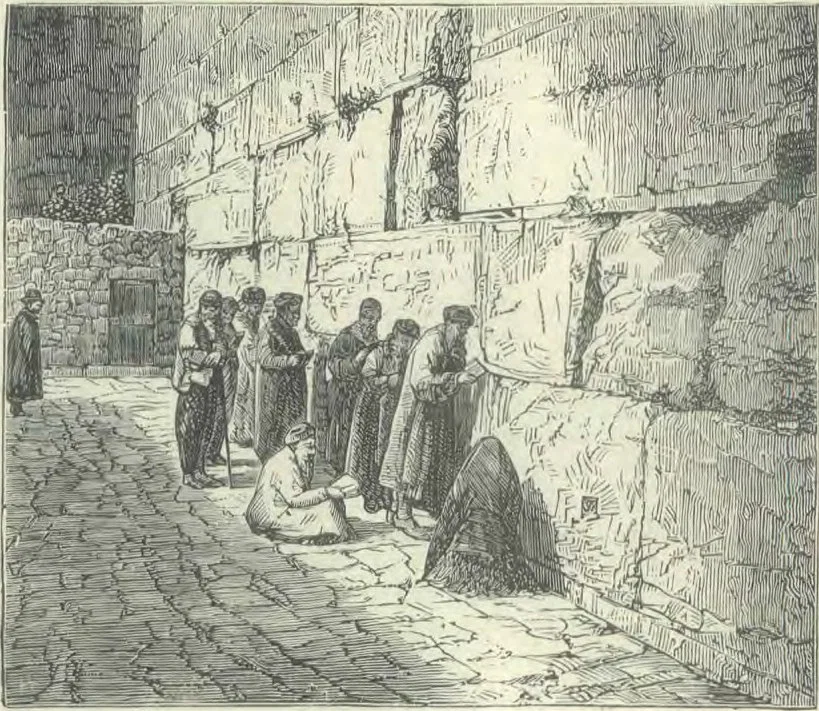
Without doubt one of the most melancholy spectacles to be seen anywhere in the world is that of the Jews at their wailing-place in Jerusalem, outside the Mosque of Omar, which stands on the site of Solomon’s temple. There they assemble every Friday to bemoan the desolation of Jerusalem, and to implore God for its early restoration. A letter from an American traveler who beheld this sad scene thus describes it: “In a narrow alley, surrounded by miserable houses; on stone flags, which have been worn by the bare feet of thousands of Jews; against a wall of great blocks of marble, which reached for fifty feet or more above them, a long line of men in long gowns, and of women with shawls over their heads, bowed, praying and weeping. Many of the men had white beards, and long, curly locks of silver. Others were in their prime; and I could not but wonder, when I saw the forms of these, at times almost convulsed with emotion. Each had a well-thumbed Hebrew Bible in his hand; and from time to time the party broke out into a kind of chant, an old, gray-haired man acting as leader, and the rest coming in on the refrain. The chant was in a strange tongue, but is translated as follows:—
“Leader.— ‘For the palace that lies desolate—’
“Response.— ‘We sit in solitude and mourn.’
“L.— ‘For the walls that are destroyed—’
“R.— ‘We sit in solitude and mourn.’
“L.— ‘For our majesty that is departed—’
“R.— ‘We sit in solitude and mourn.’
“L.— ‘For our great men who lie dead—’
“R.— ‘We sit in solitude and mourn.’
“L.— ‘For our priests who have stumbled—’
“R.— ‘We sit in solitude and mourn.’
“L.— ‘For our kings who have despised Him—’
“R.— ‘We sit in solitude and mourn.’
“The effect of this chant can not be appreciated without hearing it. The old men and weeping women, who kiss the stones of the wall that separates them from what was once the site of Solomon’s temple, and which is even now the holiest part of the earth to the Jews; the genuine feeling expressed by all; and the faith they show in thus coming here, week after week, and year after year, are wonderfully impressive. It is indeed one of the strange sights of this strangest of cities.”
Another writer thus describes what he saw and heard on a similar occasion:— “Being Friday afternoon, the time when many Jews assemble for prayer at the wall of the ancient temple, I joined their company. It was indeed a memorable sight. Here were Jews from among all nations, in their peculiar oriental costumes, some dressed in their tallith (praying-garments). As loud as they possibly could, they read the twenty-second psalm. Women cried aloud, with great earnestness, ‘My God, my God, why hast thou forsaken me? why art thou so far from helping me, and from the words of my roaring? O my God, I cry in the daytime, but thou hearest not; and in the night season, and am not silent.’ The men also were weeping and rehearsing psalms, litanies, and prayers. Most of these earnestly pressed their lips against the stones and kissed them. As I listened to their pathetic prayers, I remembered what the rabbis have said in the693Talmud,—that ‘since the destruction of the temple, the gates of prayer have been closed, and only the gates of tears are open.’
“The most touching wailing over Jerusalem is also to be witnessed in the homes of the pious Jews. At midnight they wrap themselves in their prayer-garments, put ashes on their heads, and prostrate themselves on the ground. Then, in melancholy terms, they rehearse:—
‘A voice of woe from Ramah’s hoary tower,
A voice of wail from Zion’s sainted hill;
Alas! my diadem and queenly dower,
The youthful honors I remember still.
Dark is to me the solitary bower
Who did of old a throne of splendor fill.
‘I was surnamed Jehovah’s fairest bride;
But now am forced, forlorn, disconsolate,
His heavy wrath and vengeance to abide;
My joys are flown, my heart is desolate.
Come, weep, ye daughters, at my faltering side;
For none draws near my sorrows to abate.
‘Degraded from a peerless eminence,
Victim of pride and wanton vanity,
My beating heart, in trembling violence,
Strikes at her cage of hopeless misery
Judah laments in tearful penitence,
A widow mourning in captivity.
‘I was in Solyma a radiant queen;
A golden cloud was I, the mount of God;
But now by infidels despoiled, I ween
No poorer pilgrim o’er the desert trod.
Wrenched from the bosom all my babes have been;
The elders, murdered, steeped the soil in blood.
‘Doth no one lay my wretchedness to heart?
And no one check the swiftly rolling tear?
And no one soothe the soul-empiercing smart?
And no one say, “The heathen shall not dare
Call him my husband?” O, the poisoned dart,
The cruel mockings I am bound to bear!
‘Father of mercies, come! return with grace
To Zion’s dwelling, beautified again;
Let Israel’s eye behold thy dwelling-place
Restored; then list the hallelujah’s strain,
The hymning voices of a ransomed race,
Greeting the rising wall of that eternal fane.’
“After this several psalms are read, and prayers offered. When rising from the ground, they say, ‘Shake thyself from the dust; arise, and sit down, O Jerusalem: loose thyself from the bands of thy neck, O captive daughter of Zion.’
“A remarkable prayer offered on these occasions, and having reference no doubt to Isa. 7:14, is as follows:—
‘In mercy, Lord, thy people’s prayer attend:
Grant his desire to mourning Israel,
O shield of Abraham! our Redeemer send,
And call his glorious name Immanuel.’