ALL the mammals are vertebrates, for they have a back-bone. The Pocket Animals, which we studied in our last lesson, are the lowest and queerest of the vertebrates that we shall study.
The Toothless Animals are curious creatures, and are thought to have but little sense. They received the name, “Toothless Animals,” because some of them have no teeth at all, while with others the teeth are absent from the front part of the jaw. These creatures are unknown to most of you because they live in foreign lands. They are interesting creatures, however, so we must have a short study about them, even if we may not have the privilege of seeing them. I shall describe only three of the most interesting ones,—the sloth, the ant-eater, and the armadillo.
The sloth is so named because of its lazy habits; and yet if it wants to move, it can get about as lively as most animals. It lives entirely among the trees, passing from tree to tree, hanging on the under side of the limbs by its four legs, instead of scampering about on the top of the limb, as do the squirrels and monkeys. When the day is quiet and calm, it sleeps suspended under a limb; but just as soon as the wind begins to blow, it moves about. Then is the most favorable time; for the swaying of the trees by the breeze causes the branches of different trees to come closer together. The feet of the sloth are so constructed that it can not walk on the ground, for they have no soles, but consist usually of two or three long claws, which are very useful in climbing. If the sloth is placed on quite rough ground, it drags its body along very clumsily. It is no more at home on the ground than a hen would be in the water. The sloth is wholly a vegetarian, living on leaves and fruits. Its home is, for the most part, in the tropical regions, ranging from the southern portion of Mexico to Rio de Janeiro, in South America. The sloth tribe are few in number, and live in gloomy forests, where poisonous snakes take up their abode, and where dismal swamps, with thorny bushes and shrubs, obstruct the steps of civilized man.
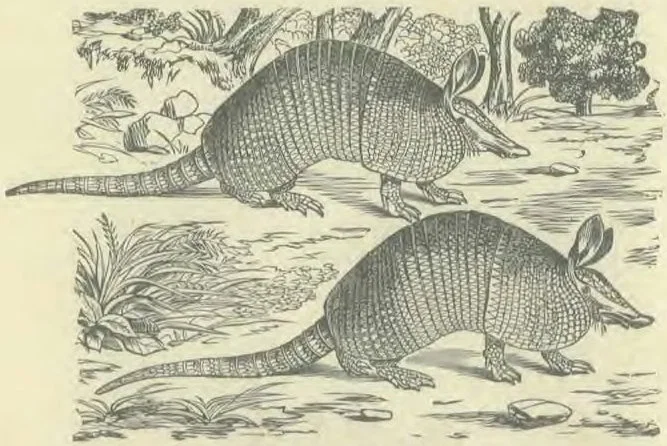
The armadillos are also found in South America, but differ much in appearance and habits from the sloth. The armadillos are burrowing animals, and for this purpose they are provided with strong digging claws. The upper surface of the body is covered with a heavy coat of mail, which is formed of hard bony plates united at their edges. This peculiar covering causes them to look something like a rat running away with a turtle’s shell. Their food consists partly of animal and partly of vegetable substances and fruits. The giant armadillo is over three feet in length, but the others are quite small.
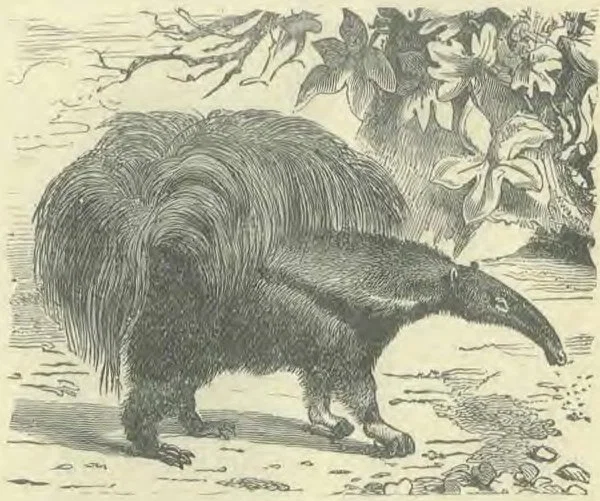
The ant-eater, as the name signifies, is a lover of ants. Most of the ant-eaters have no teeth; if any are present, they consist of a few molars; but they have long cylindrical tongues covered with sticky saliva, which furnishes the means for entrapping the prey. The body is covered with hair, and some of the ant-eaters have long, bushy tails. Their bodies are sometimes three or four feet long. Some of the ant-eaters, when threatened with danger, will roll themselves up like a hedgehog. M. E. CADY.