In company with a friend, I started across the country in Arizona, one bright July day. As we were climbing over the rocks and boulders, up the mountainside, the sun beat down on our heads with unusual strength. When we had gained the height, our eyes wandered across the barren waste, and saw nothing except here and there a bunch of desert-willow, beyond which were the mountain peaks towering high toward heaven. Some of these peaks are very rugged, standing above the rest with a sort of commanding attitude; while others are more regular in formation, and quite feminine in their appearance. One mountain rises to a considerable height, on the top of which is an oblong figure, representing, at a distance, Noah’s ark.
We traveled on, faces radiant with hope, and feet sore from walking. In a short time we found ourselves beside a steep precipice, beneath which was a small stream of water gently murmuring a joyful song as it went on its way to the mighty ocean. We had followed this stream about half a mile when there was discovered a small irrigating ditch, which captured the contents, and made them minister to the productiveness of the soil.
Being anxious to know who had been working in this way so far from the settlement, we followed the marks of civilization until our curiosity was fully satisfied. We soon came to a rude garden spot surrounded by a brush fence, inside of which were a few wigwams. Having never seen the like before, I remarked to my associate, “I wonder who lives in such a place as this?” Hep. 213 replied that he did not know; so we decided to go through the fence, and get acquainted with the inmates.
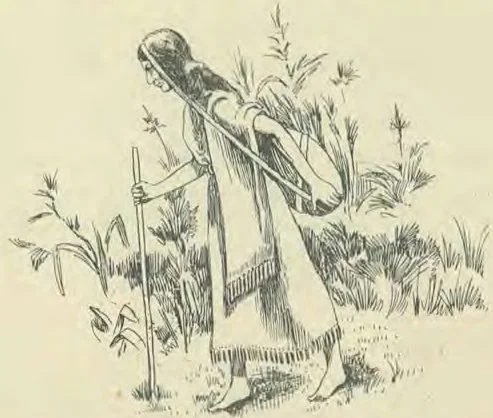
After walking through a breach, we went bravely on till, suddenly coming into an open space, we looked to the right, and there saw a squaw, sitting in the shade of a wigwam, making tateumpsia. This dish is made of seed from the century-plant. After the seeds are gathered, they are washed, then placed in a basket over a hot fire to roast; after this they are ground by placing a handful on a flat rock and rubbing with a small stone. Just back of the squaw were two small children, about eight and ten years of age. They were very timid; and as soon as they saw us, they hid themselves behind a blanket hanging from the limb of a tree.
We sat down on a rock, and began to talk to the “lady of the house,” but she was not very sociable, saying repeatedly, “Me no savy.” We found that the squaw was preparing the black-looking tateumpsia for supper; and being somewhat hungry, we did according to the Indian fashion,—helped ourselves. We made quite a lengthy visit among the “Americans,” and soon found them very friendly. They tried to teach us some words in their language; such as, “horse,” “cow,” “beans,” “corn,” “watermelon,” etc.
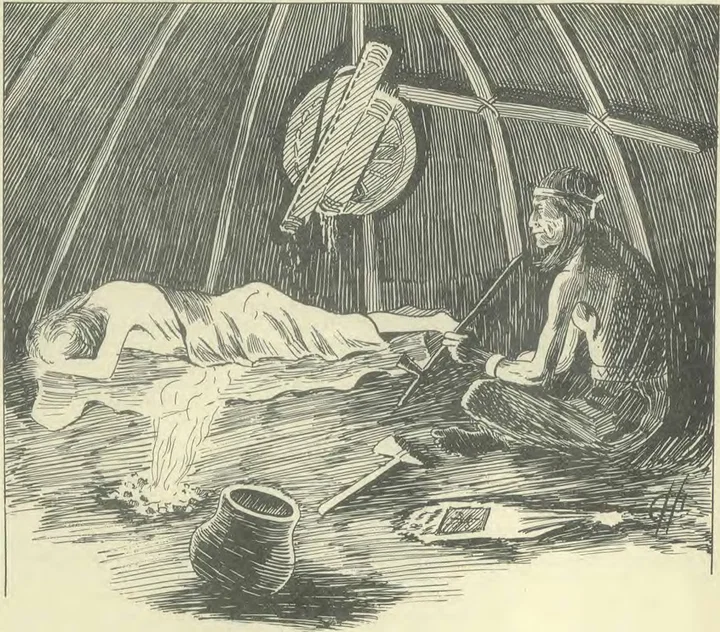
After visiting this family for some time, we went a short distance, and called on their neighbors. Here we found an old gray-headed Indian, who said by signs that he was one hundred and ten years old, and that his squaw was only ninety. They lived in a semicircular dwelling made of poles and brush, covered with rags, canvas, and worn-out pieces of bedclothes. The poor old squaw was sick. Her face was hot with fever, and there in the dirt she lay, with no one to care for her,—no one to give a cool drink to moisten her parched lips. Our hearts were moved to pity as we beheld the scene. There they were, ignorant, down in the very depths of heathenism, while we were living in civilization, under the full blaze of the gospel.
After doing all in our power to relieve the sick one, we were ready to go; and as I gave them my hand, they gave it a grasp that I shall never forget.
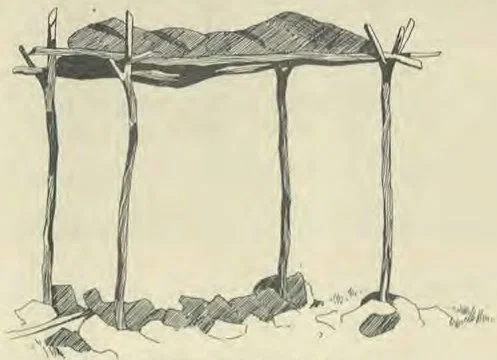
We went from this place up a short hill to view the burying-ground, where the braves were laid away with bright hopes of meeting again in the “happy hunting-grounds.” These Indians lay their dead away by wrapping them in blankets, and then placing them on a platform made of poles. With the dead Indian are placed all his belongings; such as, blankets, guns, etc.
The day being far spent, we turned our steps homeward, where we arrived before dark.
CHARLES G. STATES.