Cotton is a plant of slow growth, and is raised only in hot climates. It is sometimes called “King Cotton,” because of its superior importance as a product of the earth. It is one of the most useful agricultural products of the South. In preparing the ground for planting, it would best be plowed in the early part of the winter, so as to let it freeze; and then when it thaws in the spring, it becomes very mellow.
In the latter part of March or the first of April, the soil is thrown up into ridges, or beds, about three feet apart, in which a furrow is made. The seeds are then drilled into it. They are sown thickly, and the seed nearly all grows if it is a good season. As the plants are very tender while young, they are allowed to grow as they come up for a week or ten days, until they become hardier. Then we see the farmer take his hoe; and as we follow him down the row, we see him chop the cotton out of the row, leaving only two or three stalks in a place. These he lets grow until they are about six weeks or two months old; then they are thinned out, leaving only one stalk in a hill; these are about eighteen inches apart.
Cotton is a plant that requires a great deal of cultivation. When the plant gets about six inches high, it is cultivated once every week or ten days, until it begins to blossom.
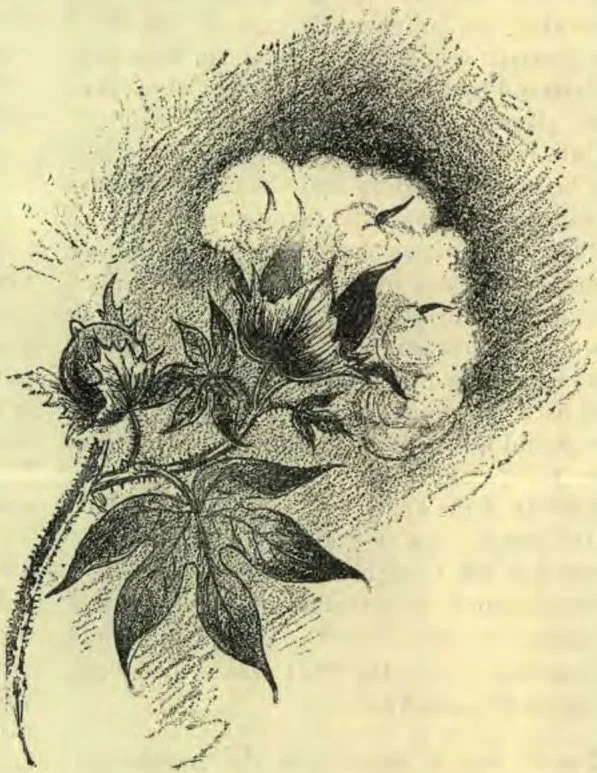
The cotton plant is beautiful. It ranges in height from one foot to fourteen feet. The leaves are a dark, glossy green, the young leaves being brighter than the others. The bloom bud is a three-cornered, conical-shaped bud. The calyx is notched, or ragged-edged, and is very pretty. The blossom opens early in the morning. When it first unfolds, it is a lovely creamy white; by the close of the first day it has turned to a delicate pink, which deepens by the close of the second day to a light purplish red. The blossoms are cup-shaped. The bloom buds, and also the little bolls or seed-pods before they leave the calyx, are called “squares.” The plant may have buds, blossoms, squares, bolls, and the open cotton, on the same stalk at one time. After the bolls have ripened, they burst open, dividing into from three to five parts; and the soft, fleecy cotton hangs from these parts in locks from three to nine inches long. This cotton has seed in it. Each little seed is covered with a soft fleece of cotton fiber from one half to three quarters of an inch long. These locks are gathered, or picked, into large sacks about one yard wide by three or four yards long.
The cotton-picking season proper begins about the first of September, and the cotton is generally about all gathered by the first or middle of December. Men, women, and children engage in the picking. Some men have been able to pick as much as seven hundred pounds of it in a day; but an average day’s work is from one to two hundred pounds.
When the farmer has gathered about sixteen or seventeen hundred pounds,—enough to make a bale of lint cotton,—he hauls it to the gin, where the little seeds are stripped of their dress. This dress, after it has been removed from the seed, is called lint cotton. It is pressed into bales weighing about five hundred pounds each. These are sent to a cotton-press, where the bales are made smaller, thus making them of a more convenient size for transport.
The seeds contain oil. They are taken to a mill, and the oil is pressed from them. This oil is then sent to a refinery, where it goes through a process which renders it fit for cooking purposes; and it is said to be much more wholesome than animal oils. What is left after the oil is pressed out, comes out of the mill in cakes; these are allowed to dry. Then they are ground into meal, which is fed to cattle. It is considered to be more nourishing even than wheat bran. ALICE J. CONWAY.