STRAWBERRY-BARRELS

10%

Review and Herald Publishing Company · Battle Creek, Mich. · Jun 22, 1899

FromThe Youth’s Instructor, Vol. 47, No. 25.

Read the full edition

STRAWBERRY-BARRELS

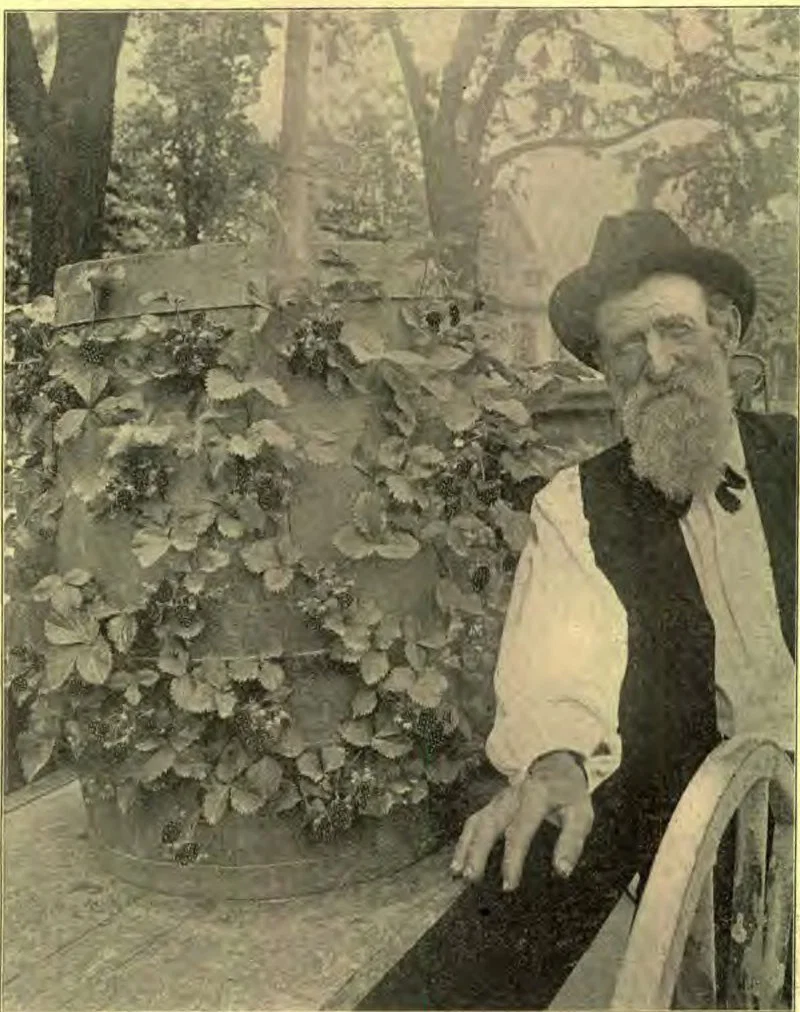
A novel way of raising strawberries has been developed by Mr. J. P. Ohmer, of Dayton, Ohio. He sets the young plants out in barrels instead of in beds, and claims marked advantages for his method over the ordinary way of growing this delightful fruit. He has raised berries in barrels for the last twenty years, adding a barrel or two to his stock each season, so that at present he has a considerable number of them.
MR. OHMER AND ONE OF HIS STRAWBERRY-BARRELS.
In order to make one of these small “hanging-gardens,” take any iron-bound barrel except those that have been used for pickles, vinegar, or sauerkraut, bore four holes in the bottom, and remove all but four of the hoops. There should be five rows of holes around the barrel for the plants, the first eight inches from the bottom, and the last five inches from the top. Each row should have twelve holes, evenly spaced around the barrel, thus providing for sixty plants. In making the holes, bore out two, one above the other, and cut out the wood between. Use a one-and-one-half-inch bit. When all the holes are made, put two inches of clean gravel in the bottom of the barrel to insure good drainage; fill in clay soil, thoroughly mixed with well-rotted manure, about three inches above the first row of holes; then get in, and tramp it down solid. Loosen the soil with a trowel where the plants are to go, and set out the first row, putting the plants as near the top of the holes as possible, to allow for settling. Spread the roots out well. Fill in the soil about half-way up to the next row of holes; take a common drain-tile twelve inches long by three or four inches in diameter, put it in the center of the barrel, and fill with coarse sand; then put into the barrel enough soil to reach about three inches above the second row of holes. Cover the tile, so none of the soil can get in, and tramp again, being careful not to move the tile. After setting out the second row of plants, lift the tile, allowing the sand to settle; fill it again; then put in soil above the third row of holes, tramp, and set out plants, repeating the operation until all the rows are planted. Do not fail to tramp the soil.
After the last row is planted, the soil is put in to reach the top of the barrel; but the tile is left empty, to take the water for the three lower rows; the two upper rows are watered from the top of the barrel. It would be impossible to water the lower rows without the tile and the core of sand. Be careful not to water the plants too much. If the tile is filled once a day, and two quarts of water are poured around it, the plants will have sufficient moisture.
The barrels should be set on bricks, and may be painted some light color before the plants are set out.
In selecting your plants, choose the largest fruiting variety that does well in your section, and a perfect blooming sort if possible. In order to secure the best results, the plants should be set out in August or early in September, although those set out early in the spring will bear fruit the same year. The plants will bear two crops. All runners should be cut off as soon as they appear. In the latitude of Dayton, the barrels will usually need no protection in winter. In all Mr. Ohmer’s experience, no plants were winter-killed until last winter, which was unusually severe.
Berries grown by this method are said to be much larger and finer than those raised in the ordinary way. The fruit is thoroughly ripened all around, and is easily gathered. Each barrel produces half a bushel of berries. At this rate a dozen barrels set four feet apart in a small city garden would supply an ordinary family with this delicious fruit fresh for the table. And there is a vast difference between the travel-worn, half-ripened, jammed, sandy berries of the market and the luscious scarlet fruit, fresh from its shining vines, as every one knows who has been so fortunate as to be “turned loose” among them, and told to help himself.
We are indebted to Mr. Ohmer for directions for planting, also for the accompanying illustration, which shows one of his barrels on a spring-wagon, as it appeared at an exhibition. The plants in this barrel were set out the spring that it was exhibited.
This method of strawberry culture contains a good suggestion for the missionary gardeners, especially those living in cities. Any bright boy can prepare two or three of these barrels; and as the fruit so grown ripens early, and is of superior quality, can get a fancy price for his berries. Try it! May there be many of these missionary barrels started this fall.