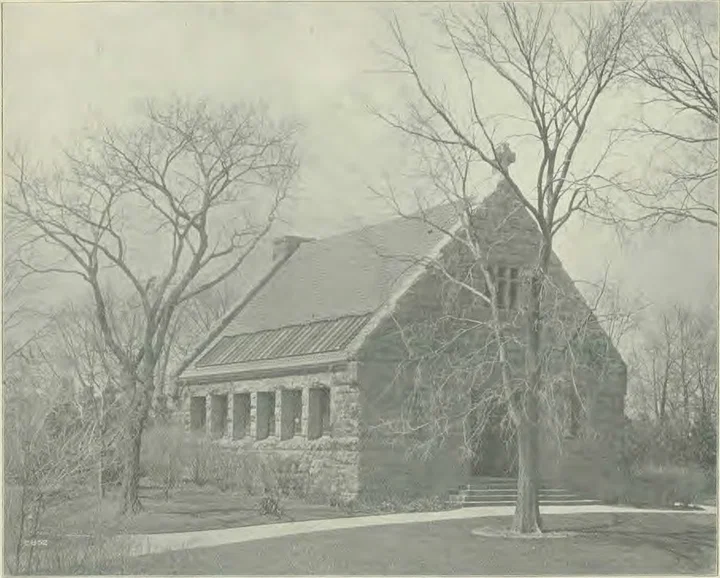
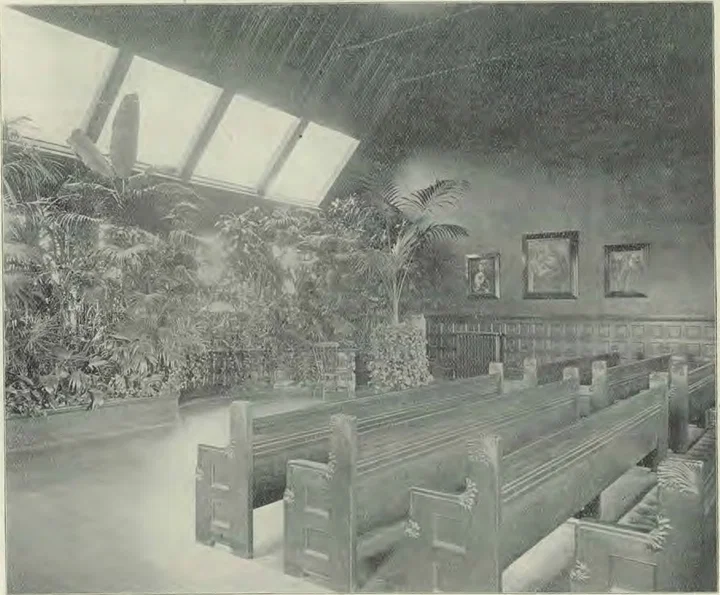
In a charming spot in Graceland Cemetery, Chicago, is a vine-covered, rustic building, made of solid granite, the doorway and steps of which are polished to a high degree; the roof is made of tile. It is situated on a small grassy knoll, which is kept in such good condition that one might think it covered with a carpet of green velvet instead of grass. On either side and in front of the building majestic trees guard the spot. Underneath the trees are beautiful violets in the spring; and in the fall the goldenrod nods its graceful head, thus adding beauty to the already seemingly perfect spot. This structure thus beautifully situated is a crematory and its chapel, a winter view of which is shown in the picture. As we step inside, a veritable Eden of tropical plants greets our eye, as you will see by looking at the accompanying cut. The palms, vines, and banana-trees are all artistically arranged around the front wall and over the door. The back part of the room looks like a church. In front of the cushioned pews is a dais, or raised platform, the size of a coffin, which is nicely draped.
On the morning of Jan. 1, 1898, we might have seen three mourners sitting in those seats; and in the coffin on the dais, the body of our beloved Frances Willard. After a short service, the coffin slowly descended from our view. Finally it entirely disappeared, and was taken below in the basement to the crematory, put into a retort, or oven, and incinerated. In a few hours the ashes, in an urn, were given to the mourners, who took them to Rose Hill Cemetery, two miles farther north, for burial. This incineration was made at Frances Willard’s own request, in this quiet way.
Among the heathen, cremation was once the most general way of disposing of the dead. Thep. 283 Greeks, Romans, Celts, Slavs, and Germans burned their dead; and our Indians, in their crude fashion, practised it hundreds of years ago. Cremation may be regarded as the universal custom of Indo-European races. In the city of the Cæsars to-day are still found the cinerary urns of thousands. Among the Jews, cremation was practised only upon the bodies of royal persons. In Japan many thousands are cremated every year.
Cremation came more and more into disuse as Christianity began to spread, and the theology of the literal resurrection of the body was taught. The ancient funeral pyre, with its smoke, disgusting odors, wailing, incantation, and human sacrifices, willing or unwilling, is surely very revolting compared with modern cremation.
The modern crematory is rectangular in shape; and, outside, is twelve feet long, seven and one-half feet wide, and eight feet high. It is made of fire-clay material, manufactured especially for the purpose. It contains three interior chambers, all of which are lined with specially shaped fire-linings, designed to withstand great heat. These are incased in a fire-clay brick wall, leaving a space of about two inches. The front of this outer incasing, or wall, contains the outside crematory door to the upper chamber, and is enameled in white, to correspond to the white walls of the rest of the basement. The upper chamber, or retort, which you can see in the illustration, is seven by three by three feet; the middle, or gas, chamber is seven by two by three feet; and the lower, or escape, chamber is seven by one by three feet. The draft is from above down, from the retort to the gas-chamber, then to the escape-chamber, and then to the smoke-stack.
The crematory is heated with crude petroleum, which has stood a fire-test of 110° F. It is supplied under pressure from a tank in the rear of the chapel. Each oil-burner is supplied withp. 284 oxygen by a small air-pipe, which supplies air under pressure. In this way the oil is first atomized as it burns, and then volatilized as the heat increases, thus making a very hot flame, and insuring perfect combustion.
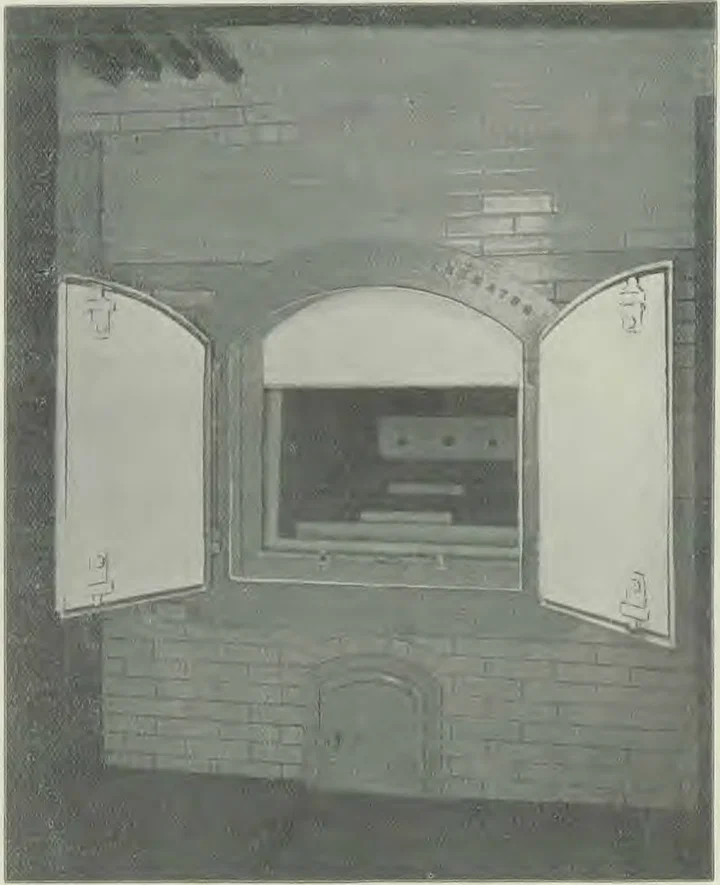
In operating the crematory, and conducting an incineration, the retort is heated to from sixteen to eighteen hundred degrees F., and the gas-chamber from twenty-two to twenty-four hundred degrees F. To attain this heat, one burner is turned on one hour before the desired time of cremation, and three other burners forty-five minutes before the desired time. At the end of this time, the burners are turned off from the retort; and it is allowed to cool seven or eight minutes, when the door is opened, and the casket, wrapped in a sheet saturated with a solution of alum to prevent the casket from taking fire till after the doors are closed, is rolled in. With daylight or electric light, the glow of the retort is not noticeable, but simply looks a natural gray color. The inner door, which is made of the same material as lines the chambers, and weighs eight hundred pounds, is carefully lowered, and the outside door closed and fastened. After a few minutes the whole bursts into bright flame from the heat of the retort. After from fifteen to twenty-five minutes, the burners are again turned on. The chambers are supplied with air under pressure by twenty tubes which enter the sides of the retort near the bottom. This fans the fire into a clear, bright flame, and greatly hastens combustion. Should there be any gases unburnt escaping from this, they pass down into the gas-burning chamber, where they are consumed, and beyond which nothing passes except the nitrogen and the anhydrides. The heat from these chambers becomes so intense that the ashes from the casket, clothes, etc., are simply dissipated, the same as burning charcoal with an intense flame, under the blow-pipe, and nothing remains except the ashes of the minerals in the human body, together, of course, with the indestructible substances in the casket. These are afterward removed from the ashes. This combustion is brought about by the high degree of heat, and the fresh oxygen contained in the air, which is forced into the chambers during the whole process. During the last stages, the heat is raised from twenty-six hundred to three thousand degrees F., and the bones assume a dazzling white, almost as bright as a calcium light. This continues twenty or thirty minutes, when the heat is turned off. The whole process has taken from sixty to eighty minutes. In from six to twelve hours the crematory has cooled, and the ashes are removed, put in a neat urn, and given to the mourners. The ashes weigh from four to six pounds.
Much of the information regarding the size of the crematory, and the material of which it is built,p. 285 was kindly furnished me by the builders of the Graceland Crematory, the Engle Sanitary and Cremator Co., Des Moines, Iowa. For the information in regard to the method of conducting incinerations, I am indebted to Mr. James Currie, superintendent of the Forest Home Crematory, Milwaukee, Wis. Mr. Currie is much interested in the subject of cremation, and has made some valuable experiments in this line, by which it was found that by supplying an increased quantity of air under pressure, the oxidation was more perfect, and the time required by the process reduced to from sixty to eighty minutes. The average time of fourteen consecutive cremations at this crematory was one hour and fifteen minutes. The average amount of oil used for these was 45.7 gallons. In most modern crematories not using air under pressure, about two hours are required for a cremation, and in older ones five or six hours.
Cremation is growing in favor in nearly all the European countries as well as in the United States. The Odd-fellows’ Crematory at San Francisco, Cal., was opened June 26, 1895, and during that year there were sixty-six cremations; in 1896 there were one hundred and one; in 1897 there were two hundred and fourteen; and during 1898 the cremations averaged nineteen a month. The crematory at Los Angeles, Cal., was started in June, 1887; and for the first six months there were six, and up to November 1 of last year there were forty-four. Our Graceland Crematory was opened in December, 1893, and had forty-three cremations for the first year, and averaged ten a month last year, notwithstanding the fact that a crematory has since been built in Milwaukee.
Those who request incineration are mostly made up from the broad-minded classes; and many leave requests, or intimate this as their choice of disposal. As to the total number of optional incinerations, the United States ranks first; next come Germany, Italy, France, England, and Switzerland. New York stands first among the cities in its number of cremations.
Kate Field said: “Cremation is not only the healthiest and cleanest, but also the most poetical, way of disposing of the dead.” Especially is cremation of hygienic value in the cities. The damage to the health of those who live near church-yards and cemeteries, from the exhalation of noxious gases and the poisoning of water-supplies, is an indisputable fact. Rev. H. W. Thomas, of Chicago, says: “There can be but little doubt that in the years to come, cremation will take the place of burial.”
EMMA ADAMS.