While we have spoken of several of the Land Animals, there are many that we shall have to leave without saying much about, further than simply to suggest their names. So far, we have studied the Many-footed Animals, Spiders, Insects Toothless Animals, Gnawing Animals, Flesh-eating Animals, Hoofed Animals. Others that would be interesting to study are the Hand-wing Animals (the bats); the Long-snouted Animals (the elephant and rhinoceros); Milk-givers of the Sea (whale, seal, walrus); but you can read and study about the habits of these animals at your leisure.
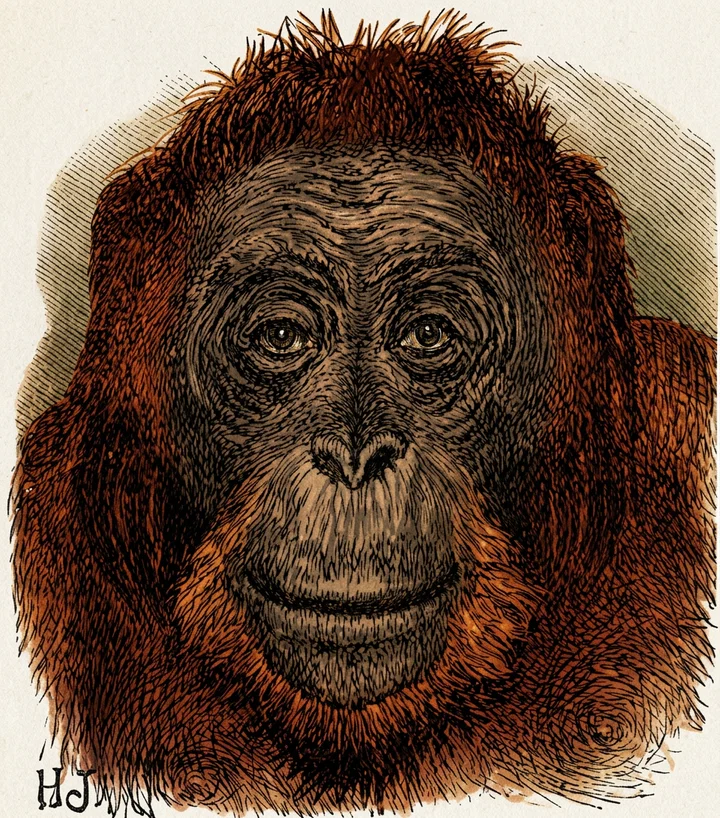
I must not close the study of the Land Animals without noticing the interesting group called the Four-handed Animals. They include the monkey, ape, gorilla, chimpanzee, orang-utan, etc. All these creatures live in tropical climates; indeed, it is with some difficulty that they can live in the temperate regions. The principal home of the monkeys of the New World is Brazil. It is a land of perpetual summer, with dense, luxuriant forests, which abound with fruit, the favorite diet of the monkey.
The reason this group is called the Four-handed Animals is because it is able to use all four limbs as hands. Not only so, but their feet are formed like a man’s hand, having four fingers and a thumb. The spider monkey is sometimes said to have five hands; for it can use its tail as a hand to grasp a branch, or another monkey’s hand. It is called the “spider monkey” because it looks like a spider going over its web, when, with hands, feet, and tail, it glides swiftly over the network of branches. These monkeys sometimes make a “monkey-rope,” reaching from the limb of a tree to the ground, by hanging by their tails, one beneath another.
Another monkey living in South America is called the “howling monkey;” for every time the sun rises and sets, this boisterous fellow begins to howl. Others take up the cry till often forty or fifty join in with him. These howlers are often caught, but it is impossible to tame them. South America contains the only monkeys that can use their tails for grasping.
The monkeys in the Old World live in Southern Asia, the Malay Islands, and in Africa. They use their tails for balancing as they pass over slender, shaky limbs. They also have pockets, or pouches, in their cheeks, in which they store away their food while gathering it.
The baboon has a head like a dog, and is larger than the monkey; but it has a shorter tail. Apes are larger than baboons, but have no pouches for storing food, or tails for grasping or balancing. Monkeys, apes, and baboons have hands with four fingers, and a thumb that can press directly against any of the fingers. The apes, which include the chimpanzee, gibbon, gorilla, and orang-utan, are more like human beings; for they often go about on two feet in their native homes.
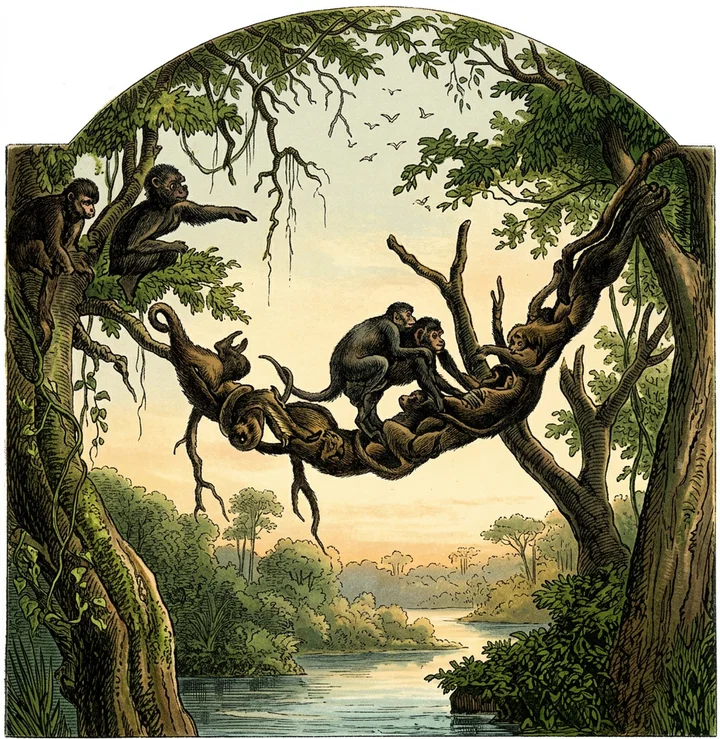
The Four-handed Animals are most interesting creatures to watch. They are very curious, mischievous, playful, and very skilful at mimicry. They perform some wonderful feats, one of which I must tell you about. Out of their own bodies the monkeys can form a living bridge across chasms, gorges, and rivers, so that the mothers and children can pass over easily and quickly. This is how it is done: Several of them run up ap. 293 large tree near the edge of the stream, then one of them passes out on a strong limb, and taking several turns of his tail about it, slips off, and hangs with his head downward. Then a second one climbs down the body of the first, and fastens his tail about the neck and fore limbs of the first. This is repeated until a long monkey-rope is formed. This living rope starts to swinging, slowly at first, but in a few moments its lower end touches the branches of a tree on the opposite side. The lower one grasps hold of these, and the bridge is made. Sometimes four or five hundred monkeys will pass over this living bridge. The question now arises, How will the monkeys forming the bridge pass over? If number one should let go his tail, he, with several others, would be dashed against the opposite bank, or soused into the water. God has endowed these creatures with intelligence which will help them out in their seeming emergency. Several of the strongest monkeys throw their tails about the last monkey in the bridge, and run up a strong, high limb, thus lifting the bridge into an almost horizontal position. This being done, a screaming signal is given by the last monkey, to the first one forming the bridge, to let go of the limb; then the whole chain swings over. The lowermost animals drop to the ground, while the higher ones leap to the branches, and come down by the trunk.
This completes our study of the Land Animals. While our study of the Four-handed Animals has reminded us of man, there is a wider difference between them than there is between them and other creatures in the whole animal kingdom. Next time we will take up the study of Man, the master-piece of all God’s creation. M. E. CADY.