This week we will make a tool that is very useful in doing good work. It is called a “wood-scraper,” and is used to smooth down work after the wood has been planed. Sometimes lumber is very cross-grained and “eaty,” as we call it. By using a wood-scraper, all such places can be made smooth. If these instructions are followed, you will not have any trouble in making this tool and keeping it in order.
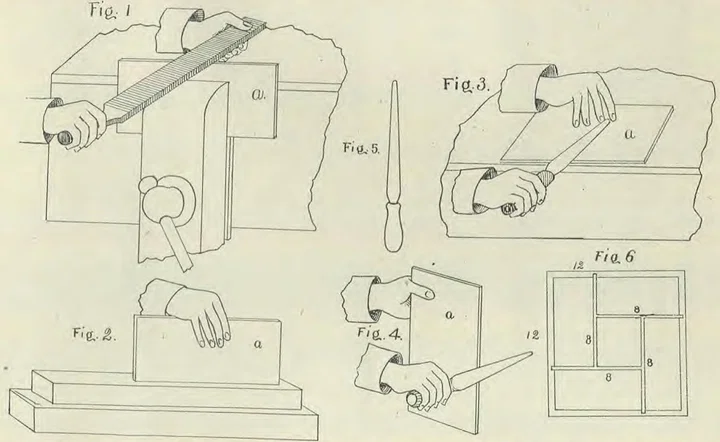
Most all hardware dealers who carry carpenters’ tools keep wood-scrapers. They can be bought for twenty-five cents. I usually make mine. Sometimes a saw gets broken, or becomes so worn that I do not care to keep it any longer. I then work it up into scrapers. A good size is about two and a half or three by five inches. To make one, mark out the size of the scraper on the saw, screw the blade into an iron vise, and with a sharp cold-chisel held close to the jaw of the vise, begin at one edge, and cut out the scraper. Then put it in your vise, as shown in Fig. 1, and file it. Hold the file in the position shown in Fig. 1, the left hand being quite a way ahead of the right one, so that the file rests diagonally on the scraper. Hold the file up level, and shove it from one end to the other of the scraper, or as machinists would say, “draw-file it;” but do not shove it crosswise of the steel. The edge will be straight, smooth, and square.
When this is done, lay the scraper flat upon the oil-stone, and rub it smooth upon each side. Next set it upon the edge, as seen in Fig. 2, and shove it endwise upon the oil-stone until it is smooth. Then you will have two square corners upon each edge.
To keep a scraper sharp, you will need a tool called a burnisher, which is shown in Fig. 5. You can make one. Take an ordinary saw-file that has been worn out, grind it upon a stone or emery-wheel until all the file-marks disappear, grind off the sharp corners so that they will be rounded off, making the tool as smooth as you can. Take some fine sandpaper or emery-paper, put some oil on it, and rub the burnisher smooth. Then put on a handle, and you have a good tool. The burnisher should be made of very hard steel.
Having finished your burnisher, take your scraper, and run it through your lips to wet it, doing the same with the burnisher. This prevents them from sticking when they are rubbed together. Lay the scraper down flat upon the edge of the workbench or a board, as shown in Fig. 3. Hold down the scraper solid with the left hand, and with the right hand rub the burnisher across the scraper a few times, dropping your hand a little,p. 288 so that in rubbing the burnisher across, it will turn the edge of the scraper down a trifle. Do this upon both sides; then turn your scraper around, and serve the other edge the same way. Wet your scraper in your lips again, and stand it upon the end, as shown in Fig. 4. Put your burnisher down at the bottom of the scraper, and draw it up, drawing it a little toward you all the while, so that you turn the edge over toward you. Now when you use it upon the wood, it will take off a smooth shaving.
Do not be discouraged if you do not get these tools just right the first time, but keep on trying. In my next article I will tell you how to use this tool.
Fig. 6 will show you how to lay the floor joists spoken of in the preceding article.
W. K. LOUGHBOROUGH.