Before studying how to breathe, we should know what we breathe with; that is, what the organs of respiration are.
All things of life breathe—plants, animals, and man. The “breath of life” sustains them all. It is interesting to notice how, and by what means, life is taken into these organisms. Man and the animals have lungs with which to take in air; plants breathe through cells which cover all their leaves, and so they breathe over all the surface of their bodies. This is true of the human skin. There are cells all over our bodies, through which we breathe. But the organs of respiration are the air-passages,—the lungs, with the thorax, or chest, with its muscles and ribs. The mouth, nose, and nasal cavity are the beginning of the air-passages. Then the pharynx unites the back parts of the nasal and mouth cavities.
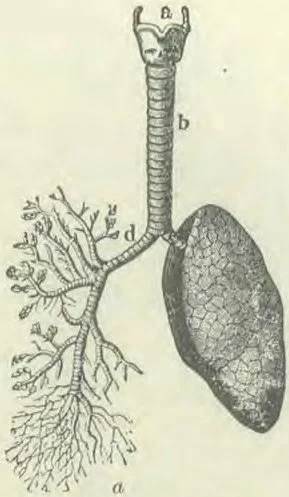
The “soft palate” separates the pharynx from the mouth, and the “uvula” hangs pendent from the center of it. There are some “glands” here also, that we will study about under the subject of glands, when we shall have reached that subject in later articles.
The next organ in the throat on the way down, is the larynx, or “voice-box.” This is the upper portion of a tube of cartilage, like gristle, leading to the lungs. In the upper portion of this cartilage tube are the vocal cords, with which we make the sounds of speech. But as the esophagus, or tube for conveying food to the stomach, is very close to the larynx, being just behind it, we would get into serious difficulty by swallowing our food into the wrong tube, were it not for a little trap-door that fits down tight over the larynx, called the “epiglottis.” It is a spoon-shaped piece of cartilage, hinged at the root of the tongue, so that in swallowing, as the tongue is drawn back, the cover is drawn down tight. Sometimes wep. 297 are in a hurry to breathe and swallow at the same time. Then we get choked, and cough until the food or drink is expelled from the larynx, where it does not belong. The extension of this tube is called the trachea, or windpipe. It is composed of from sixteen to twenty rings of cartilage; and from the base of the trachea to the lungs is about four or five inches. It divides, at the upper part of the chest, into two branches, called the “bronchial tubes,” one going to the right and the other to the left side. Then these two branches divide and subdivide, like the branches of a tree. Imagine a tree turned upside down, and you will get an idea of the bronchial tubes as they run through the lungs.
The lungs are the two essential organs of respiration. They are composed of air-cells and tubes, and are light, spongy, and elastic. They are covered with a membrane called the “pleura.”
Both lungs weigh about forty-two ounces, the right lung being larger and heavier than the left. The right lung has three lobes; the left lung two.
The air-cells are bound together by connective tissue and considerable yellow elastic tissue, which gives to the lungs remarkable elasticity.
The chest cavity is called the thorax, and is composed of ribs and the muscles and tissues that cover them and fill the space between them.
The back-bone and the breast-bone help to form the thoracic cavity, in which are the lungs.
The diaphragm, a large muscle, closes the under side of the cavity, and divides the thoracic from the abdominal cavity. This important muscle will be described in connection with the process of breathing, in our next study.
MRS. M. D. McKEE.